Navigating the Unprecedented Federal Reserve Rate Hike: Market Realities and Artificial Intelligence Integration

The global financial landscape is currently digesting a monetary policy shift that diverges sharply from historical norms. When the Federal Reserve implements a 25-basis-point rate hike, market observers typically look back at previous tightening cycles to forecast macroeconomic outcomes and equity performance. However, the current tightening phase stands apart from any monetary maneuver witnessed over the past three decades. By analyzing historical precedents from firms such as Goldman Sachs, LPL Financial, Schwab, and Barclays, financial analysts are attempting to decode a market environment complicated by geopolitical supply shocks, elevated core inflation, and a central bank that appears to be battling bond market dynamics rather than domestic demand. Simultaneously, non-technology sectors are beginning to integrate transformative artificial intelligence tools, evidenced by landmark partnerships in the pharmaceutical industry. This convergence of restrictive monetary policy and technological evolution presents a complex puzzle for institutional and retail investors alike.
The Uniqueness of the Current Federal Reserve Tightening Cycle

To understand the risks associated with the Federal Reserve’s latest quarter-point rate increase, market strategists must contrast the current economic environment with every hiking cycle recorded since 1994. Historically, the Federal Reserve initiated rate hikes to cool an overheated economy, combat robust demand-driven inflation, or normalize monetary policy following periods of extreme economic accommodation.
Today’s macroeconomic starting point defies this traditional mold. Current economic growth is hovering right at trend levels, while core Consumer Price Index (CPI) inflation remains only slightly elevated. Crucially, the recent upward ticks in inflation are driven by geopolitical supply shocks rather than an excess of domestic demand. Furthermore, monetary policy has already entered restrictive territory well before this latest adjustment, with the Federal Funds rate sitting nearly 2% higher than Gross Domestic Product growth and 10-year real interest rates reaching multi-decade highs.
This dynamic suggests that the central bank is effectively fighting the bond market rather than responding to runaway economic expansion or unsustainable consumer spending. Because fundamental economic indicators do not argue for additional tightening, analysts warn that the current trajectory risks becoming a significant policy error. The disconnect between monetary actions and underlying economic fundamentals forces investors to re-examine traditional playbook assumptions regarding how equities and fixed-income assets behave in a rising-rate environment.
Historical Market Performance and Sector Leadership During Tightening Cycles
Market participants tracking the aftermath of the Federal Reserve’s policy pivot are heavily reliant on empirical studies of past tightening cycles. Research compiled by Goldman Sachs across seven tightening cycles dating back to 1988 reveals a distinct behavioral pattern for equities. Typically, the broader stock market experiences a modest decline of roughly 2% over the initial three months following a rate hike. This period is generally followed by choppy trading through the middle of the year, ultimately culminating in a positive return averaging about 12 months out.
Data from LPL Financial covering six cycles since 1994 corroborates this trajectory, pointing toward an average market gain of 6.7% and a median gain of 10.7% a year after the initial tightening step. However, focusing solely on the twelve-month horizon obscures the volatility investors must endure in the interim. Charles Schwab’s historical data highlights that the average maximum drawdown during the first year of a tightening cycle reaches 14%, with a 12% drawdown typically occurring within the first six months. This tension between long-term gains and near-term volatility creates a challenging environment for asset allocation.

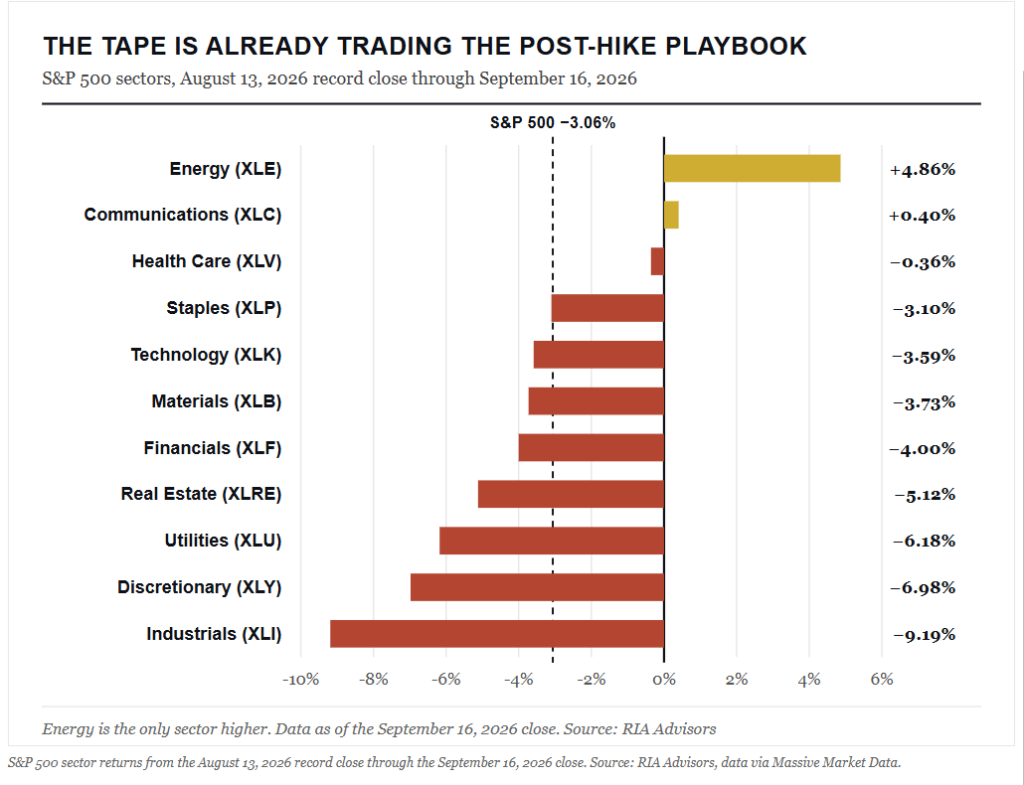
Sector-specific performance offers an even more granular roadmap for portfolio management. Historical analysis conducted by Barclays across five tightening cycles beginning in February 1994 demonstrates that leadership shifts rapidly. Three months after the first rate hike, the S&P 500 has historically fallen by a median of 3.9%, while the Russell 2000 small-cap index suffered a median drop of 7.2%. Financial sector equities historically bore the heaviest brunt, posting a median loss of 8.4%. Notably, the energy sector stood out as the sole major equity grouping to generate a positive median return during these initial three-month windows. Furthermore, value stocks consistently outperformed growth equities, with the performance gap widening significantly within small-cap segments.
Current Market Manifestations and Trading Strategy
The historical template is currently playing out in real time across global equity exchanges. Following market peaks, sector divergence has closely mirrored historical norms even before subsequent rate adjustments can take effect. Energy equities have demonstrated notable resilience, emerging as one of the few sectors maintaining positive momentum, while industrial stocks, small-cap companies, and high-beta assets have faced substantial downward pressure.
Technical indicators on major indices reflect a cautious market sentiment rather than a state of capitulation. Trading ranges have hovered below recent record highs, sitting near crucial short-term moving averages while maintaining a buffer above longer-term trendlines. Relative Strength Index (RSI) metrics indicate a soft market stance rather than a washed-out valuation environment.
Professional portfolio managers navigating these conditions are increasingly emphasizing quality and value equities over high-beta growth stocks. By maintaining a disciplined cash buffer capable of yielding steady returns while awaiting clearer market signals, investors are attempting to mitigate the risks associated with the Federal Reserve’s current policy stance. The overarching consensus among market strategists is to avoid indiscriminate selling driven by headline rate hikes, focusing instead on reducing portfolio crowding and monitoring key technical support levels to guide asset allocation decisions.
Artificial Intelligence Integration Across Non-Technology Sectors

While monetary policy commands immediate trading attention, corporate boardrooms are simultaneously navigating a structural shift driven by artificial intelligence. Market discussions regarding AI have historically centered on the massive capital expenditures required for data center expansion and semiconductor manufacturing. However, tangible productivity gains are rapidly permeating traditional, non-technology sectors of the global economy.
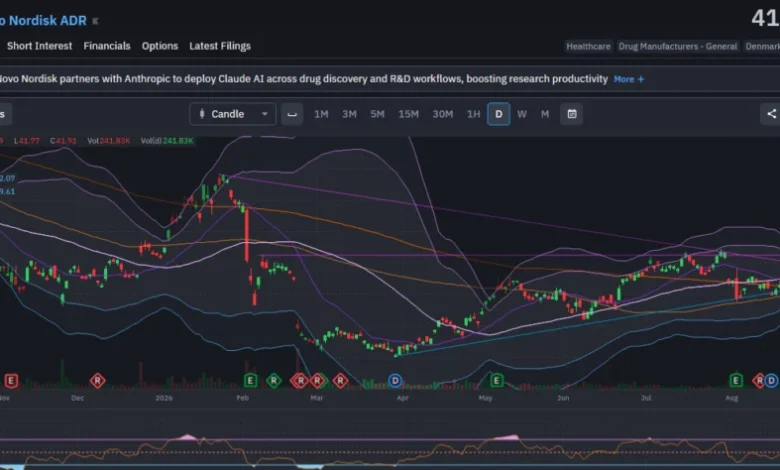
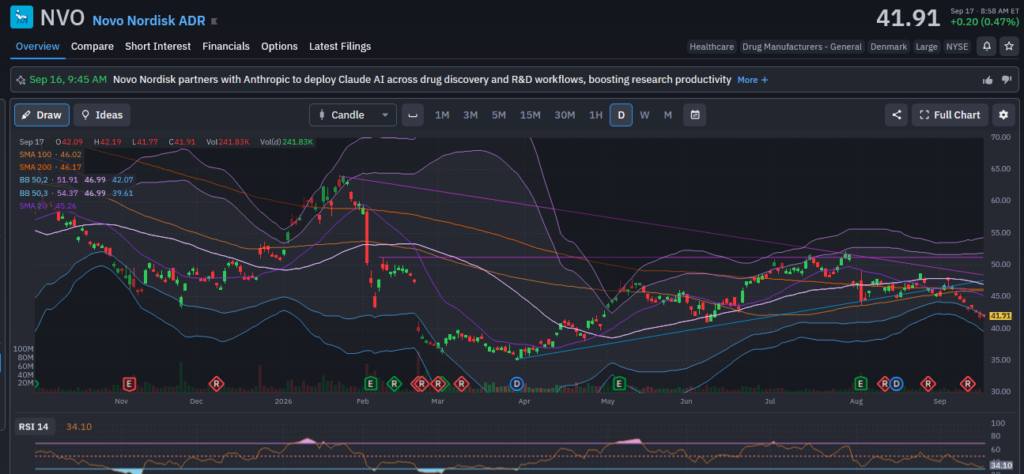
A prime example of this evolution is the pharmaceutical sector. Major healthcare and biotechnology companies have begun establishing strategic partnerships with leading artificial intelligence developers to revolutionize drug discovery and corporate operations. Notably, pharmaceutical giant Novo Nordisk announced a collaboration utilizing advanced science-specific artificial intelligence platforms to accelerate drug discovery pipelines, optimize software development, and automate manufacturing workflows. This initiative mirrors similar partnerships undertaken across the pharmaceutical industry by firms such as Eli Lilly, Merck, and Roche.
Industry leaders have been vocal about the multifaceted benefits of integrating artificial intelligence into research, development, and commercial operations. Corporate executives emphasize that advanced machine learning models do more than merely compress the timeline from initial laboratory research to a marketed therapeutic product. These tools enhance scientific reasoning, improve the understanding of human biology and complex drug mechanisms, and streamline operational efficiencies.
Implications for Corporate Earnings and Broader Economic Productivity
The integration of artificial intelligence into non-tech industries addresses a central question for equity analysts: when will technological advancements translate directly to the bottom line of traditional corporations? While artificial intelligence has yet to autonomously shepherd a novel drug through the entire regulatory approval process, its immediate utility lies in administrative automation, predictive research modeling, and commercial optimization.
Executives across the healthcare sector note that artificial intelligence functions as a dual-engine mechanism for corporate growth. On one side of the ledger, it drives revenue generation by accelerating sales pipelines, improving patient identification, and shortening time-to-market. On the other side, it compresses cost structures, enabling companies to achieve greater output with leaner resource allocation.

This dual capability—simultaneously expanding revenue potential while reducing structural costs—represents the core productivity unlock that economists anticipate will eventually reflect in corporate earnings reports and broader Gross Domestic Product figures. As non-technology industries successfully scale these technologies, the economic impact of artificial intelligence is expected to transition from infrastructure-heavy capital investment to widespread operational efficiency.
Conclusion
The convergence of an unorthodox Federal Reserve tightening cycle and the nascent productivity waves of artificial intelligence creates a multifaceted environment for the global economy. As central bankers navigate the complexities of managing inflation driven by supply shocks against a backdrop of steady economic growth, financial markets must contend with the historical volatility typical of rising interest rate regimes. Simultaneously, the integration of artificial intelligence into traditional sectors like healthcare signals a fundamental shift in corporate productivity that may counterbalance macroeconomic headwinds. For investors and policymakers alike, successfully navigating this period requires a careful balance of historical perspective, risk discipline, and an awareness of structural technological transformations.