Quantitative Analysis of Insider Purchase Filings Reveals Short-Term Market Alpha and Long-Term Uncertainty


The practice of tracking corporate insider transactions, particularly Form 4 purchases by C-suite executives, has long been a cornerstone of quantitative equity research. Because Form 4 filings are mandated by the U.S. Securities and Exchange Commission (SEC) and must be submitted by the end of the second business day following a reportable transaction, they offer a uniquely structured, public, and time-sensitive dataset. Recent analysis of 7,406 public signals derived from C-suite code-P purchase filings between January 1, 2022, and June 30, 2026, provides a granular look at the market impact of executive confidence. While the data confirms a statistically significant, albeit modest, price drift in the immediate aftermath of these filings, the long-term predictive power remains elusive.
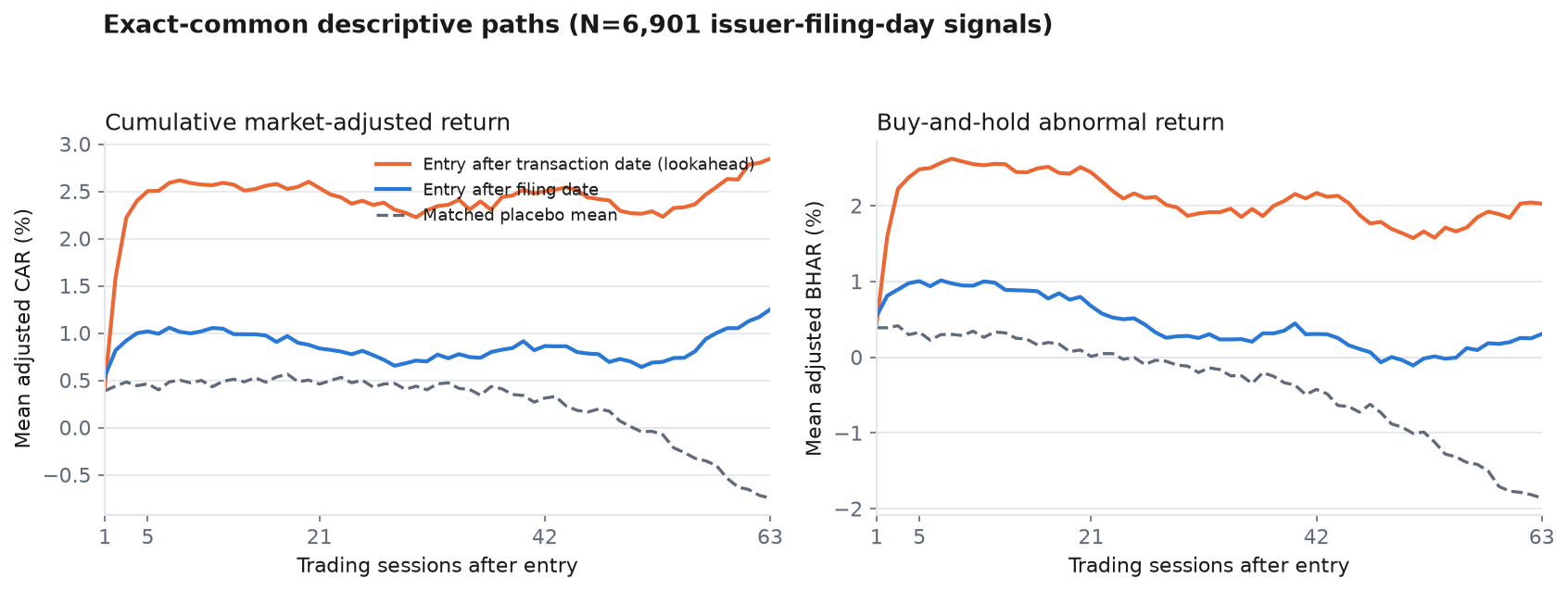
The primary results indicate that the SPY-adjusted mean cumulative abnormal return (CAR) for these insider purchase events is +0.534% for the next trading session and +1.009% over five sessions. These findings are supported by robust two-way clustered t-statistics of 6.460 and 5.053, respectively. However, as the analysis extends to 21 and 63 trading sessions, the adjusted CAR confidence intervals widen to include zero, suggesting that the initial market reaction may not translate into a durable, sustained performance edge for external investors.
The Anatomy of Insider Disclosure
To understand the significance of these filings, one must look beyond the simplified narrative of "one insider, one trade." An SEC Form 4 is a complex document that can aggregate multiple transaction rows, involve multiple beneficial owners, and include diverse security classes. The SEC mandates specific codes for these filings: "P" denotes an open-market or private purchase, while "S" denotes a sale.
The research methodology employed in this study utilized a rigorous "filing-only" funnel. Starting from 1,345,036 raw non-derivative transaction rows, the sample was filtered to exclude amendments, gifts, and non-purchase transactions. By focusing exclusively on C-suite officers—defined here as CEOs, CFOs, and COOs—and removing transactions affirmatively flagged as Rule 10b5-1 plan trades, the study isolated 11,957 component events. This rigorous filtering process ensures that the findings are not contaminated by routine, automated trading programs that are legally shielded from opportunistic intent.
Chronology and Filing Lag
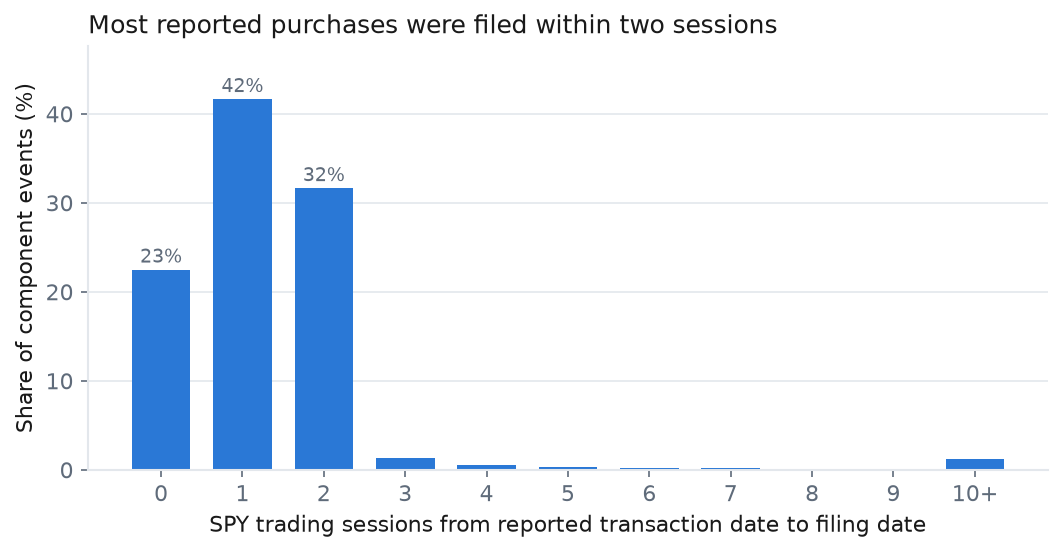
The SEC requires that insiders report transactions within two business days. Data from the 2022–2026 period shows that the market is highly efficient in absorbing this information. Figure 1 of the study highlights that 95.8% of these insider purchases are filed within two sessions of the transaction date. The median lag is just one session. By anchoring the event study to the filing date rather than the transaction date, researchers avoid "lookahead bias"—the error of attributing stock movements to an event before the market actually had access to the information.
When transaction-date entries are compared to filing-date entries, the former consistently show higher, artificial returns. This confirms that a significant portion of the "alpha" cited in less rigorous studies is simply the price drift that occurred between the transaction and the public disclosure. The current analysis strictly adheres to the filing-date anchor, providing a realistic estimate of what an external investor could achieve.
Data Integrity and Price Validation
A critical challenge in working with SEC research files is the potential for misaligned ticker symbols, historical corporate actions (such as stock splits or dividends), and ambiguous fill prices. This study employed a rigorous validation layer, comparing reported volume-weighted average prices (VWAP) against nominal daily closing prices.
Of the initial component events, 1,888 were excluded due to missing or unverifiable price data, often associated with delisted or highly illiquid securities. Furthermore, the study utilized a ledger of 705 corporate actions to ensure that returns were adjusted for split-adjusted history. By rejecting signals where the reported fill price was significantly disconnected from the daily market close, the researchers filtered out potential data entry errors or non-standard private transactions, ensuring the resulting signal is a proxy for open-market activity.
Statistical Rigor and Market Models
To avoid overstating the statistical significance, the study employed Cameron-Gelbach-Miller two-way clustered covariance. This method accounts for the fact that multiple filings can occur for the same issuer or within the same calendar month, which would otherwise lead to an artificial inflation of t-statistics.
The research also tested a traditional market model to assess sensitivity. While the market-model approach produced larger CAR estimates—+6.560% at 63 sessions—the researchers treat this as a sensitivity check rather than a headline finding. Much of this "alpha" is derived from negative pre-event alpha, which mechanically boosts cumulative residuals over time. Consequently, the study emphasizes the adjusted CAR and BHAR (Buy-and-Hold Abnormal Return) as the more reliable, conservative estimators.
Implications for Market Participants
The data suggests that while insider purchases are a signal of corporate optimism, they are not a "silver bullet" for portfolio management. The lack of a persistent effect beyond the one-week horizon is a notable takeaway. At 63 sessions, the adjusted BHAR remains near zero, and the median returns are negative, which serves as a cautionary note for those seeking to build long-term strategies solely on the back of Form 4 filings.
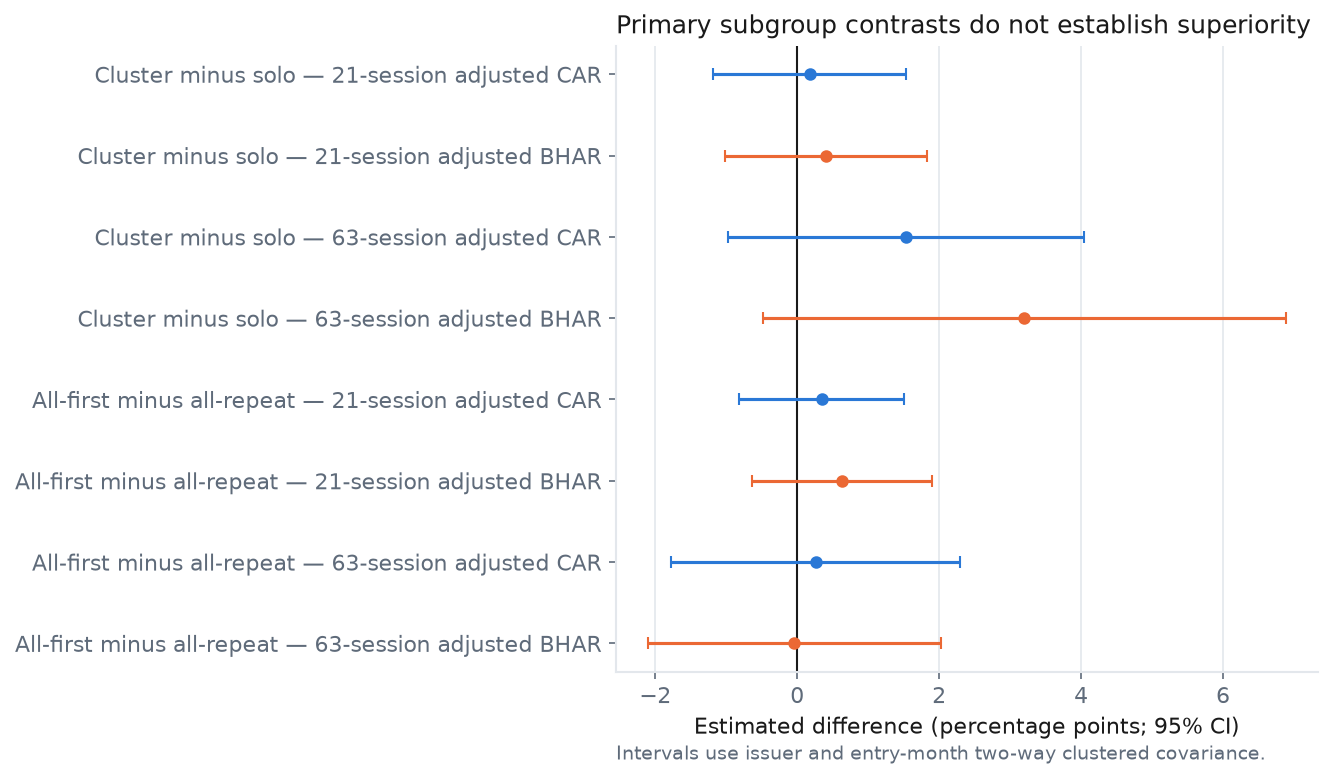
Furthermore, the study examined whether "all-first" purchases (the first time an insider files a purchase during the sample period) outperform "repeat" purchases. The data showed no statistically significant difference between the two groups. This contradicts the hypothesis that initial purchases are inherently more informative than subsequent ones.
Limitations and Regulatory Context
It is essential to recognize the limitations of this analysis. The study does not account for trading costs, market impact, or the liquidity constraints of the underlying securities. For nearly 10% of the signals, the disclosed purchase value exceeded 100% of the median daily dollar volume of the stock, suggesting that a hypothetical strategy attempting to replicate these trades would face significant execution hurdles.
Moreover, the "not affirmatively flagged as a 10b5-1" label is a necessary, yet imperfect, proxy for discretionary trading. As the SEC continues to update its disclosure requirements—most notably the 2023 amendment requiring the explicit flagging of 10b5-1 plans—the quality of structured data is improving, but it remains limited to what is reported on the form itself.

Conclusion: The Value of Methodology
The findings presented here serve as a benchmark for event studies in the age of accessible, high-frequency SEC data. The primary contribution of this research is not the discovery of a "get-rich-quick" strategy, but rather the establishment of a rigorous framework for assessing insider activity. By separating the signal from the noise—filtering for C-suite roles, using filing-date anchors, and applying conservative statistical clustering—the analysis reveals that insider purchases do indeed move markets, but only for a very short duration.
For practitioners, the takeaway is clear: information efficiency in the U.S. equity markets is exceptionally high. When an executive buys stock, the market prices that information within hours. Any remaining excess returns at the end of the first week are likely driven by broader market factors or idiosyncratic news, rather than a persistent, exploitable edge derived from the initial disclosure. This research underscores that in the world of quantitative finance, the most valuable insights often come from what the data does not show as much as what it does.