Speculative Decoding Explained: How This Technique Achieves 3x Faster Inference for Large Language Models

The deployment of large language models (LLMs) has transformed the landscape of artificial intelligence, yet a persistent technical bottleneck remains: the autoregressive nature of token generation. Because models generate text one token at a time, the computational overhead required for every single output character scales linearly with the length of the response. This constraint has historically hindered the transition of LLMs from research environments into latency-sensitive production systems like real-time coding assistants and autonomous agents. Speculative decoding has emerged as the industry-standard solution to this latency challenge, offering a method to increase inference speed by two to three times without compromising the mathematical integrity of the model’s output.
The Mechanism of Autoregressive Bottlenecks
To understand why speculative decoding is revolutionary, one must first identify the primary constraint of current AI hardware. When an LLM generates a response, it operates on a "token-by-token" basis. For each new token, the model must perform a forward pass through its entire parameter set. In contemporary architectures, these parameters—often numbering in the billions—reside in high-bandwidth memory (HBM).
The computational bottleneck is not the floating-point arithmetic performed by the GPU’s tensor cores, but rather the "memory wall." The time required to move weights from the GPU’s memory into the processing units exceeds the time required to perform the actual calculations. Consequently, the GPU spends the vast majority of its cycle time waiting for data to arrive. This state is known as being "memory-bandwidth bound." In this paradigm, simply adding more raw compute power to a server yields diminishing returns, as the system remains perpetually throttled by the transfer speed between memory and the processor.
A Chronology of Inference Efficiency
The quest for faster inference began in earnest as models like GPT-3 and LLaMA entered the mainstream. Early efforts focused on model quantization—reducing the precision of model weights from 16-bit to 8-bit or 4-bit—to decrease memory footprint. While effective, these methods often involved a trade-off in model accuracy.
The breakthrough for speculative decoding arrived around 2023, with landmark research papers proposing that the sequential generation process could be parallelized. By 2024, the technique had matured into production-ready software. Implementations like vLLM and llama.cpp began integrating speculative execution as a core feature, moving the technology from academic white papers into the hands of engineers. This transition marked a shift in strategy: instead of attempting to make the model "smarter" or "smaller," researchers began to focus on making the "act of generation" more efficient through algorithmic orchestration.
How Speculative Decoding Functions
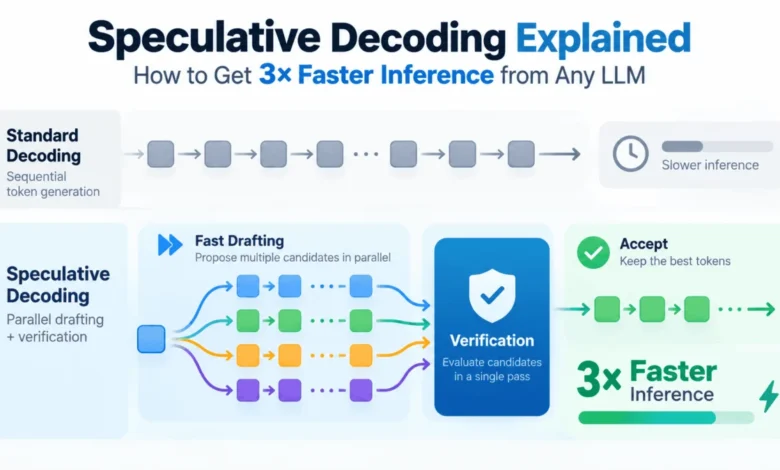
The architecture of speculative decoding relies on a two-tier system consisting of a "draft model" and a "target model." The draft model is a significantly smaller, faster version of the target model, designed to predict the next few tokens in a sequence with high speed, albeit with lower confidence.
- The Drafting Phase: The draft model generates a sequence of potential tokens (typically four to eight) in a single rapid burst.
- The Parallel Verification Phase: These candidate tokens are then fed into the target model simultaneously. Because modern GPUs are optimized for parallel processing, evaluating a sequence of tokens as a batch takes only marginally longer than evaluating a single token.
- The Acceptance Criterion: The target model compares the candidate tokens against its own internal probability distribution. If the target model’s confidence in the draft tokens meets a specific statistical threshold, the tokens are accepted. If a token is rejected, the target model discards the incorrect prediction and samples a new, corrected token.
A key feature of this method is the "mathematical guarantee." The process is designed so that the final probability distribution of the output remains identical to that of the target model running alone. The speculative nature of the process does not "approximate" the answer; it simply finds the exact answer faster by letting a smaller model do the "easy" legwork, while the larger model acts as a rigorous validator.
Data-Driven Performance Metrics
Industry benchmarks indicate that the effectiveness of speculative decoding is highly correlated with the "acceptance rate" of the draft model. When a well-matched pair of models is used—where the draft model is sufficiently aligned with the target model—acceptance rates typically hover between 70% and 80%.
In these scenarios, the speedup is profound. If the target model generates one token per step, and the draft model proposes five tokens, an 80% acceptance rate means that, on average, four tokens are accepted per step. Including the one token produced by the target model, the system achieves an effective throughput of five tokens for the cost of a single target model pass. This reduction in memory access cycles directly translates to the 2x to 3x speed improvements observed in production environments.
However, practitioners must account for the "overhead cost." If the draft model is poorly suited to the task—resulting in high rejection rates—the additional computation required to run the draft model can actually result in a net slowdown. Therefore, the selection of the draft model is a critical design choice, often involving distilling a large model into a smaller one to ensure the draft model "thinks" like its larger counterpart.
Evolution: Beyond the Two-Model Paradigm
As the field has progressed, the requirement to manage two separate models has been identified as a hurdle for resource-constrained deployments. Newer iterations have sought to remove this complexity:
- Medusa: Instead of a separate model, Medusa adds additional "heads" to the target model’s final layer. These heads are trained to predict multiple future tokens simultaneously. This allows the model to draft its own candidates, effectively turning a single model into a self-correcting parallel generator.
- Eagle: This approach improves upon Medusa by utilizing hidden states from the transformer layers to inform future token predictions. By leveraging deeper contextual information, Eagle achieves higher acceptance rates, particularly in complex domains where the vocabulary is highly technical.
- Prompt Lookup Decoding: Perhaps the most lightweight method, this technique requires no training or additional model layers. It scans the prompt and previous context for recurring phrases. For applications like code generation or document drafting, where repetition is common, the system can "copy-paste" chunks of text from the input, providing near-instant generation for predictable content.
Broader Implications and Industry Impact
The integration of speculative decoding into standard inference frameworks like Hugging Face’s text-generation-inference and vLLM signals a new phase in the lifecycle of generative AI. By mitigating the latency barrier, speculative decoding enables the deployment of high-quality, large-parameter models on hardware that would otherwise be insufficient for real-time applications.
From a business perspective, the implications are significant. Reduced latency improves user retention in customer-facing AI agents, and increased throughput allows companies to serve more concurrent users on existing hardware, directly lowering the cost per query. As AI moves toward agentic workflows—where models must perform multiple steps of reasoning to complete a task—the ability to generate tokens rapidly will be a primary competitive differentiator.
While speculative decoding is not a panacea for all inference bottlenecks, it represents a sophisticated application of statistical validation to solve a physical hardware constraint. As the industry continues to iterate on these methods, we can expect the gap between "thought" and "output" in large language models to narrow further, bringing us closer to the goal of seamless, real-time machine intelligence.