Strong CoreWeave Results Revive Confidence in AI-Related Equities While Hawkish Fed Expectations Continue to Support Dollar’s Rally


Global financial markets are navigating a complex intersection of surging artificial intelligence enthusiasm and mounting macroeconomic tightening, creating a unique dynamic where both technology equities and the US dollar are advancing simultaneously. Recent stellar corporate earnings from cloud provider CoreWeave have injected much-needed optimism back into the technology sector, driving significant gains across global semiconductor and equity indices. At the same time, a notable hawkish repricing of Federal Reserve monetary policy expectations has propelled the US dollar higher, testing critical resistance levels across currency and equity benchmarks alike. This juxtaposition of strong tech-sector fundamentals and restrictive central bank pricing highlights a divergence in market drivers, raising vital questions about whether these parallel rallies can sustain their momentum.
CoreWeave Sparkles as AI Infrastructure Demand Defies Skepticism
The recent resurgence in artificial intelligence equities was catalyzed by CoreWeave’s remarkable third-quarter financial performance, which served as a powerful antidote to mounting investor skepticism regarding the sustainability of AI capital expenditures. CoreWeave reported an astonishing 168 percent surge in third-quarter revenue, reaching USD 3.7 billion and soundly beating consensus forecasts. Furthermore, the company issued robust full-year revenue guidance between USD 13.0 billion and USD 13.3 billion, comfortably eclipsing the market’s previous expectations of approximately USD 12.86 billion.
Beyond top-line growth, CoreWeave’s financial disclosures revealed approximately USD 9 billion in customer prepayments and deposits. This massive backlog provided undeniable empirical evidence of robust, sustained enterprise demand for high-performance computing capacity required to train and deploy advanced artificial intelligence models. Adjusted operating income projections also outpaced Wall Street estimates, triggering a double-digit premarket rally in CoreWeave shares that quickly rippled across the broader global technology landscape.
Global Spillover and Regional Market Reactions
The positive sentiment generated by CoreWeave’s earnings report did not remain isolated to US premarket trading; it swiftly transmitted across international semiconductor and equity markets. In Asia, Taiwan’s benchmark stock index surged 3.6 percent, led by heavyweights in the semiconductor manufacturing sector. South Korea’s KOSPI advanced 2.60 percent, buoyed by optimism surrounding memory chip demand, while Japan’s Nikkei 225 gained 1.31 percent. European chipmakers and technology shares followed suit, helping lift Nasdaq-100 futures by nearly 2 percent and allowing the technology-heavy index to vastly outperform the broader S&P 500 and Dow Jones Industrial Average futures.
Despite this impressive relief rally, analysts emphasize that the recovery remains heavily concentrated within the technology sector rather than reflecting a broad-based improvement across all equity markets. Fundamental headwinds that contributed to the previous week’s correction—including the massive financing requirements necessary for scaling AI infrastructure, stretched valuations across major tech firms, and potential regulatory hurdles facing the construction and power consumption of next-generation data centers—remain largely unresolved.
The Nasdaq’s Crucial Recovery Test at 26,000

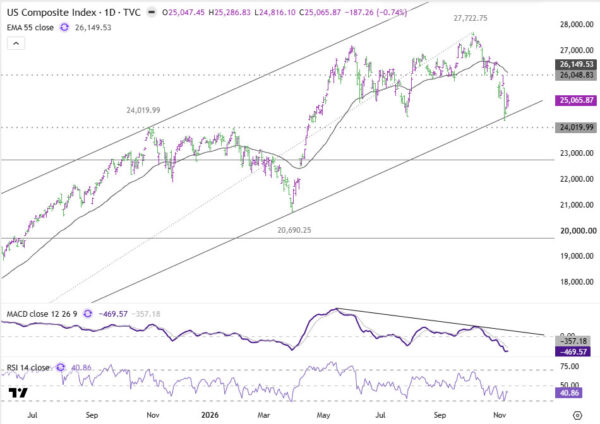
The underlying fragility of the tech sector was underscored just prior to CoreWeave’s announcement, when the Nasdaq Composite suffered a steep 5.5 percent drop in a single trading session, abruptly wiping out a preceding relief rally. Even with the subsequent bounce, the Nasdaq Composite closed near 25,066, remaining roughly 9.6 percent below its all-time record high.
Market participants are now closely monitoring whether the index can successfully reclaim the pivotal 26,000 threshold, a technical level that coincides closely with the index’s 55-day moving average. A decisive and sustained breakthrough above 26,000 would significantly strengthen the technical argument that the recent market correction has reached its conclusion. Conversely, a failure to regain this milestone would reinforce fears that the current advance is merely another temporary relief rally in an ongoing corrective phase.
Hawkish Fed Repricing Fuels the Greenback
While technology equities found their footing through robust earnings and infrastructure demand, the US dollar drew formidable strength from an entirely different macroeconomic catalyst: a aggressive reassessment of the Federal Reserve’s future interest rate trajectory. Driven by a stronger-than-expected October US Consumer Price Index (CPI) report and a series of cautious commentary from central bank officials, investors have drastically recalibrated their expectations for US monetary policy.
According to the CME FedWatch tool, financial markets are now assigning an 85.6 percent probability to a 25-basis-point rate hike at the upcoming December Federal Open Market Committee (FOMC) meeting, with a 14.4 percent probability assigned to a more aggressive 50-basis-point increase. The prospect of the Fed leaving interest rates unchanged has been virtually eliminated from market pricing.
More profoundly, the expected cumulative monetary tightening through June 2027 shifted dramatically, rising from approximately 44 basis points to 76 basis points. This monumental shift means that bond markets have incorporated more than one additional 25-basis-point rate hike into the policy outlook over a relatively short timeframe, signaling that higher-for-longer interest rates are becoming the consensus baseline.
Treasury Yields Surge and DXY Approaches Resistance
The sharp repricing of Federal Reserve policy sent shockwaves through the US fixed-income market. On Tuesday, the two-year Treasury yield surged by 18 basis points to reach 4.746 percent, while the benchmark ten-year Treasury yield climbed to 5.000 percent, amplifying borrowing costs across the broader economy.
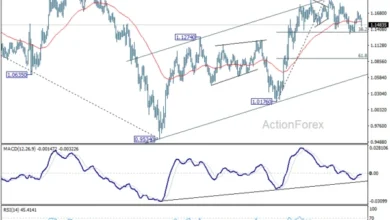
This significant widening of yield differentials provided a powerful tailwind for the US dollar. The DXY dollar index advanced roughly 0.5 percent, pushing steadily toward the 102.52 level and extending gains against a basket of major international currencies. The greenback is now bearing down on the critical 103 resistance region, situated just above its recent peak of 102.945.
A decisive breakout above the 103 mark would solidify the continuation of the dollar’s broader bullish trend, proving that hawkish monetary policy expectations can override typical market correlations. On the other hand, a failure to breach this psychological and technical barrier could suggest that the near-term policy repricing has been fully priced into the currency. With US Treasury cash markets closed in observance of Veterans Day, traders must await the reopening of bond markets for fresh confirmation from yield movements.
Can AI Equities and the US Dollar Coexist in a Rallied State?
The simultaneous appreciation of both technology equities and the US dollar presents an apparent paradox for macroeconomic theorists, as higher interest rates traditionally create severe headwinds for high-valuation growth stocks by increasing discount rates. However, financial analysts note three primary reasons why both rallies can temporarily coexist.
First, the two asset classes are fundamentally responding to entirely different immediate catalysts. AI equities are being propelled by superior corporate earnings and concrete infrastructure spending, whereas the US dollar is drawing its strength from shifting monetary policy expectations. Because these fundamental drivers operate independently, technology shares and the greenback are capable of advancing in tandem without direct conflict.
Second, sustained and productive investment in artificial intelligence infrastructure could stimulate broader productivity gains across the US economy. In this scenario, robust economic growth driven by technological innovation would grant the Federal Reserve greater latitude to maintain restrictive interest policies without inadvertently pushing the economy into a recession. Consequently, strong AI demand could reinforce expectations for higher interest rates, simultaneously supporting the dollar while preserving corporate profitability in the technology sector.
Third, an improvement in risk sentiment could encourage institutional investors to reallocate capital out of safe-haven US Treasuries and back into growth-oriented equities. Such a capital rotation would naturally depress Treasury prices and push bond yields higher, creating an indirect mechanism that bolsters the US dollar even as equity valuations recover.
Broader Implications and Future Market Outlook
Despite these potential coexistence channels, fundamental limits remain regarding how long these competing forces can operate harmoniously. Should elevated borrowing costs begin to exert genuine downward pressure on corporate valuations or complicate the vast financing structures required for ongoing AI infrastructure projects, the very rise in yields supporting the dollar could eventually undermine the technology equity rebound.
Ultimately, market participants are left watching two vital numerical benchmarks: the Nasdaq 26,000 level to gauge the staying power of the artificial intelligence recovery, and the DXY 103 mark to test whether hawkish Federal Reserve pricing can sustain greenback dominance in the face of improving global risk appetite. A decisive breakthrough through both levels would validate the scenario in which tech optimism and a restrictive central bank coexist peacefully, while rejection at either threshold will likely expose which macroeconomic force is primed to dictate market direction in the weeks ahead.