EUR/USD Technical Outlook: Navigating Near-Term Consolidation Amid Pivotal Long-Term Resistance Levels

The foreign exchange market has entered a critical phase for the world’s most heavily traded currency pair, as the EUR/USD contends with crucial technical thresholds across multiple timeframes. Following an extended decline over the preceding week, market participants are carefully evaluating whether the recent downward trajectory represents a transient correction within a broader bullish recovery or the early stages of a more significant medium-term trend reversal. As the pair searches for direction, currency strategists and institutional traders are closely monitoring key Fibonacci retracement levels, psychological barriers, and shifting momentum indicators that could dictate the trajectory of the euro against the U.S. dollar in the weeks and months ahead.
Recent Price Action and Immediate Market Dynamics
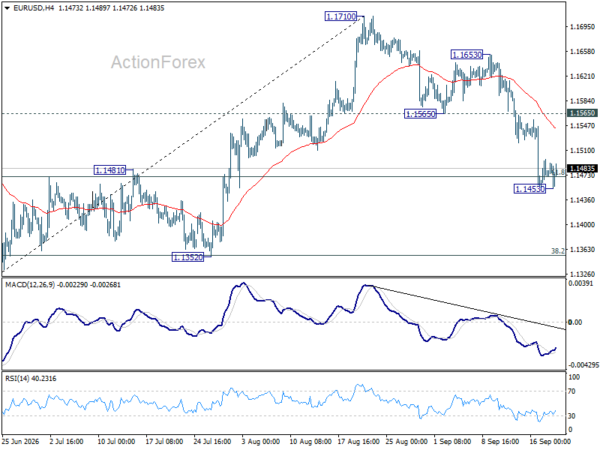
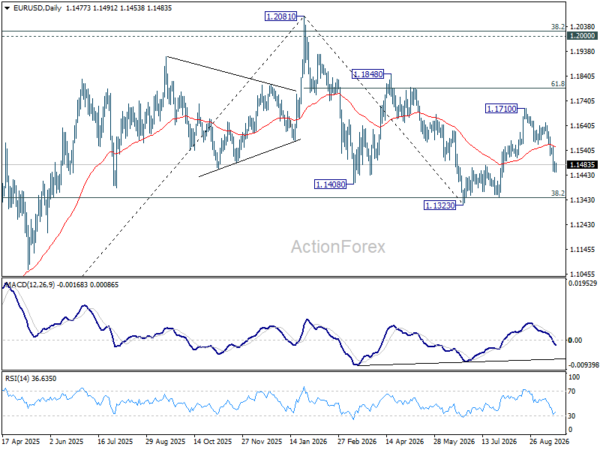
The current market structure for the EUR/USD highlights a distinct loss of upward momentum that initially characterized the pair’s advance from the 1.1323 swing low up to the 1.1710 peak. The subsequent pullback last week strongly suggests that this upward corrective phase has reached a definitive top. However, downward momentum encountered immediate friction as the pair tested the 61.8% retracement level of the 1.1323 to 1.1710 move, located at 1.1471.
Unable to establish a firm foothold below this critical support zone, the exchange rate has flattened out into a sideways consolidation pattern. Consequently, the initial trading bias for the week has turned neutral, with market participants adopting a wait-and-see approach.
Despite the near-term consolidation, the overarching technical risk remains skewed to the downside. This bearish predisposition will persist as long as the crucial barrier at 1.1565—previously serving as a support level and now converted into firm resistance—remains intact. Should selling pressure resume and push the pair decisively below the 1.1453 mark, technical models indicate a high probability of a retest of the foundational 1.1323 low.
Broader Medium-Term Perspective and Retracement Levels
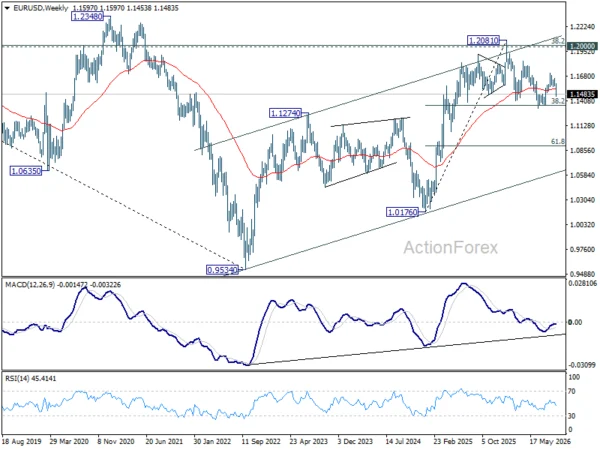
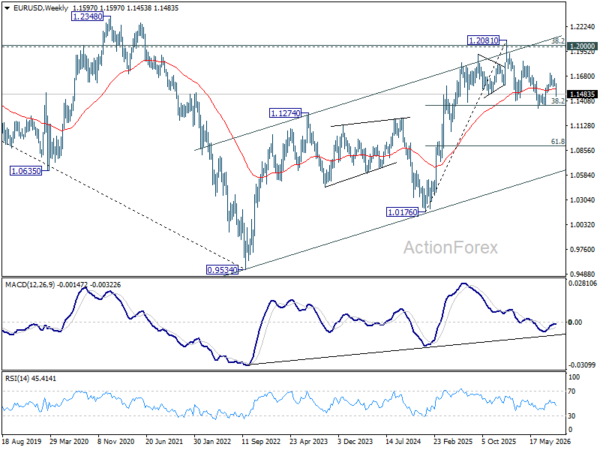
Stepping back to analyze the broader market picture reveals a more resilient underlying structure for the European currency. Price action originating from the significant 2025 low of 1.0176 up to the subsequent peak of 1.2081 establishes the baseline for the medium-term trend. Within this larger framework, the crucial 38.2% retracement level of the 1.0176-to-1.2081 wave is situated at 1.1353.
As long as this vital threshold remains unbroken on a sustained closing basis, technical analysts view the current downward price movements from 1.2081 merely as a routine corrective pullback within the larger, established up-trend that began in 2025. In this scenario, once the corrective phase exhausts itself, a renewed bullish push targeting a break of the 1.2081 resistance ceiling remains the baseline expectation for a later stage.
Conversely, a decisive and sustained break below the 1.1353 support level would invalidate this optimistic outlook. Such an event would significantly elevate the probability of a medium-term trend reversal, signaling that bearish forces have regained structural control over the currency pair.
Long-Term Historical Context and Psychological Barriers
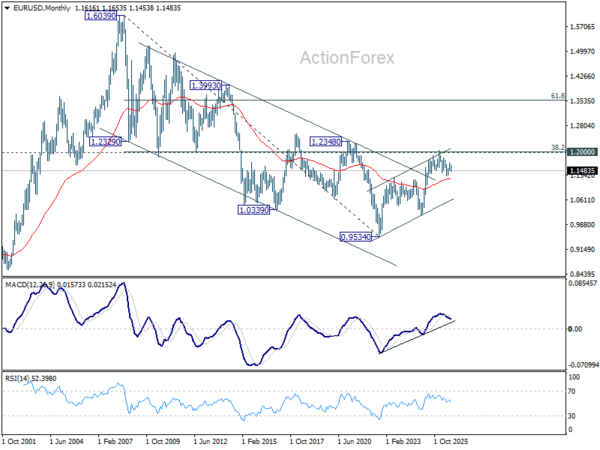
A macro-level examination of the EUR/USD places current market movements within a multi-decade historical context, illuminating the immense significance of long-term structural resistance zones. The primary focal point for the multi-year outlook centers on the 38.2% retracement of the massive historical decline spanning from the record high of 1.6039 down to the generational low of 0.9534. This critical retracement level is calculated at 1.2019, aligning closely with the formidable psychological milestone of the 1.2000 handle.
Market historians and long-term macro strategists note that the 1.2000/1.2019 zone represents the ultimate battleground for currency bulls and bears. A decisive rejection of the exchange rate by this overhead resistance area would preserve the multi-decade downward trend that originated at the 2008 high of 1.6039. Under such a rejection scenario, the long-term outlook for the euro would remain neutral at best, trapped within historical secular ranges.
On the other hand, a definitive, high-volume break and consolidation above the 1.2000/1.2019 resistance band would carry profound implications for the global financial architecture. Such a breakthrough would signal a historic long-term bullish trend reversal, opening a pathway toward higher long-term technical objectives, most notably the 61.8% retracement target situated at 1.3554.
Chronology of Key Technical Milestones
To fully understand the current positioning of the EUR/USD, it is helpful to trace the chronological evolution of key price milestones that have shaped the pair’s modern trading history:
- 2008: The EUR/USD reaches its all-time historical peak at 1.6039, initiating a multi-decade structural downtrend driven by shifting global trade dynamics and structural economic divergences.
- September–October 2022: The pair registers its generational cyclical low at 0.9534, testing parity and prompting significant central bank interventions and verbal defenses of the single currency.
- 2025: A robust recovery takes hold, establishing a major cyclical low at 1.0176 and setting the foundation for a renewed medium-term upward trend.
- Recent Months: The pair pushes higher to carve out a local peak at 1.2081, before encountering strong resistance and entering the current corrective phase characterized by the recent slide from 1.1710 down toward the mid-1.1400s.
Macroeconomic Implications and Market Reactions
While technical analysis provides the immediate roadmap for price action, the underlying fundamentals continue to drive the broader macroeconomic narrative surrounding the euro and the U.S. dollar. Economic policymakers on both sides of the Atlantic face distinct challenges that directly influence investor sentiment and capital flows.
In the Eurozone, the European Central Bank (ECB) navigates a delicate balancing act. Economic growth data across the bloc has shown persistent regional divergence, with core economies struggling to maintain robust industrial momentum amid shifting global trade policies and energy considerations. Inflation readings, while stabilizing closer to official medium-term targets, continue to prompt cautious commentary from governing council members, who remain non-committal regarding the exact timing and magnitude of future monetary policy adjustments.
Concurrently, the United States Federal Reserve contends with its own complex economic matrix. U.S. labor market reports, domestic consumption indicators, and persistent service-sector inflation metrics continue to keep currency traders guessing about the future path of U.S. interest rates. Shifts in market expectations regarding Federal Reserve rate cuts frequently trigger sharp, high-volatility movements in the greenback, directly dictating the inverse price action observed in the EUR/USD pair.
Institutional currency desks and corporate treasury departments have responded to this heightened macroeconomic uncertainty by adopting flexible hedging strategies. Many institutional managers note that until the EUR/USD definitively resolves its current consolidation pattern—either by breaking through key overhead resistance or succumbing to medium-term support failures—trading desks are likely to favor range-bound strategies and short-term tactical positions over aggressive directional exposure.
Outlook and Trader Takeaways
As the trading week progresses, market participants will maintain a vigilant watch over key intraday and daily price levels. The immediate battleground remains defined by the 1.1471 Fibonacci support and the 1.1565 resistance threshold. A sustained violation of either boundary will likely dictate the directional momentum for the remainder of the month.
For long-term investors, the broader technical framework serves as a reminder of the macroeconomic forces at play. Whether the current market phase is merely a temporary consolidation before a continuation of the 2025 recovery or the prelude to a structural trend reversal will depend heavily on incoming economic data releases, central bank policy signals, and the market’s ability to challenge or defend multi-year psychological barriers.