Security Researcher Discovers Four High-Severity Linux Kernel Vulnerabilities Enabling Local Root Access via AI-Assisted Methods

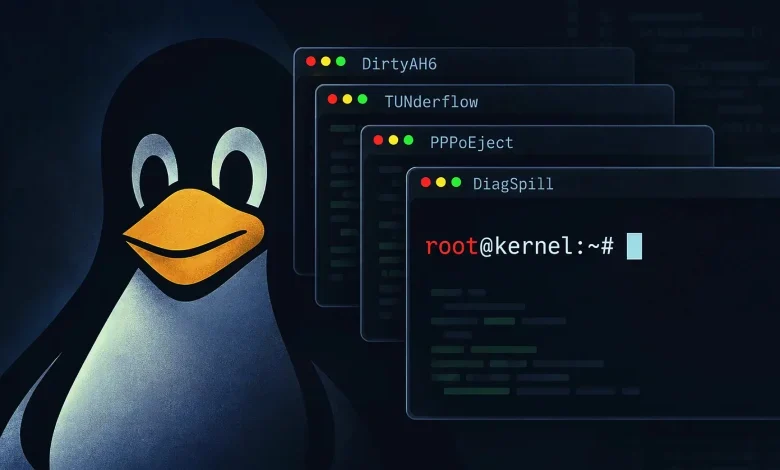
A prominent security researcher has publicly released working exploit code for four critical vulnerabilities affecting the Linux kernel, each capable of granting a local user root privileges—the highest level of administrative control on a machine. The flaws, collectively dubbed the "LPE Quartet," target fundamental components of the kernel’s networking subsystem.
Although kernel maintainers and major Linux distributions have integrated patches over the past several weeks to neutralize the threats, the public availability of exploit code places unpatched systems at heightened risk. Systems running older, non-updated kernels require immediate attention from system administrators and enterprise security teams to prevent potential local privilege escalation (LPE) attacks.
The vulnerabilities—designated DirtyAH6 (CVE-2026-80844), TUNderflow (CVE-2026-81000), PPPoEject (CVE-2026-68121), and DiagSpill (CVE-2026-74469)—were discovered by security researcher Asim Manizada. The discovery underscores a growing trend in vulnerability research: the integration of artificial intelligence tools to map complex kernel memory layouts and uncover latent, decades-old memory-safety flaws.
Chronology and Coordinated Disclosure
The timeline of the discovery and subsequent remediation highlights standard industry practices regarding coordinated vulnerability disclosure. Manizada initially identified the four memory-safety flaws during security audits of the Linux kernel and formally reported his findings to the Linux kernel security team in mid-July.
Recognizing the severity of potential local privilege escalation vectors, Manizada engaged in a coordinated disclosure timeline with major Linux distributions. This collaboration allowed maintainers for Debian, Ubuntu, Red Hat, SUSE, and other prominent distributions to develop, test, and stage security updates before the technical details became public knowledge.
Following a designated embargo period, Manizada published a comprehensive technical write-up on September 18, accompanied by functional exploit code for each of the four vulnerabilities. As of reporting, there are no documented instances of these exploits being deployed in real-world, malicious cyberattacks. Because Manizada’s exploit code is finely tuned to specific kernel builds and carries a significant risk of causing kernel panics or system crashes, the material is currently suited primarily for isolated laboratory environments and testing suites.

Detailed Breakdown of the LPE Quartet
All four vulnerabilities originate from deep-seated memory-safety errors embedded within various components of the Linux kernel’s networking code. The underlying flaws are remarkably mature, with original coding mistakes dating back between 10 and 21 years before their discovery. An analysis of the technical specifications reveals distinct prerequisites for each bug:
1. DirtyAH6 (CVE-2026-80844)
- Kernel Area: IPsec AH6 (IPv6 Authentication Header)
- Local Prerequisite: Unprivileged user namespaces
- Remote Vector: Crash only (requires host acting as an IPv6 router/gateway utilizing transport mode AH)
DirtyAH6 resides in the IPv6 IPsec Authentication Header implementation. Under standard configurations, an ordinary, unprivileged user can leverage user namespaces—a security feature enabling a normal user account to operate with administrative privileges inside an isolated sandbox—to reach the vulnerable code path. While primarily an LPE vector, Manizada demonstrated that DirtyAH6 could theoretically be triggered remotely to cause a denial-of-service (DoS) system crash, provided the target host is configured as an IPv6 router utilizing specific transport mode configurations.
2. TUNderflow (CVE-2026-81000)
- Kernel Area: TUN/TAP virtual network devices
- Local Prerequisite: Unprivileged user namespaces
- Remote Vector: None
This vulnerability affects the handling of TUN/TAP virtual network drivers within the kernel. By exploiting memory corruption mechanisms through unprivileged user namespaces, a standard local user can manipulate virtual interface operations to overwrite critical kernel memory structures, ultimately achieving a root shell.
3. PPPoEject (CVE-2026-68121)
- Kernel Area: Point-to-Point Protocol over Ethernet (PPPoE)
- Local Prerequisite: Unprivileged user namespaces
- Remote Vector: None
PPPoEject targets the network stack handling PPPoE connections. Similar to DirtyAH6 and TUNderflow, the exploit relies on the presence of unprivileged user namespaces to interface with the vulnerable kernel subsystem, executing memory manipulation routines that escalate local user privileges to root.
4. DiagSpill (CVE-2026-74469)
- Kernel Area: Stream Control Transmission Protocol (SCTP via
sctp_diag) - Local Prerequisite: None
- Remote Vector: Crash only (requires non-default SCTP options enabled)
DiagSpill stands apart from the other three vulnerabilities as the sole flaw requiring no unprivileged user namespaces or specialized pre-existing privileges. Instead, it relies on the presence of the SCTP networking module on the target system. While it can be exploited locally for privilege escalation, it also presents a limited remote crash vector under specific, non-default SCTP configurations. However, Manizada noted that remote code execution via DiagSpill remains highly improbable due to structural limitations in memory shaping.
Technical Analysis of Exploitation and Impact
Local privilege escalation vulnerabilities are of primary concern in multi-tenant environments, shared server architectures, and enterprise infrastructure where numerous users possess low-privilege accounts. An adversary who has gained initial, limited access to a system through compromised credentials or web application vulnerabilities can leverage public exploit code to escalate their footprint to root, thereby compromising the entire host operating system, accessing sensitive data, and potentially pivoting to other network segments.
Furthermore, security analysts have evaluated the theoretical potential for container escapes using these exploits. Because containers frequently rely on unprivileged user namespaces and shared host kernel features to maintain performance and isolation boundaries, vulnerabilities within core networking modules can, under specific conditions, allow an attacker confined within a container to break out and compromise the underlying host system.

Despite the theoretical remote capabilities noted with DirtyAH6 and DiagSpill, practical remote exploitation remains exceedingly complex. Achieving remote code execution requires precise memory layout manipulation—often referred to as "memory shaping"—over a network interface. Manizada observed that while remote denial-of-service crashes are feasible under narrow environmental conditions, achieving remote root access through these network vectors is an exceptionally difficult engineering challenge.
The Role of Artificial Intelligence in Vulnerability Discovery
A notable aspect of the LPE Quartet discovery is Manizada’s methodology. The researcher utilized an AI-assisted analytical framework designed to construct a comprehensive internal map of how the Linux kernel processes memory and manages complex data structures. By employing large language models and custom tooling to reason about kernel memory layout, the discovery process was significantly accelerated.
This development highlights an evolving paradigm in both offensive and defensive cybersecurity. Kernel maintainers acknowledged this shift transparently; the official source tree commit implementing the fix for DirtyAH6 incorporates an "Assisted-by" attribution crediting Manizada’s custom AI tooling.
The LPE Quartet represents the continuation of a notable trend throughout the year 2026, during which several high-profile Linux kernel vulnerabilities—such as the July disclosure of the Open vSwitch OVSwrap flaw and May’s Dirty Frag exploit—were uncovered with the assistance of advanced machine learning models. Manizada has indicated that this series of discoveries likely concludes the public phase of his AI-assisted vulnerability research initiatives.
Mitigation Strategies and Remediation Recommendations
Security operations centers and systems administrators are strongly advised to apply official kernel patches provided by their respective operating system vendors. Because enterprise distributions (including Red Hat Enterprise Linux, Ubuntu, Debian, SUSE, and others) maintain independent version numbering schemes and backport security fixes to their respective stable releases, administrators should consult vendor-specific security advisories rather than relying solely on upstream Linux kernel version numbers.
In environments where immediate patching and reboots are operationally prohibitive, secondary risk-mitigation steps can be implemented:
- Disable Unprivileged User Namespaces: Restricting the creation of user namespaces via kernel sysctl parameters (such as
kernel.unprivileged_userns_clone = 0on systems where applicable) effectively neutralizes three of the four flaws (DirtyAH6, TUNderflow, and PPPoEject) by cutting off the primary local attack vector. - Unload Unused Network Modules: Disabling or blacklisting rarely used networking modules, such as SCTP, mitigates the exposure presented by vulnerabilities like DiagSpill.
However, security experts emphasize that temporary mitigations are not a substitute for comprehensive patching. Because alternative, undiscovered code paths may exist to reach similar memory-safety vulnerabilities, full kernel updates remain the definitive remedy for securing infrastructure against the LPE Quartet.