Maximizing AI Efficiency Through Data Formatting: How SerpApi is Reducing Token Costs for LLM Agents

The rapid proliferation of autonomous AI agents has fundamentally transformed how businesses interact with the web, yet this evolution has introduced a significant, often overlooked financial burden: token bloat. As agents rely increasingly on search results and large-scale file retrievals to perform complex reasoning, the sheer volume of data ingested often exceeds the actual informational requirement of the model. In an environment where every token consumed translates directly into operational expenditure, the industry is witnessing a pivot toward data optimization. SerpApi, a leader in search engine data integration, has recently introduced a Markdown-based output format designed specifically to mitigate these costs by stripping away the non-essential metadata that traditional JSON structures carry.
The Hidden Cost of AI Autonomy
The current architecture of AI agents often involves recursive loops where a model is tasked with fetching data, analyzing it, and potentially rerunning queries if the initial results are unsatisfactory. When an agent searches for information—such as a simple request for local businesses or product specifications—the standard response format is typically JavaScript Object Notation (JSON). While JSON is the gold standard for software engineering and API interoperability, it is inherently verbose.
A standard search query in JSON format includes a vast array of tracking links, internal metadata, and nested objects that are critical for web developers but functionally invisible to Large Language Models (LLMs). These extra characters consume significant portions of the context window. For enterprises operating at scale, the cost of processing this "noisy" data is not merely a matter of convenience; it is a direct hit to the bottom line. As agents ingest thousands of tokens per request, the compounding effect can lead to exorbitant cloud computing bills and reduced performance, as the model’s limited context window becomes saturated with structural markers rather than actionable insights.
Comparative Analysis: JSON vs. Markdown
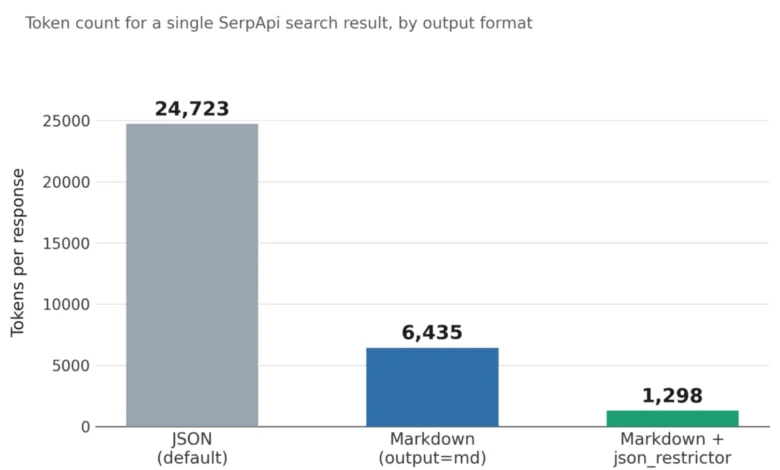
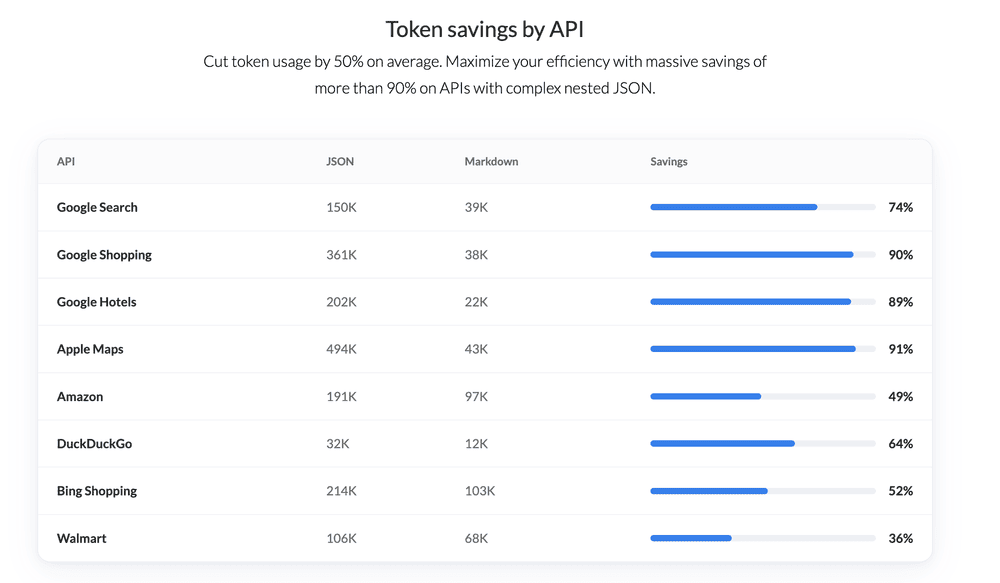
The core of the problem lies in the structural redundancy of JSON. In a recent benchmark conducted using a standard query for "coffee," researchers compared the token requirements between traditional JSON and the newly implemented Markdown output. The findings were stark: a search that required 24,723 tokens in JSON format was reduced to 6,435 tokens when processed as Markdown. This represents a reduction of approximately 74 percent. Further optimization, involving restricted field sets, allowed the same data to be delivered in just 1,298 tokens.
This reduction is achieved by prioritizing the semantic density of the content. Markdown, a lightweight markup language, inherently strips away the hierarchical nesting and redundant tracking fields that define JSON objects. Instead, it provides a cleaner, human-readable format that retains the essential information required for an LLM to reason effectively. By removing the "syntactic sugar" that machines use to parse data but models ignore, the efficiency of the entire AI pipeline is significantly enhanced.
The Chronology of Data Optimization
The shift toward model-centric data delivery has been accelerating over the past 18 months as AI developers began to hit the physical limits of context windows. Initially, the focus was on expanding the context window itself—increasing capacity from 8k to 128k or even 1 million tokens. However, developers quickly realized that increasing capacity was only half the battle. If an agent fills its expanded window with irrelevant metadata, it increases the likelihood of "hallucinations" or cognitive drift, where the model loses focus on the core task.
In late 2023 and early 2024, industry feedback indicated that "context hygiene" had become a top priority. Engineering teams began building custom scrapers and middleware to sanitize data before feeding it into GPT-4, Claude, or Llama models. SerpApi’s decision to integrate Markdown output at the API level marks a formal recognition of this trend. By moving the sanitization process to the server-side, SerpApi allows developers to bypass the need for intermediary data-processing layers, thereby reducing latency and further lowering the operational cost of AI integration.
Strategic Implications for Enterprise AI
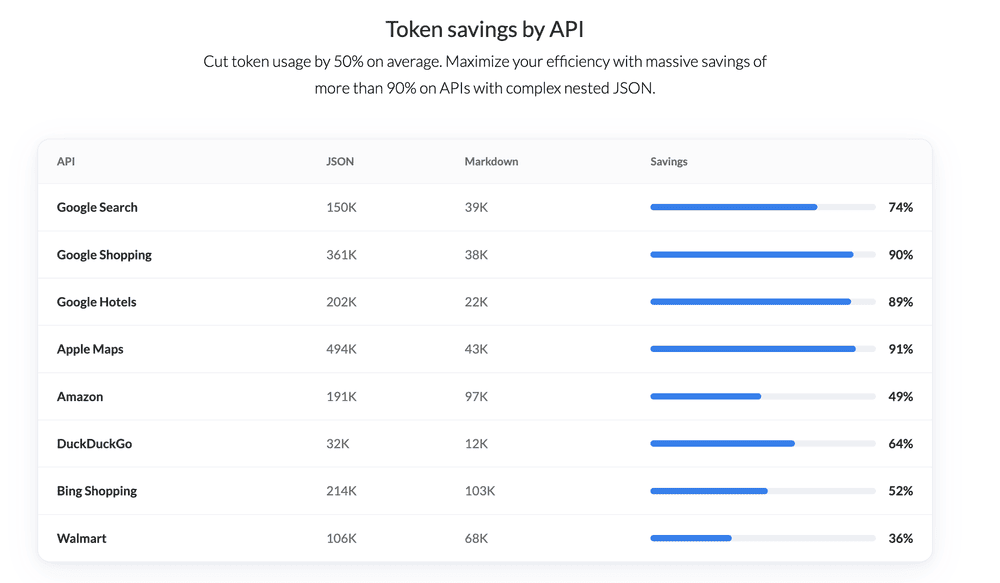
For businesses, the move toward Markdown is not merely about saving pennies on API calls; it is about architectural scalability. When a model is tasked with summarizing dozens of product reviews or analyzing market trends across multiple search results, every saved token allows for a larger breadth of information to be included in the context window. This creates a more robust agent that can "see" more of the landscape without being forced to truncate data due to budget constraints.
However, the industry remains cautious about the universal application of Markdown. The distinction between "data for machines" and "data for models" is critical. JSON continues to be the superior format for transactional workflows. If an application requires precision—such as extracting float-based ratings, integer-based pricing, or structured arrays for database storage—JSON remains indispensable. Markdown, by contrast, is a lossy format by design. It excels in summarization, reasoning, and synthesis tasks, but it lacks the strict schema enforcement required for financial or programmatic backend integration.
Implementation and Technical Methodology
SerpApi’s approach to this transition involves a flexible integration strategy that does not disrupt existing workflows. By utilizing a simple query parameter or header adjustment, developers can toggle between JSON and Markdown output without retooling their backend infrastructure.
The process is designed to be seamless across all 100+ search APIs offered by the provider. When a user requests Markdown, the system automatically performs the following:
- YAML Frontmatter Generation: Retains essential metadata in a concise header format.
- Table Structuring: Converts dense object data into Markdown tables, which models are highly efficient at parsing.
- Tracking Removal: Strips out non-essential URL parameters and tracking tokens that do not contribute to the model’s analytical capability.
- Redundancy Filtering: Identifies and collapses duplicate fields that often appear in complex API responses.
Furthermore, the introduction of the json_restrictor tool allows for a secondary layer of control. This server-side filtering mechanism enables developers to define exactly which fields they require before the data leaves the SerpApi server. By combining Markdown formatting with selective field restriction, the payload size can be surgically minimized, resulting in maximum efficiency.
Future Outlook and Industry Impact
The movement toward leaner data payloads is indicative of a broader shift in the AI industry toward "agentic" efficiency. As the hype cycle around LLMs settles, the focus is shifting toward the practical, long-term costs of maintaining autonomous agents. The ability to optimize data delivery at the source is likely to become a standard expectation for all major data providers.
Observers note that while SerpApi is currently at the forefront of this specific Markdown implementation, the entire ecosystem of data providers—including financial APIs, news aggregators, and social media scrapers—will likely follow suit. The industry is moving away from a "one-size-fits-all" data delivery model toward a "model-aware" paradigm, where the structure of the data is tailored specifically to the consumer of that data.
Ultimately, the goal is to make AI agents more capable by feeding them higher-quality, higher-density information. By reducing the noise and focusing on the signal, developers can create agents that are faster, cheaper, and more accurate. As the cost of intelligence decreases through better data management, the barrier to entry for building sophisticated, autonomous AI systems will continue to drop, paving the way for more complex applications in fields ranging from automated research and competitive intelligence to real-time market monitoring.
For those currently managing large-scale AI operations, the immediate recommendation is to audit existing API calls. By analyzing the token delta between legacy JSON responses and optimized Markdown, developers can quantify their potential savings and determine where this transition adds the most value to their specific use case. The era of blind token consumption is nearing its end; the era of data-efficient AI is just beginning.