The US government holds half of all multifamily mortgages. The rest is spread around.

The landscape of American commercial real estate (CRE) is currently navigating a period of unprecedented volatility, characterized by a fundamental misalignment between historic debt obligations and the contemporary interest rate environment. At the center of this turbulence is the $2.3 trillion multifamily mortgage market. While the federal government, through government-sponsored enterprises (GSEs) Fannie Mae and Freddie Mac, underwrites approximately $1.2 trillion of this debt, the remaining exposure is distributed across a disparate network of private equity firms, commercial banks, insurance companies, and securitized debt vehicles.
This concentration of risk within federal agencies effectively places the American taxpayer in a position of primary exposure for nearly half of the nation’s rental apartment debt. However, the private sector’s portion—held through Commercial Mortgage-Backed Securities (CMBS) and Collateralized Loan Obligations (CLOs)—has become the epicenter of a growing wave of defaults, as developers and investors face the harsh reality of "balloon" payments that cannot be refinanced under current fiscal conditions.
The Anatomy of the Multifamily Crisis
The current crisis is not merely a product of market cyclicality but the result of a "perfect storm" created by the transition from a decade of ultra-low interest rates to a regime of elevated borrowing costs. During the period of monetary expansion following the 2008 financial crisis and accelerating through 2020, capital was inexpensive and abundant. Real estate developers leveraged this environment to secure fixed-rate, interest-only loans, often with five-year terms, betting that the low-rate environment would persist indefinitely.
When the Federal Reserve initiated its aggressive interest rate hiking cycle to combat inflationary pressures, the math supporting these projects collapsed. For many properties, the SOFR-pegged (Secured Overnight Financing Rate) variable-rate loans saw immediate cost spikes. For those with fixed-rate debt, the problem manifested upon maturity. As these loans reached their balloon payment dates, borrowers found that the cost of refinancing exceeded the net operating income (NOI) of the properties, particularly as rental income growth slowed or contracted in many major metropolitan markets.
Chronology of Recent Defaults
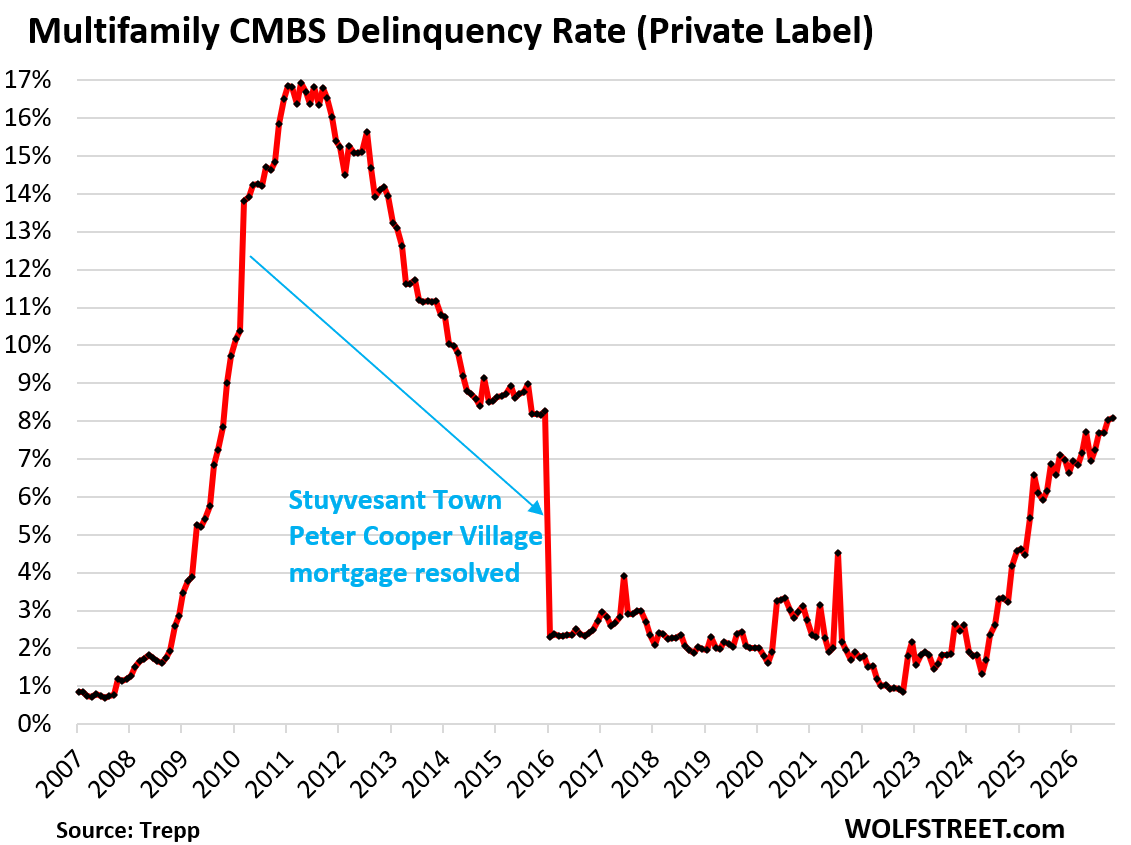
The breakdown of the "extend and pretend" strategy is increasingly visible in the data provided by analytical firms like Trepp.
- 2020–2022: A surge in CRE lending occurs, driven by institutional optimism and low cost of capital.
- Late 2023: Early warning signs emerge as vacancy rates in major urban cores rise, driven by remote-work trends and oversupply.
- March 2024: Morningstar DBRS reports significant credit degradation on high-profile assets, including "The Cove at Tiburon," a luxury waterfront property in California. Despite a 2020 valuation based on prime location and amenities, the property’s occupancy plummeted from 91.9% in 2022 to 80.2% by early 2024.
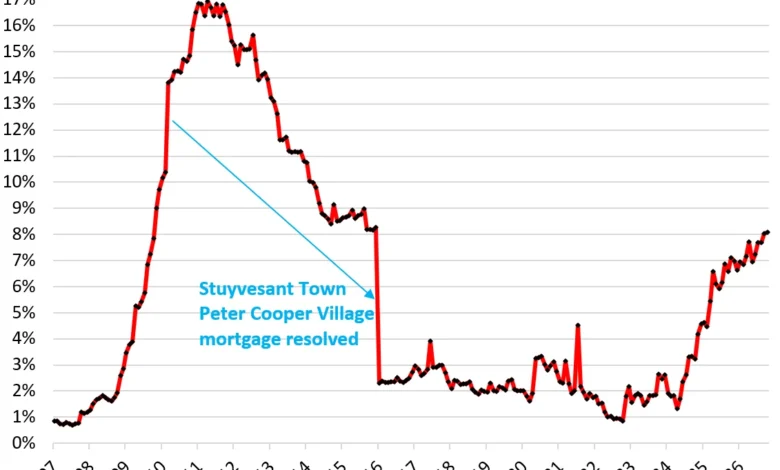
- October 2026: The multifamily CMBS delinquency rate climbs to 8.1%, the highest level since the 2016 Stuyvesant Town–Peter Cooper Village delinquency in New York City.
- November 2026: Failed refinancing attempts for major assets lead to a cascade of defaults, with lenders forced into negotiations for short-term extensions as a last-ditch effort to avoid foreclosure.
Case Studies in Asset Distress: The Cove and The Beaudry
The failure of The Cove at Tiburon serves as a microcosm for the broader CMBS sector. Securitized in 2020, the $210 million mortgage was backed by the assumption that rental premiums would remain high. Instead, the property faced a decline in leasing velocity and a softening of the local rental market. When the debt matured in October, the inability to bridge the gap between declining cash flow and higher debt service costs forced the property into a cycle of attempted modifications.
Equally significant is the case of "The Beaudry," a 64-story luxury tower in downtown Los Angeles. Developed by Brookfield at a cost of approximately $600 million, the property stands as a symbol of the "lifestyle apartment" era that preceded the post-pandemic shift in urban usage. The $360 million loan, held by a Bridge Investment Group entity, has effectively been abandoned by the developer. Brookfield’s decision to "hand over the keys"—a practice becoming common across their portfolio—underscores the lack of equity remaining in these projects. With over 10,000 new units entering the downtown Los Angeles market between 2017 and 2021, the supply glut has made it impossible for luxury towers to hit the rent targets required to satisfy debt obligations.
The Role of Institutional Investors and Private Equity
The involvement of firms like Apollo (via Bridge Investment Group) highlights the vulnerability of alternative asset managers to the CRE downturn. Unlike traditional commercial banks, which are heavily regulated and restricted by capital reserve requirements, private equity firms and alternative managers often hold high-yield debt instruments that are highly sensitive to market shocks.
When these loans default, the impact is dispersed through various investment vehicles, affecting pension funds, insurance companies, and individual investors who hold shares in these funds. The systemic risk is not necessarily a repeat of the 2008 banking collapse, but rather a "slow-motion" erosion of capital values that could suppress institutional appetite for real estate investment for years to come.

Market Implications and Future Outlook
The broader implications for the US economy are multifaceted. First, the supply-demand imbalance in the rental market is expected to persist. While the high-end luxury sector is currently bearing the brunt of the defaults, the oversupply of units is putting downward pressure on rents across various tiers, which may benefit consumers but simultaneously erodes the collateral value for lenders.
Second, the "extend and pretend" strategy—whereby lenders grant short-term extensions in the hope of a future rate cut or market recovery—is reaching its limit. Financial analysts suggest that if interest rates remain "higher for longer," the delinquency rate will likely continue to climb. The 8.1% CMBS delinquency rate is viewed by many as a floor rather than a ceiling, particularly as the "wall of maturities" for CRE debt approaches its peak in 2027 and 2028.
Third, the government’s exposure via Fannie Mae and Freddie Mac poses a unique political and fiscal risk. If these agencies are forced to write down significant portions of their $1.2 trillion multifamily portfolio, the federal deficit could face additional strain. While the government has the capacity to absorb these losses, doing so would likely trigger debates regarding the role of GSEs in fueling speculative real estate bubbles.
Conclusion: The Correction Continues
The multifamily sector is currently undergoing a painful repricing. The era of cheap debt that fueled the construction of high-end towers and incentivized aggressive lending has definitively ended. As developers walk away from projects and lenders struggle to liquidate or restructure failing loans, the market is beginning a process of consolidation.
For the average renter, the impact may be muted by the sheer volume of new supply hitting the market, potentially stabilizing rents in the short term. For investors, however, the landscape is one of extreme caution. The reliance on future interest rate cuts is no longer a viable strategy, and the focus has shifted toward fundamental asset performance, expense management, and the difficult reality of capital impairment. As the delinquency rates continue to signal distress, the CRE sector prepares for a prolonged period of restructuring, where the winners will be those with the liquidity to survive the transition and the ability to adapt to a reality where the cost of capital is no longer near zero.