When the Federal Reserve oversteps its mandate by promising the impossible, macroeconomic credibility is put on the line.

The Federal Reserve has long prided itself on measured communication. Traditionally, the chair of the Federal Open Market Committee (FOMC) and its governors outline economic conditions, present financial data, and state policy intentions. They rarely make explicit guarantees about future economic outcomes, fully aware that central bank tools have distinct boundaries. However, a noticeable shift has emerged in recent policy statements. Across the first three FOMC meetings under the leadership of Federal Reserve Chair Warsh, a definitive phrase has anchored the official press release: "The Committee will deliver price stability."
This subtle semantic pivot—shifting from an objective statement of purpose to a definitive promise—invites close scrutiny. The modern central bank controls the overnight federal funds rate, influencing domestic borrowing costs and overall liquidity. It does not, however, dictate global commodity markets, geopolitical conflicts, or corporate capital expenditure cycles. By committing to an absolute outcome in an environment dictated by uncontrollable external shocks, the Federal Reserve risks severe reputational damage. To preserve institutional credibility, policymakers might find it prudent to return to more measured language, acknowledging that the central bank aims for price stability rather than unilaterally delivering it.

The Geopolitical Drivers of Energy Inflation
The limits of central bank authority are currently on stark display in the global crude oil market. West Texas Intermediate and Brent crude benchmarks have surged past the $100-per-barrel threshold, representing a dramatic 70% increase over the past year and a 14% gain in a single month. This persistent upward pressure is driven almost entirely by escalating conflict involving Iran and the broader instability threatening critical supply corridors, such as the Strait of Hormuz.
Monetary policy cannot resolve geopolitical conflicts, nor can it reopen blocked shipping lanes or instantly ramp up foreign petroleum production. Recognizing these constraints, the FOMC previously noted in its July policy statement that elevated domestic inflation was driven "in part" by supply shocks that triggered sharp price increases across specific sectors, notably energy. Yet, despite acknowledging that these pressures stem from forces entirely outside the purview of monetary policy, the committee’s recent communications continue to lean into absolute guarantees regarding price stability. When energy prices remain elevated due to military conflict and supply chain fragmentation, raising or lowering overnight interest rates does little to cool immediate pump prices, highlighting a profound disconnect between Federal Reserve rhetoric and economic reality.
The AI Capital Expenditure Boom and Corporate Spending
Compounding the supply-side pressures facing the central bank is the historic capital expenditure (capex) supercycle currently underway within the technology sector. Mega-cap technology leaders—including Alphabet, Microsoft, and Amazon—have charted a combined capital spending trajectory approaching $600 billion for calendar year 2026. Furthermore, industry pioneers like Alphabet have already signaled expectations for significantly expanded outlays moving into 2027.
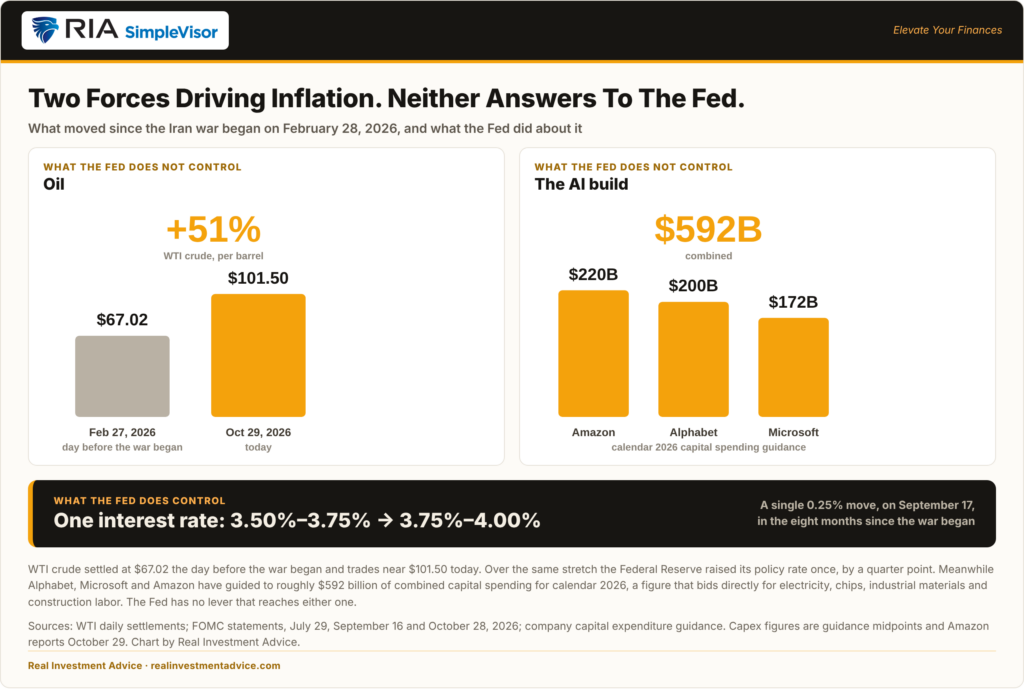
This unprecedented wave of corporate investment is acting as a dual-edged sword for the broader macroeconomy. On one hand, it serves as a powerful engine for gross domestic product (GDP) growth, sustaining economic expansion even as traditional interest-rate-sensitive sectors feel the pinch of restrictive monetary policy. On the other hand, the sheer scale of liquidity deployment infuses the economy with persistent demand, exerting upward pressure on prices and complicating the Federal Reserve’s path toward its targeted inflation rate.
The central bank exercises no authority over these corporate boardrooms. It does not vote on whether technology giants allocate $600 billion or $400 billion toward artificial intelligence infrastructure, data centers, and semiconductor procurement. Because these structural investments are financed through robust corporate balance sheets and strategic debt issuance rather than traditional consumer credit, they remain largely insulated from standard monetary tightening channels. Consequently, the Federal Reserve finds itself attempting to steer an economy heavily influenced by forces it cannot regulate.
Alphabet’s Earnings Volatility and Market Reaction
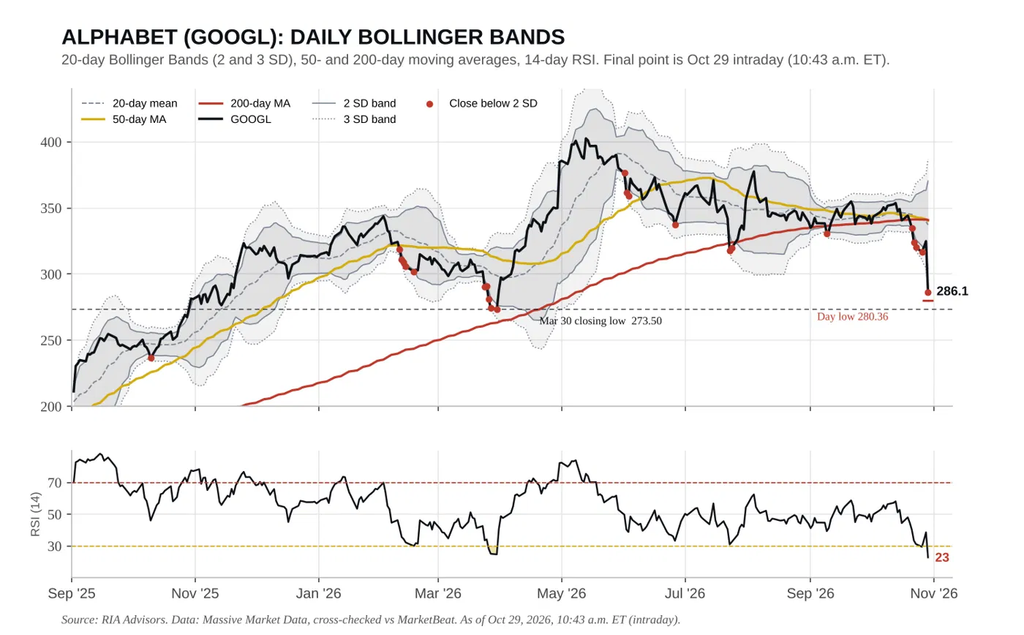
The tensions underlying the modern technology landscape came to a head during the final week of October 2026, when mega-cap earnings reports dominated financial news cycles. Alphabet’s quarterly financial disclosures triggered a sharp response on Wall Street, sending its shares tumbling nearly 12% in a single session—the stock’s worst daily performance since the pandemic-driven market sell-off of March 2020.
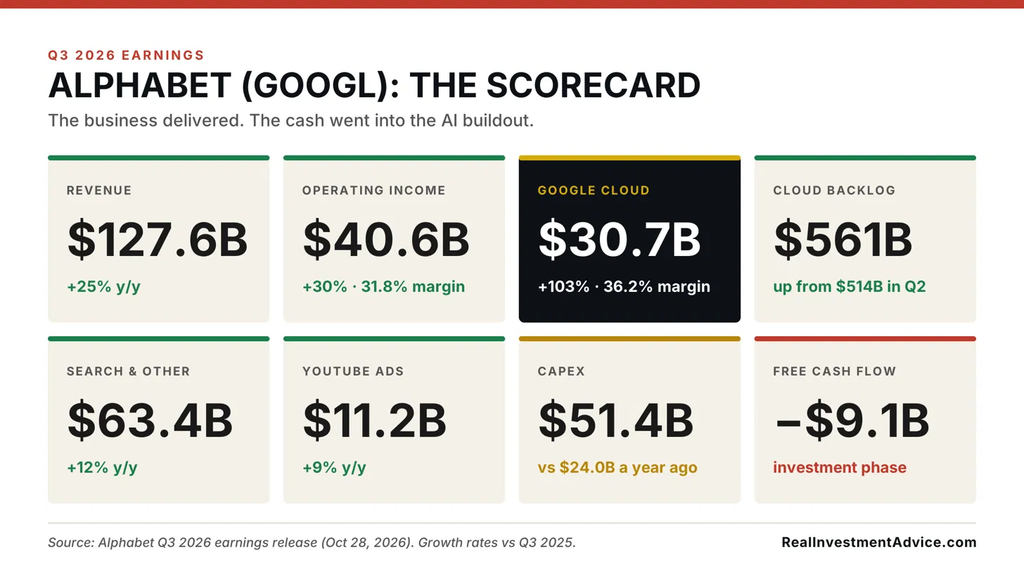
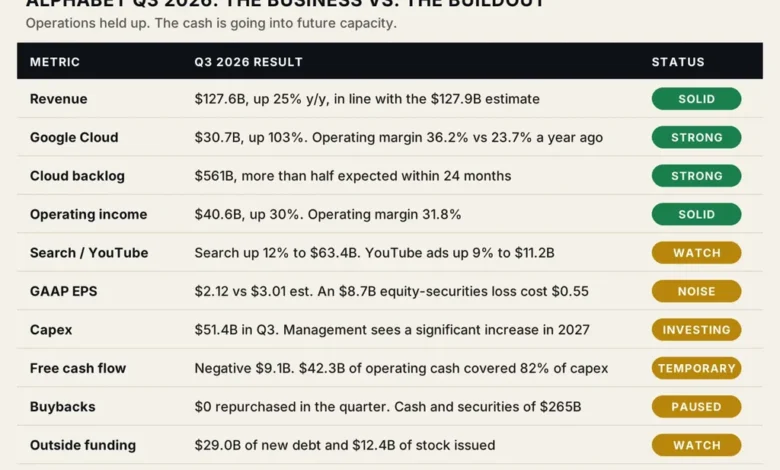
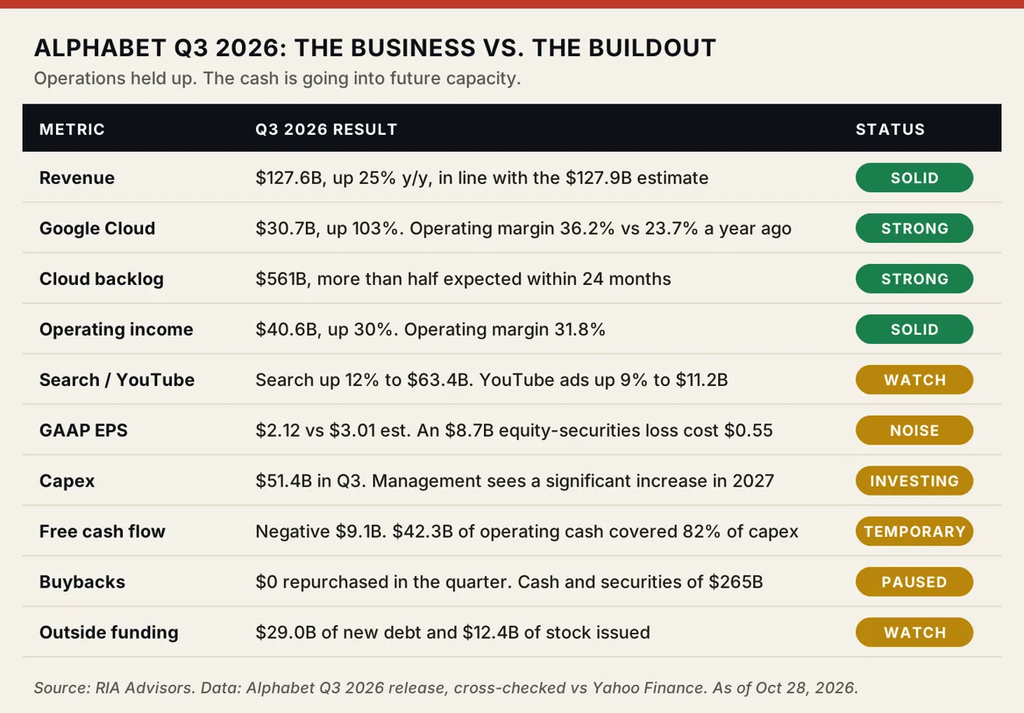
A granular examination of Alphabet’s financials reveals a complex narrative of robust operational growth juxtaposed with heavy investment burdens. On the positive side, Google Cloud revenue doubled year-over-year to reach $30.7 billion, while its operating margin expanded from 24% to an impressive 36%. Furthermore, the division’s total cloud backlog climbed to a staggering $561 billion, underscoring robust long-term enterprise demand. However, the company reported a headline GAAP earnings miss, posting $2.12 per share against a consensus expectation of $3.01. This shortfall was primarily driven by an $8.7 billion non-cash, paper loss on equity holdings—an accounting adjustment rather than a fundamental operational deterioration.
Market participants, however, reacted sharply to the company’s cash flow metrics. Capital expenditures surged to $51.4 billion for the quarter, and management’s forward guidance indicated that spending would increase substantially through 2027. As a result, free cash flow dipped into negative territory at $9.1 billion, share repurchases were temporarily halted, and the firm raised $29 billion in debt alongside $12.4 billion in new stock issuance.
This capital-intensive phase reflects the immense cost of building out artificial intelligence infrastructure. Alphabet’s operating cash flow of $42.3 billion still covered roughly 82% of the quarter’s capex, and the firm retains approximately $265 billion in cash and marketable securities. This positions the tech giant far differently from smaller speculative cloud operators dependent on external debt financing. Nevertheless, the immediate market reaction underscored investor anxiety regarding near-term cash burn and the longer-term depreciation risks associated with aggressive hardware accumulation.
Diversification and the Evolution of Tech Revenue
Beyond cloud computing and capital expenditures, Alphabet’s earnings report provided fresh data regarding the long-standing bear thesis surrounding search engine monetization. For the past two years, market skeptics argued that conversational artificial intelligence assistants—such as Google’s Gemini—would cannibalize traditional search traffic and erode core advertising revenue.
The third-quarter data offered little support for that bearish hypothesis. Google Search and related advertising revenues expanded by 12% year-over-year to $63.35 billion. YouTube advertising revenue climbed 9% to $11.21 billion, while the Google Network publisher business grew 1% to $7.46 billion. In total, advertising revenue reached $82.0 billion, representing a 10.5% increase compared to the same period in the previous year.
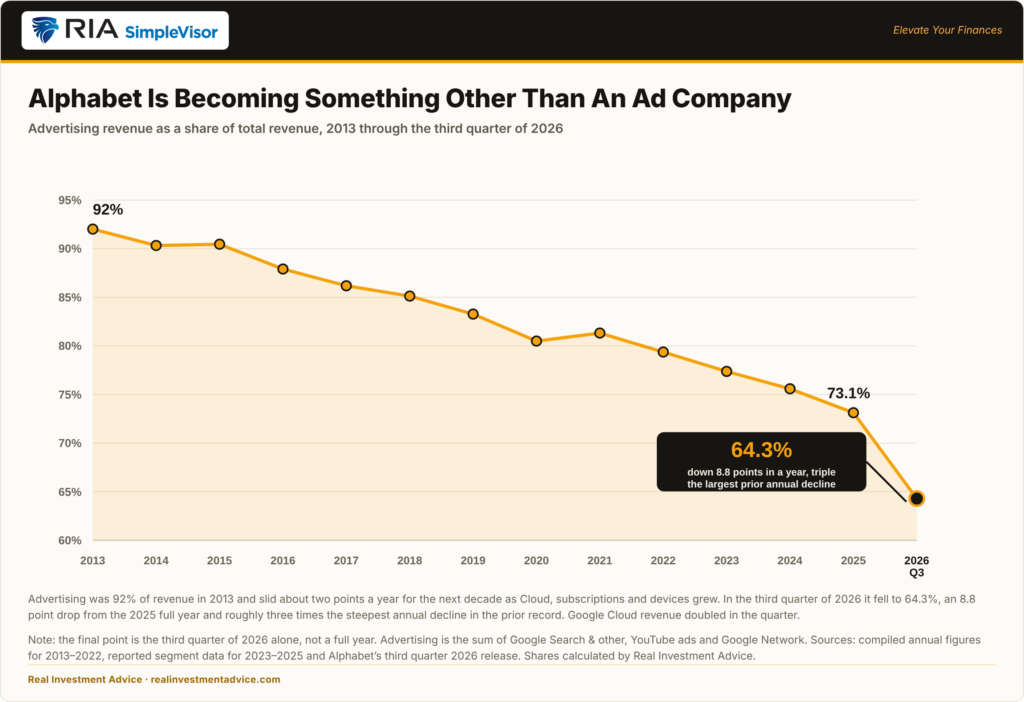
Overall, Alphabet’s total revenue grew by an impressive 25% for the quarter, with advertising accounting for a significant portion of the absolute dollar expansion, complemented heavily by the explosive growth of Google Cloud. These figures illustrate that Alphabet is successfully transforming into a diversified technology conglomerate rather than a pure-play advertising utility. As artificial intelligence integration deepens, the central debate for market analysts has shifted away from near-term ad-revenue displacement and toward the long-term earnings potential of an AI-driven digital economy.
Economic Calendar and Macroeconomic Data Releases
As October 2026 drew to a close, financial markets digested a busy slate of economic data and corporate reports designed to gauge the health of the broader economy. The final trading session of the month brought critical updates concerning labor costs and regional manufacturing activity.
According to data released by the Bureau of Labor Statistics, the Employment Cost Index (ECI) for the third quarter rose by 0.7%, coming in slightly below the consensus economist forecast of 0.8% and down from the prior quarter’s reading of 0.9%. ECI wages and salaries for the same period increased by 0.8%, pointing toward a continued, orderly moderation in wage pressures across the domestic workforce. Meanwhile, the Chicago Purchasing Managers’ Index (PMI) for October registered at 56.0, marginally below consensus expectations of 56.1 and easing slightly from September’s print of 58.8, signaling ongoing but stabilizing regional manufacturing activity.
In the corporate sector, the conclusion of mega-cap earnings week featured major oil conglomerates reporting their quarterly financials. ExxonMobil (XOM) posted earnings per share of $4.03 on revenues of $104.4 billion, while Chevron (CVX) reported an EPS of $4.83 on revenues of $60.7 billion. Healthcare giant AbbVie (ABBV) also reported earnings before the opening bell, posting an EPS of $3.77 on revenues of $17.3 billion.

Federal Reserve officials maintained their scheduled commentary following the central bank’s decision to hold benchmark interest rates steady. St. Louis Fed President Alberto Musalem delivered scheduled remarks, addressing ongoing economic resilience, labor market normalization, and the persistent challenges of navigating inflation in an environment marked by external supply shocks. With October concluding, institutional portfolios also experienced traditional month-end rebalancing flows, adding volatility into the closing bell.
Strategic Implications and Market Outlook
The convergence of geopolitical energy shocks, multi-billion-dollar corporate capital expenditure cycles, and central bank rhetoric creates a uniquely complex environment for investors and policymakers alike. The Federal Reserve’s persistence in promising an absolute outcome like price stability—while structural drivers of inflation remain outside its direct sphere of influence—leaves monetary authorities vulnerable to credibility gaps.
For equity markets, the recent volatility observed in high-growth technology shares highlights the delicate balance between aggressive long-term infrastructure investment and near-term shareholder returns. While capital-intensive buildouts are a necessary phase of technological evolution, they introduce temporary cash-flow strains and heightened depreciation risks that financial markets are forced to reprice in real time.
Ultimately, macroeconomic stability cannot be guaranteed solely through policy statements when global supply chains and private sector innovation cycles operate on independent trajectories. As financial markets navigate the final months of the year, market participants will continue to monitor whether the Federal Reserve adjusts its communication strategy to better align with the complex, uncontrollable realities of the global economy.