What Are Diffusion Language Models and Why Are They Different From GPT?

The landscape of generative artificial intelligence is undergoing a significant architectural shift as researchers move beyond the traditional autoregressive paradigm that has defined the Large Language Model (LLM) era. While models like GPT-4, Claude, and Llama rely on a token-by-token, left-to-right generation strategy, a new class of architectures known as diffusion language models is gaining traction for its potential to accelerate inference and rethink how text is constructed. By treating text generation as an iterative refinement process rather than a linear sequence completion task, these models are challenging the long-standing assumption that language must be generated one word at a time.
The Evolution of Diffusion: From Pixels to Prose
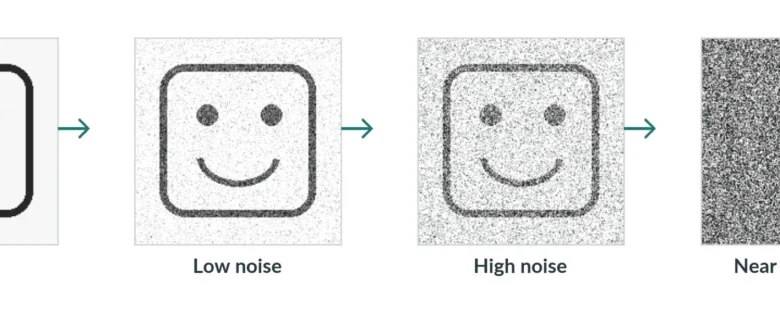
The concept of diffusion originated in the domain of computer vision, fundamentally changing how generative models create imagery. The landmark 2020 paper, Denoising Diffusion Probabilistic Models (DDPM), introduced a methodology where a model learns to reverse the process of adding Gaussian noise to an image. By starting with a canvas of pure random noise, the model iteratively denoises the pixels until a coherent, high-fidelity image emerges.
For years, the application of this concept to text remained theoretical and technically fraught. Unlike images, which rely on continuous values—where a slight adjustment to a pixel’s color is visually imperceptible—text is fundamentally discrete. A token ID represents a specific word or sub-word unit in a finite vocabulary. Adding "noise" to an integer index does not result in a "nearby" word in a meaningful way, creating a barrier to adopting standard diffusion techniques for natural language processing.
However, the year 2025 marked a pivotal shift in research. Through projects such as LLaDA, Mercury, and the integration of diffusion techniques into Google’s Gemini and DiffusionGemma architectures, the field demonstrated that text could indeed be generated via iterative refinement. These models do not simply append the next word; they propose a global structure for a sequence and progressively fill in or correct the gaps, offering a compelling alternative to the serial dependency limitations of traditional LLMs.
Autoregressive Models and the Serial Dependency Problem
To understand the disruption caused by diffusion models, one must first analyze the constraints of the autoregressive approach. GPT-style models function on a probabilistic factorization: $p(x) = prod_i=1^N p(x_i mid x1, dots, xi-1)$. This means the probability of the $N$-th word is entirely dependent on every word that preceded it.
During the training phase, this is efficient because "teacher forcing" allows the model to process all tokens in parallel. However, during inference, this architecture faces a critical bottleneck: the "serial dependency problem." Because the model requires the output of the previous step to predict the next, it cannot parallelize the generation of a sentence. If a response requires 500 tokens, the system must execute 500 sequential passes through the neural network. This latency becomes increasingly problematic as models grow in complexity and context window size.
Diffusion models disrupt this by decoupling the generation process from a rigid temporal sequence. Instead of starting with the first word and moving to the end, a diffusion model initializes an output sequence with masked tokens. It then iteratively refines these masks, often predicting multiple tokens across different positions simultaneously. This allows the model to "glance" at the entire structure of the sentence, potentially identifying errors or inconsistencies in the middle of a paragraph and correcting them in subsequent denoising steps—a feat that is inherently impossible for a standard autoregressive model that cannot "see" what it hasn’t written yet.
The Mechanism of Masked Diffusion
The shift from continuous diffusion (used in images) to discrete diffusion (used in text) relies heavily on the "masking" technique. In this paradigm, a sentence is progressively corrupted by replacing tokens with a special [MASK] identifier.
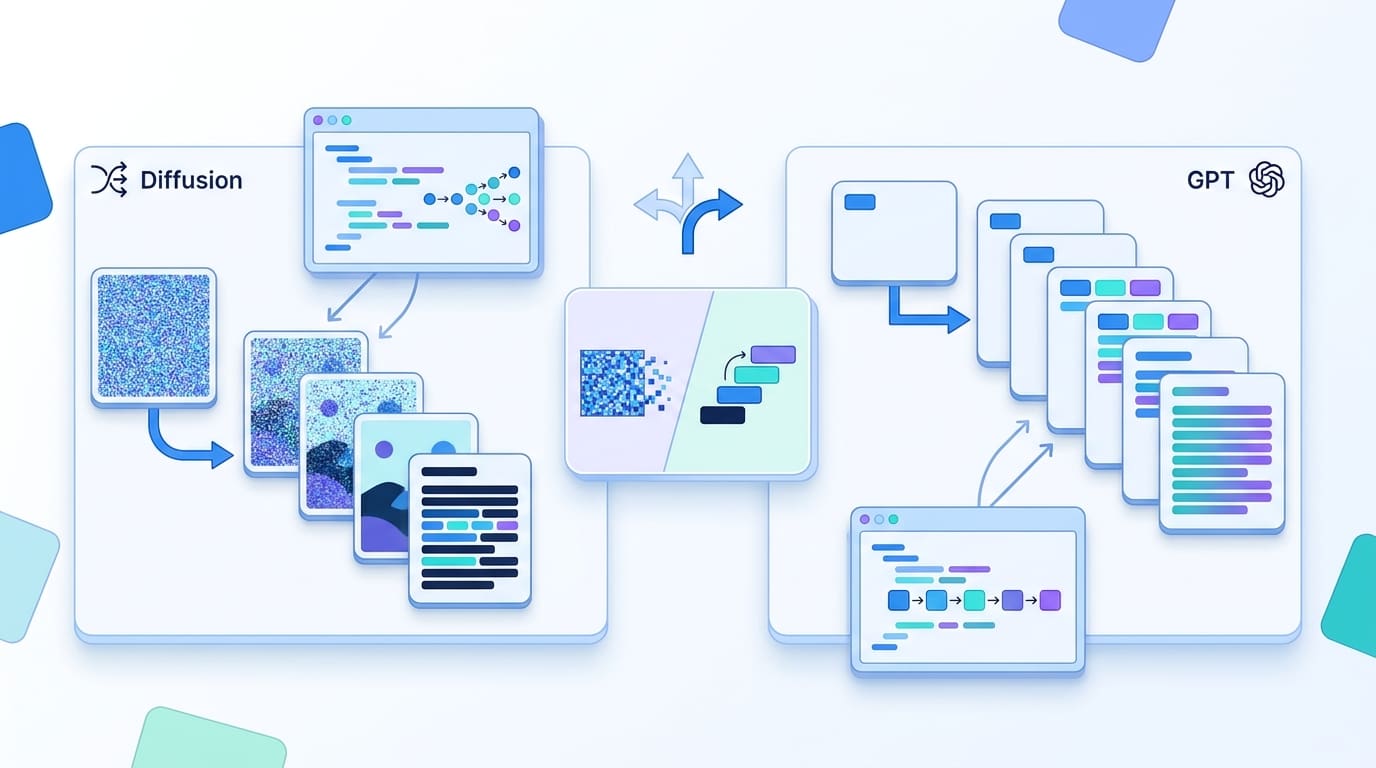
- Forward Process: The model is trained on sequences where a varying percentage of the tokens are masked. At a high noise level (t=1), a sentence might be almost entirely masked. At lower levels (t approaches 0), only a few tokens are hidden.
- Reverse Process: During training, the model acts as a denoising agent. It receives the masked sequence and attempts to predict the original, clean tokens. By doing this across thousands of variations, the model learns the statistical relationships between words and their context, effectively learning the "grammar" of the language without needing to read it in a linear fashion.
- Inference: At runtime, the sampler initializes an empty, fully masked sequence. It makes an initial set of predictions for all positions, assigns confidence scores to those predictions, and commits the most certain tokens to the canvas. In subsequent rounds, it revisits the remaining
[MASK]tokens, using the previously committed context to refine the uncertain sections.
This iterative nature allows for "revision." If a model initially predicts an awkward phrasing, it can technically re-mask and rewrite that section in a later diffusion step, allowing for a degree of internal self-correction that autoregressive models lack.
Broader Implications and Research Challenges
The emergence of diffusion in language processing has sparked a central debate: Do language models even need to generate one token at a time?
The implications for hardware utilization are significant. Because diffusion models can parallelize token generation, they are better suited for modern GPU architectures that thrive on batch processing rather than serial instruction execution. This could lead to a future where high-quality text generation is significantly faster, reducing the cost of inference for service providers and improving response times for end-users.
However, significant hurdles remain. One of the primary criticisms of diffusion models is the computational cost of the iterative process. While they avoid the serial dependency of GPT, they require multiple "passes" to refine the sequence. If the number of refinement steps is too high, the latency advantage over autoregressive models disappears. Researchers are currently focused on "distillation" techniques, aiming to shrink the number of denoising steps required to produce high-quality text from dozens down to just a few.
Furthermore, there is the challenge of "consistency." Because diffusion models can rewrite parts of the sequence during the denoising process, maintaining a stable, coherent narrative flow requires sophisticated sampling algorithms. Ensuring that the model does not "flip-flop" between different, equally valid, but contradictory words remains a focus of current development.
The Road Ahead: Hybrid Architectures
The consensus among industry researchers is that diffusion will likely not replace autoregressive models entirely in the short term. Instead, the future appears to be moving toward hybrid architectures. Many developers are exploring systems where an autoregressive model provides a "draft" of the content, and a diffusion-based model acts as a "refiner" or "editor," cleaning up the output and ensuring structural integrity.
As of 2026, the adoption of DiffusionGemma and similar technologies suggests that the industry is transitioning from a "one-size-fits-all" approach to a modularized view of generation. By separating the drafting process from the refinement process, engineers can optimize for both speed and quality.
While the mathematics of diffusion remains complex, the intuition is clear: by moving away from the rigid, one-way street of autoregressive generation, AI models are gaining the ability to think more holistically about the text they produce. Whether this leads to a total paradigm shift or remains a specialized tool for specific tasks, it marks the most significant architectural evolution in LLMs since the introduction of the Transformer itself. As research continues to accelerate, the question of whether we will eventually abandon token-by-token generation remains one of the most compelling frontiers in computer science.