WordPress Patches Critical Click2Shell Vulnerability That Enables Remote Code Execution Through Chained Theme Flaws

The global content management landscape faced a renewed security test as WordPress officially rolled out urgent patches to address a sophisticated set of core vulnerabilities. Among the most concerning discoveries is a security flaw dubbed "Click2Shell" by the security research firm pwn.ai. This vulnerability allows an attacker to weaponize a carefully crafted web link. When clicked by an authenticated administrator, the link silently installs a legitimate theme from the official WordPress.org directory without requiring any manual intervention or clicking of an installation prompt.
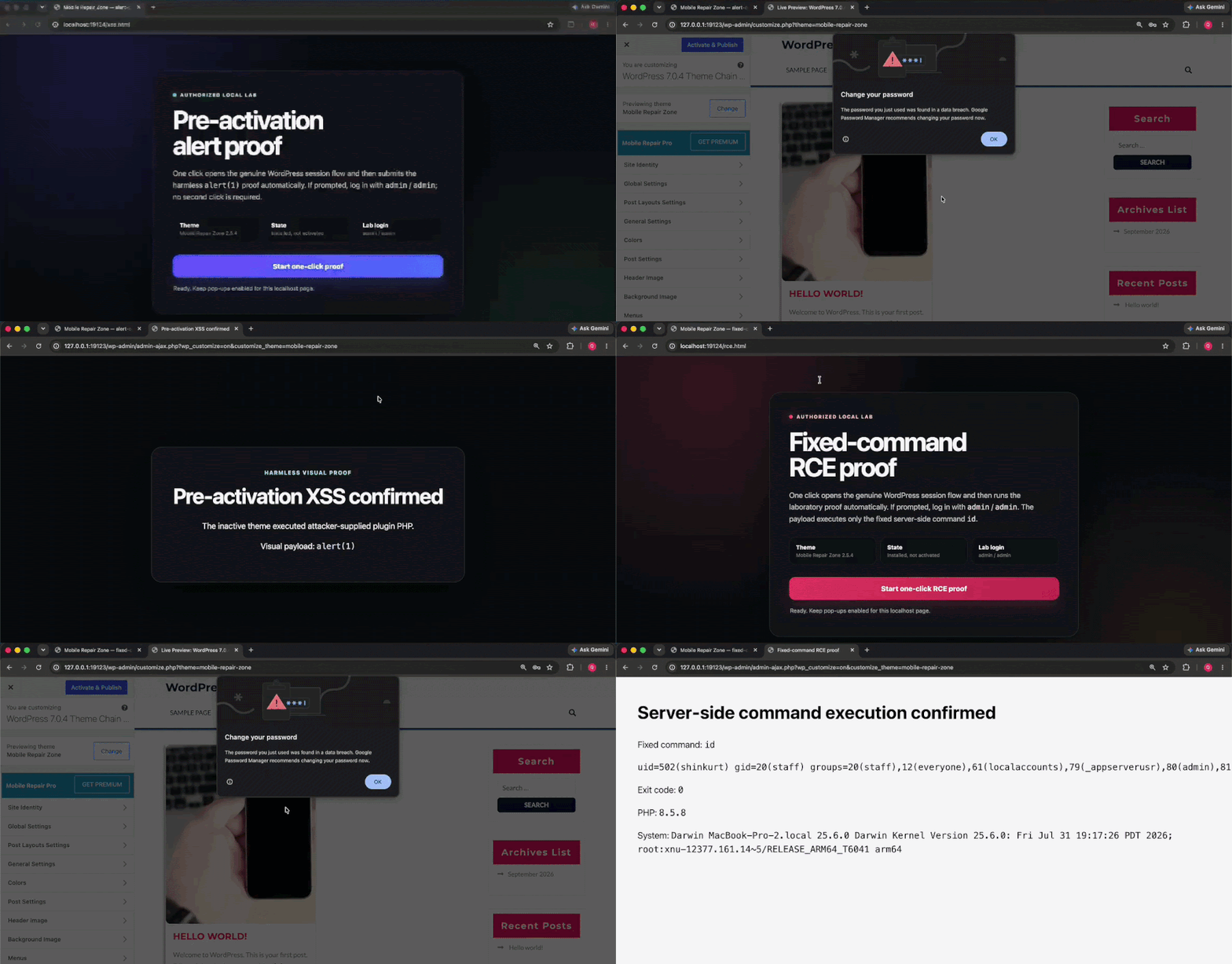
While the core vulnerability on its own is restricted to fetching and installing a pre-selected theme without executing arbitrary payloads, researchers demonstrated that it could be effectively chained with a secondary weakness within an installed theme. This combination successfully achieves full remote code execution (RCE) on the underlying server. Responding swiftly to the disclosures, WordPress released version 7.1.1 on September 17, implementing critical security fixes across multiple supported historical branches stretching back to version 4.7. Although no active exploits or in-the-wild campaigns leveraging Click2Shell have been detected at this time, security experts strongly urge administrators to apply the updates immediately.
The Mechanics of Click2Shell: Anatomy of a Forced Installation
The Click2Shell attack chain relies on a nuanced discrepancy in how different components of the WordPress environment interpret and handle incoming uniform resource locators (URLs). The vulnerability stems from a logical mismatch where the WordPress.org directory evaluates the parameter within a maliciously crafted link as a standard, benign theme name, subsequently returning a legitimate theme package.
Simultaneously, the administrative victim’s browser reuses the original text—complete with its punctuation and auxiliary parameters—within internal scripts designed to parse and isolate page elements. By appending specific, attacker-engineered characters to the link, the payload manipulates this parsing logic, effectively redirecting the browser’s execution flow toward the administrative dashboard’s "Install" button. WordPress’s native scripts then automatically trigger a simulated click event.

Because the target administrator is already logged into the WordPress dashboard during this process, their active session inadvertently supplies all necessary permissions and cryptographic security tokens. Consequently, the attacker needs neither credentials nor direct authorization tokens to initiate the theme deployment. Once downloaded, the newly installed theme remains dormant and switched off by default, ensuring that the visual layout of the website stays entirely unchanged and masking the compromise from the site owner.
Achieving Code Execution: Chaining the Core Flaw with Vulnerable Themes
A silent, dormant theme installation alone is insufficient to compromise a server. However, the architecture of WordPress introduces pathways where inactive code can be parsed or invoked. Specifically, when the platform constructs a preview of a site within its built-in Customizer tool, it possesses the capability to load a theme’s PHP scripts even if that theme has not been actively activated on the production site.
To escalate the Click2Shell flaw into a critical system compromise, the researchers at pwn.ai paired the core installation bug with a secondary vulnerability found in a third-party product named the Mobile Repair Zone theme. This specific theme contained an insecure background request handler that accepted arbitrary web addresses via HTTP requests, downloaded remote packages, and executed the embedded code directly—all while completely bypassing permission validations and cryptographic security token checks.
When chained immediately following the forced, automated installation of this vulnerable theme, the background handler permitted the attackers to execute arbitrary system code on the host server. Because of this multi-stage escalation, researchers rated the initial forced-installation flaw in the WordPress core as a high-severity issue with a CVSS score of 7.1. Conversely, the complete end-to-end attack chain resulting in remote code execution was classified as critical, receiving a severe CVSS score of 9.6.
Official Response and Remediation Measures
WordPress security maintainers addressed the core vulnerability in version 7.1.1, alongside a broader maintenance and security package. Official release documentation notes that the vulnerable behavior affects WordPress installations spanning from version 6.0 up to the iterations immediately preceding the patch. Furthermore, because WordPress maintains backward security support, backported patches were issued for older supported branches dating all the way back to version 4.7.

In its official advisory, WordPress described the vulnerability with measured terminology, stating that "Specially crafted URLs can automatically install and preview an inactive theme from WordPress.org." While a formal Common Vulnerabilities and Exposures (CVE) identifier had not been assigned at the time of publication, industry tracking sources indicate that one is forthcoming.
For website administrators and hosting providers, the primary mitigation strategy is updating the WordPress core to version 7.1.1 immediately. Websites configured to receive background automatic updates will incorporate the fix autonomously. In scenarios where immediate patching is not feasible, administrators must exercise extreme caution regarding links opened while authenticated as high-privileged users. Neither WordPress nor the discovering security firm published isolated workarounds, emphasizing that upgrading the core software is the definitive method to neutralize the attack vector, regardless of which themes happen to be installed on a given instance.
Broader Context and Increasing Scrutiny on WordPress Core Security
The disclosure of Click2Shell highlights an ongoing trend of advanced vulnerability research targeting the foundational architecture of the world’s most popular content management system. This incident represents the second major core vulnerability uncovered and disclosed by pwn.ai within a matter of weeks.
In August, WordPress patched a similarly structured pre-authentication Cross-Site Scripting (XSS) vulnerability discovered by the same research group. That earlier flaw could also be manipulated and chained to achieve code execution, and similarly prompted differing perspectives between the discoverers and the vendor regarding the true scope of the risk.
However, security analysts distinguish these findings from other recent high-profile vulnerabilities, such as the "wp2shell" core flaw disclosed in July. Unlike Click2Shell and its predecessor—which necessitate administrative authentication and user interaction such as clicking or opening a crafted link—wp2shell required neither user authentication nor interaction. Notably, the U.S. Cybersecurity and Infrastructure Security Agency (CISA) has previously cataloged wp2shell as actively exploited in real-world cyberattacks, a status that Click2Shell has fortunately avoided thus far.

Implications for Web Administrators and the CMS Ecosystem
The emergence of Click2Shell and similar complex attack chains underscores a shifting paradigm in web application security. Modern vulnerability research has moved beyond simple input validation bypasses, focusing instead on complex logic flaws. These sophisticated vulnerabilities exploit the subtle discrepancies between how different software subsystems interpret data, how administrative permissions are inherited, and how optional features—such as theme previews and background handlers—interact.
For enterprise organizations, digital agencies, and individual site owners alike, these developments reinforce fundamental cybersecurity best practices. Administrators are advised to adopt the principle of least privilege, avoiding the permanent use of administrative accounts for routine tasks such as content creation or basic moderation. Additionally, rigorous asset management—including regular audits of installed plugins and themes, prompt removal of inactive or abandoned software components, and the implementation of automated update protocols—remains vital to defending against multi-stage web application attacks. As threat actors continue to refine sophisticated chaining techniques against ubiquitous platforms, proactive patching and defense-in-depth strategies are more critical than ever to maintaining secure digital infrastructures.