The 2026 Midterm Elections Deliver a Stunning Rebuke to President Trump, Remaking Washington and Upending Global Financial Markets

The political landscape of the United States shifted dramatically this week following the conclusion of the 2026 midterm elections, handing a decisive and unexpected majority in both the Senate and the House of Representatives to the Democratic Party. This sweeping electoral outcome represents a severe and direct rebuke of the domestic and foreign agendas pursued by President Donald Trump during the first two years of his administration. Voters across the nation, increasingly squeezed by persistent inflationary pressures, soaring energy bills, and the economic fallout of aggressive trade policies, delivered a verdict that has immediately transformed Washington into a theater of divided government and sent powerful shockwaves through global financial markets.
The scale of the Democratic victory caught pollsters and political strategists off guard. Historically, midterm elections frequently serve as a referendum on the sitting president, punishing the incumbent party; however, the magnitude of the swing in traditionally reliable Republican strongholds highlights deep voter fatigue regarding the administration’s handling of the economy. Political analysts note the profound irony of these results: the very issue that propelled President Trump back into the White House in the 2024 general election—the punishing cost of living—has now become the primary catalyst for his party’s downfall in Congress.

Chronology and Escalation of Economic Pressures
To understand the trajectory that led to this dramatic electoral shift, one must examine the economic and geopolitical milestones of the preceding twenty-four months. Following the inauguration of President Trump in January 2025, the administration swiftly implemented an ambitious and disruptive economic agenda characterized by sweeping protectionist measures.
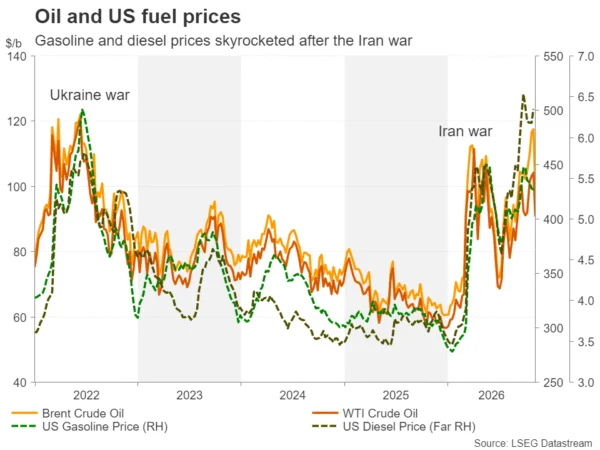
In early 2025, the administration introduced the controversial “Liberation Day” tariffs, placing broad levies on major trading partners. While intended to revitalize domestic manufacturing, the immediate consequence was a sharp increase in consumer goods prices, supply chain friction, and retaliatory measures from key international allies. Simultaneously, escalating tensions in the Middle East—culminating in direct military engagement with Iran—severely disrupted global petroleum supplies. By the summer of 2026, crude oil prices had surged, pushing gasoline and diesel costs for American consumers to multi-year highs.
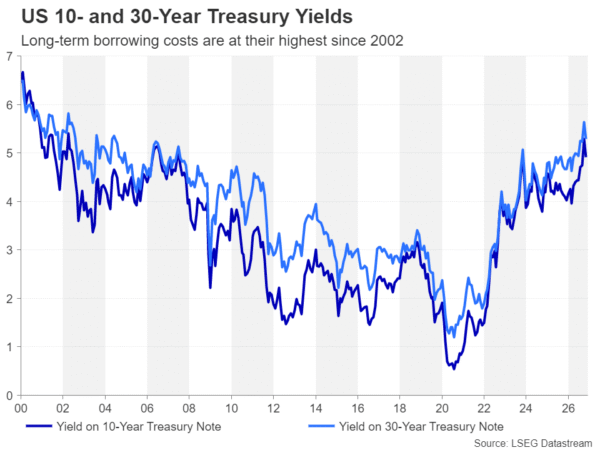
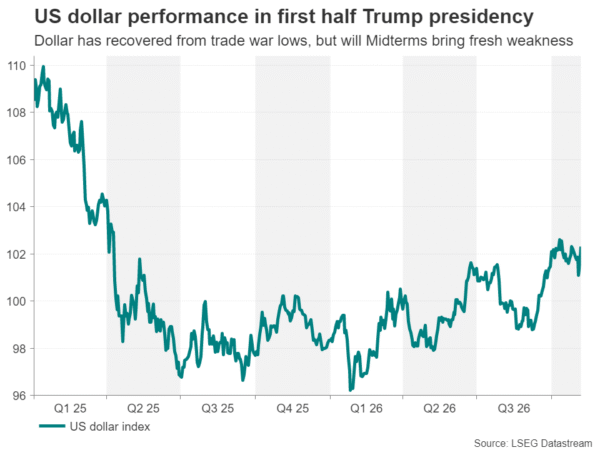
Compounding these inflationary drivers, the bond market suffered a historic rout in September 2026. Long-term U.S. Treasury borrowing costs climbed to levels not witnessed since 2002. This spike was fueled by a dangerous combination of sticky inflation expectations, aggressive monetary policy tightening by the Federal Reserve, and a massive issuance of sovereign and corporate debt to finance ballooning federal deficits. While the U.S. dollar remained remarkably resilient—clinging tightly to its safe-haven status amid global foreign exchange volatility—the broader domestic economy groaned under the weight of high interest rates and diminished purchasing power, setting the stage for the November electoral reckoning.
Legislative Gridlock and Fiscal Implications
With Democrats now firmly in control of Capitol Hill, the dynamic of President Trump’s remaining two years in office has shifted from a period of unbridled executive action to one characterized by institutional gridlock and intense negotiation. While the president retains the formidable constitutional power to veto major legislation, the legislative branch is now uniquely positioned to check the administration’s ambitions.
Financial markets have reacted with cautious optimism regarding one specific consequence of the Democratic sweep: the reduced likelihood of further fiscal expansion. Under a divided government, the runaway budget deficits that previously alarmed bond traders are expected to moderate. Major tax cuts beyond what was already secured in earlier legislative packages will face an impenetrable wall in the House and Senate. Consequently, immediate post-election trading saw U.S. Treasury yields retreat from their recent multi-year highs, as the probability of catastrophic debt-ceiling showdowns or unconstrained spending sprees diminished.
Nevertheless, immediate fiscal hurdles loom large on the legislative calendar. Lawmakers face a critical deadline on December 11 to pass a comprehensive federal funding bill before newly elected members officially assume office. Economists and congressional aides warn that these lame-duck negotiations could prove intensely contentious, raising the genuine specter of a temporary government shutdown unless leadership agrees to a stop-gap continuing resolution to kick the fiscal can down the road. Furthermore, negotiations to raise the statutory debt limit, anticipated during the first half of 2027, will require bipartisan compromise despite the Democratic majorities in both chambers.
Sectoral Realignments on Wall Street and Corporate America
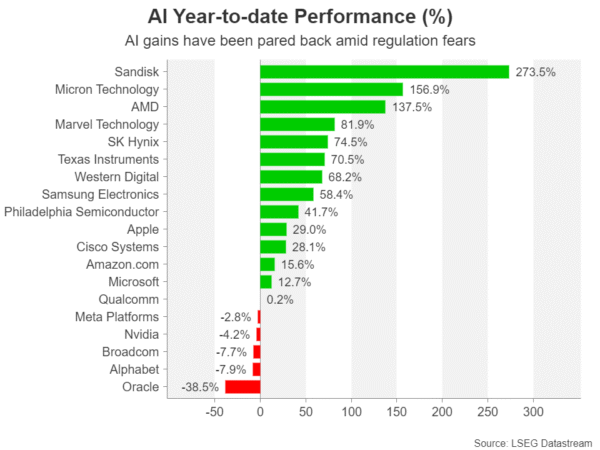
The political upheaval has triggered a profound reallocation of capital across Wall Street, creating distinct winners and losers among various market sectors. Equity markets are currently pricing in a slower pace of economic growth, largely driven by the expectation that a Democrat-controlled Congress will aggressively pursue stricter regulatory oversight, particularly regarding the booming artificial intelligence (AI) sector.
For months, the rapid expansion of AI infrastructure and data centers has been a primary engine of American corporate growth. However, Democratic lawmakers—backed by state-level officials in key regions—have signaled an intent to impose environmental, energy, and operational regulations on data center developments to curb surging electricity consumption and address environmental concerns. While this potential dampening of AI capital expenditure has sent shockwaves through semiconductor manufacturers and specialized chipmakers facing softening demand, it has paradoxically provided relief to Big Tech giants. Investors anticipate that moderated AI spending will lower corporate overhead, while a less aggressive Federal Reserve rate-hiking path will ease borrowing costs.
Beyond technology, the healthcare and financial sectors are anticipated to benefit from the new congressional alignment. Democrats are expected to push for the restoration of expired Affordable Care Act subsidies and increased healthcare spending, providing a tailwind for pharmaceutical and healthcare providers. Conversely, traditional energy and defense stocks face heightened headwinds. With Republicans quietly acknowledging that the military campaign against Iran directly contributed to their electoral defeat, bipartisan pressure is mounting to de-escalate the Middle Eastern conflict. Consequently, defense contractors and traditional fossil-fuel producers anticipate a more restrictive fiscal environment and lower geopolitical risk premiums.
Geopolitical Shifts and the Foreign Policy Calculus
Perhaps the most immediate international implication of the midterm outcome centers on U.S. foreign policy in the Middle East. President Trump’s military posture toward Iran has faced relentless criticism from the American public due to its direct correlation with domestic energy inflation.
In the wake of the election, international oil prices experienced a sharp downward correction, reflecting market sentiment that a prolonged or expanding military campaign is now politically untenable. With both Democrats and chastened Republicans recognizing the domestic electoral cost of the war, the executive branch faces unprecedented legislative pressure to pursue a durable ceasefire and curtail offensive operations. While the risk of sudden Iranian escalation remains a volatile wildcard, financial analysts increasingly price in a swifter diplomatic resolution to the conflict. This shift not only relieves pressure on global energy markets but also reinforces the Federal Reserve’s capability to maintain a more measured interest rate trajectory over the coming twelve months.
Commodities, Currencies, and Cryptocurrencies
The macroeconomic cocktail of lower Treasury yields, a potentially softer U.S. dollar, and stabilizing or declining oil prices has generated an intensely supportive environment for gold and other precious metals. Bullion prices have found a strong technical and fundamental floor as the political landscape shifts, though analysts caution that a prolonged equity market correction could occasionally trigger short-term liquidation of gold holdings by institutional investors meeting margin calls.
Meanwhile, the legislative agenda for digital assets has also been cast into uncertainty. Prior to the midterms, momentum was building around the passage of the CLARITY Act to establish a comprehensive regulatory framework for cryptocurrencies. Under a Democratic-led Congress, lawmakers are expected to resurrect the bill with substantially tougher amendments. These revisions will likely target tighter anti-money laundering provisions, enhanced consumer protections, and explicit restrictions on cryptocurrency transactions involving executive branch officials and their business associates. While regulatory clarity remains fundamentally constructive for major tokens like Bitcoin and Ether, the certainty of legislative delays means that crypto markets may experience prolonged consolidation through at least 2028.
Conclusion and Outlook for the Road Ahead
As Washington prepares for the swearing-in of the new Congress, the full ramifications of the 2026 midterm elections will take months to crystallize. The transition to a divided government introduces a complex array of checks and balances that will undoubtedly constrain the executive branch’s economic and foreign policy ambitions.
While investors must navigate the immediate uncertainties of year-end budget negotiations and the shifting regulatory landscape surrounding technology and energy, the broader structural environment points toward fiscal prudence, a moderation of aggressive monetary tightening, and a recalibration of America’s global engagements. The voters have spoken, delivering a profound message of economic exhaustion and demanding a course correction that will shape the trajectory of the United States economy for the remainder of the decade.
Related posts: