De-anonymizing Qilin: How Digital Footprints Led Investigators to the Mastermind Behind the World’s Most Active Ransomware Operation

The relentless expansion of ransomware-as-a-service (RaaS) operations has presented a persistent challenge to global law enforcement and cybersecurity agencies. Among the myriad syndicates dominating the modern threat landscape, the Russia-based cybercrime collective Qilin has rapidly ascended to the pinnacle of illicit productivity. According to a comprehensive Q3 threat intelligence report published by cybersecurity firm NCC Group, Qilin claimed at least 365 victim organizations in a mere three-month span, cementing its status as the world’s most industrious ransomware affiliate program.
Despite operating within the relative sanctuary of Eastern Europe and employing sophisticated operational security (opsec) measures, even elite threat actors are susceptible to cumulative digital missteps. A meticulous investigation drawing upon intelligence from platforms such as Intel 471, Flashpoint, Spycloud, Constella Intelligence, and the AI-driven de-anonymization tool IntelHawk has bridged a decade of online aliases. This convergence of cyber threat intelligence, historic forum memberships, and leaked government databases points directly to a 36-year-old man from St. Petersburg, Russia: Aleksey Mikhailovich Yakovtsev.
The Rise of Qilin and Its Lucrative Affiliate Ecosystem
First emerging under its current moniker in September 2022, Qilin quickly established a formidable reputation within the underground economy by aggressively courting skilled affiliates. The group incentivizes external hackers to breach corporate networks by offering an exceptionally generous split, traditionally yielding at least 80 percent of any extortion payment to the affiliate, while the core administrative team retains the remainder.
Qilin operates primarily under a "double extortion" model. Affiliates infiltrate corporate systems, exfiltrate sensitive proprietary data, and subsequently deploy encryption payloads. If victims refuse to negotiate or pay the ransom demand, the stolen data is leaked publicly on dedicated extortion portals. Unlike many of its Russian-speaking counterparts that maintain insular recruitment policies, Qilin has historically maintained an open-door policy for English-speaking affiliates. Communications intercepted by researchers indicate that Qilin’s leadership has actively collaborated with prominent cybercriminal ecosystems, including the disruptive affiliate networks Scattered Spider and the RansomHub RaaS platform.
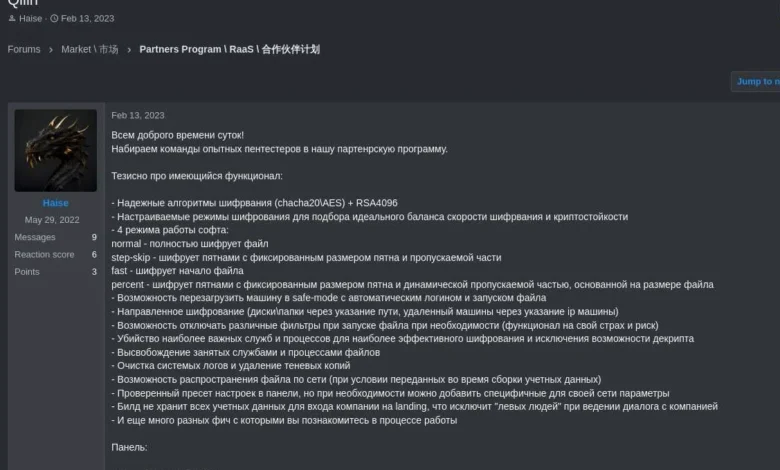
At the helm of this sprawling criminal enterprise is an administrator who operates under the primary handle "Haise." While changing monikers is a standard opsec practice designed to sever ties with compromised or poorly maintained historical identities, cybercriminals frequently trip over the administrative requirements of joining elite, vetted forums. To gain admission into exclusive underground communities, prospective members must often reference past handles and credentials, creating a permanent bridge between their historical and contemporary personas.
A Decade-Long Digital Trail: From Minor Fraud to Major Extortion
The de-anonymization of the Qilin administrator did not happen overnight; rather, it represents the culmination of a multi-year digital footprint that spans nearly a decade of underground activity. According to indexing by the cyber intelligence platform Intel 471, an individual utilizing the handle Haise formally applied for membership in June 2022 to RAMP (Russian Anonymous Marketplace), a tightly guarded cybercrime forum specifically established as a sanctuary for ransomware affiliate programs.

Direct messages extracted from RAMP—which was ultimately seized by the Federal Bureau of Investigation (FBI) in January 2026—reveal that the forum’s administrator approved Haise’s application while explicitly cross-referencing the applicant with a Telegram username: Alexbigboss44.
Pivoting the investigation to the Telegram handle Alexbigboss44 unspooled a deeper historical timeline. Security platform Flashpoint noted that Alexbigboss44 was a prolific participant across various cybercriminal forums and instant messaging channels, specializing primarily in the illicit acquisition and trade of web traffic, browser logs, and compromised corporate access accounts. Further data indicates that this user managed large-scale networks of traffickers, purchasing stolen data to fuel fraudulent advertising operations and online gambling schemes.
A retrospective search through Intel 471 records linked the Alexbigboss44 and Haise identities directly to an even older persona: "Rjun." Operating as early as 2020 on prominent Russian-language cybercrime forums such as Exploit and XSS, the user behind the Rjun handle utilized the exact same Telegram contact information.
According to IntelHawk founder and chief technology officer Leo Bogod, an algorithmic and stylometric analysis of these evolving identities highlights a clear career progression. The individual transitioned from a relatively novice arbitrageur and credit card fraudster between 2018 and 2019 into a sophisticated coordinator of complex cybercrime operations by 2020, eventually shifting deep focus toward malware deployment, botnet infrastructure, and high-stakes financial extortion.
Connecting the Alias to Real-World Identity Databases
The cryptographic and infrastructural links forged between Haise, Alexbigboss44, and Rjun ultimately provided investigators with the breakthrough needed to pierce the veil of anonymity. Intel 471 records established that when Rjun initially applied for membership across a suite of older Russian crime forums—including Darkmarket, Verified, and Zloy—the user registered with a specific email address: [email protected].
Identity threat protection firm Spycloud subsequently identified that this email address had historically utilized the weak password "Rjun132." Armed with this historical credential, researchers queried breach tracking platforms, discovering that the identical email address appeared within records tied to gosuslugi.ru, the official digital portal for state and municipal services in the Russian Federation.
In late 2025, gosuslugi.ru suffered a massive data breach that reportedly exposed more than 20 million citizen records, including full legal names, birth dates, and registered mobile telephone numbers. A cross-reference of the [email protected] address within the leaked gosuslugi dataset revealed that it belonged to Aleksey Mikhailovich Yakovtsev, born August 18, 1990, residing in St. Petersburg, Russia.
Corroborating Evidence: Education, Telephony, and Travel Records

Independent threat intelligence operations reinforced the validity of the gosuslugi leak. Records pulled from Russia’s federal education watchdog, Rosobrnadzor, established that Yakovtsev spent his formative grade-school years in Murmansk before pursuing higher education, ultimately earning a master’s degree in computing and information systems.
Further data correlation performed by Constella Intelligence and Flashpoint uncovered that the Telegram ID associated with Haise (ID 118329521)—which has recorded over 5,000 operational messages since 2018—is directly linked to the Russian mobile telephone number +79602347275. Pivoting on this phone number unveiled a web of auxiliary email addresses, including [email protected] and [email protected].
IntelHawk analysis determined that the telephone number is officially registered to Yakovtsev’s biological sister, and that Aleksey frequently utilized familial contact details and email variations as a buffer when registering across various commercial websites. Nevertheless, this operational overlap ultimately proved fatal to his digital anonymity.
Commercial travel databases obtained via Russian travel agencies—several of which have suffered corporate data breaches in recent years—further cemented the timeline and physical movements of the suspect. Flight manifests confirm that Aleksey Yakovtsev frequently traveled between St. Petersburg and Murmansk between 2013 and 2014. More recent transit records indicate that while Yakovtsev has not engaged in international air travel outside of the Russian Federation, he frequently commutes between St. Petersburg and Sochi, the prominent Black Sea resort city located approximately 1,200 miles to the south.
Independent verification of these findings was later mirrored by "GangExposed," an anonymous intelligence-tracking account on X (formerly Twitter) known for successfully deanonymizing high-profile ransomware operators. Utilizing the analytical frameworks provided by IntelHawk, independent researchers arrived at identical conclusions regarding the real-world identity of the Qilin administrator.
Broader Implications and Industry Reactions
Efforts by security researchers and journalistic outlets to reach Aleksey Yakovtsev via his known telephone numbers and email addresses for comment were unsuccessful. Given his geographic residence within the Russian Federation, where state tolerance of cybercrime targeting Western entities has historically provided de facto immunity from foreign extradition, immediate legal prosecution remains unlikely.
However, the exposure of Qilin’s administrative leadership underscores a profound shift in the cybersecurity landscape. The increasing fusion of AI-driven stylometry, graph database analysis, and massive historical breach leaks has dramatically eroded the operational security once enjoyed by elite threat actors. As intelligence platforms become increasingly adept at tracking individuals across multi-year alias evolutions, even the most industrious ransomware administrators face the constant, looming threat of public exposure, rendering their offline lives vulnerable to the very digital footprints they leave behind.
Related posts: