White House Devices Unknowingly Operating as Global Residential Proxy Nodes, Exposing Secure Network to Commercial Renters

Security researchers have uncovered a major operational security vulnerability within the Executive Office of the President, revealing that several White House staffers have inadvertently connected computers and mobile devices running residential proxy services to secure government networks. This configuration inadvertently rents out the internet addresses of the United States government to external buyers, allowing third parties to route their web traffic through the heart of the American executive branch.
The alarming discovery, made independently by threat intelligence firms Layer3 Intel and Synthient, highlights a widespread cyber hygiene blind spot that extends far beyond political offices and into vital global enterprise and public sector infrastructures. Among the services detected operating inside the White House network is Infatica, a residential proxy network whose founder has historic ties to Russian state-sponsored cyber operations targeting American electoral infrastructure.
The Detection and Network Exposure Timeline
The unauthorized proxy activity was first identified by Layer3 Intel while conducting routine telemetry analyses of global residential proxy networks. Researchers noticed multiple residential proxy nodes consistently beaconing outward from the designated internet address network reserved for the Executive Office of the President, formally tracked under Autonomous System number AS2650.
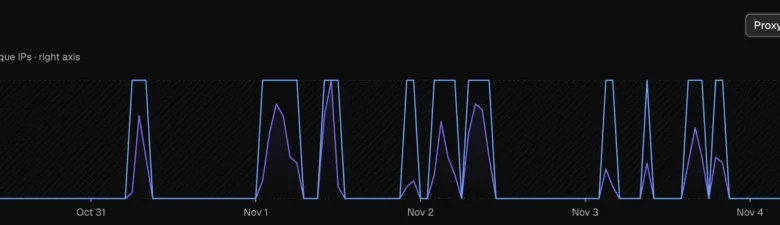
According to Layer3 Intel’s diagnostic logs, the proxy activity persisted across nearly a full month, recorded active between October 5 and November 3. During this observation window, automated probes and global rotating proxy sweeps demonstrated that traffic could successfully exit through the White House network exactly 236 times.
Layer3 Intel’s technical breakdown indicated that these proxy exit nodes operated across six distinct internet addresses mapped directly to the White House infrastructure. Intrressingly, this activity was not distributed evenly throughout the day. Telemetry data revealed that the vast majority of the proxy handshakes occurred during evening hours, specifically between 5:00 p.m. and midnight, a temporal pattern strongly suggesting the involvement of personal devices, laptops, or mobile phones brought into the complex by staffers after standard working hours.
Further investigation by Synthient linked these specific AS2650 exit nodes to multiple Windows 11 installations running Infatica. This proxy software is frequently bundled or covertly integrated into seemingly innocuous "free" mobile applications, browser extensions, and desktop software utilities. When users install these applications, they often unknowingly agree to terms of service that transform their local devices into active proxy endpoints for commercial traffic routing.
The Russian Connection and Historical Precedents
The involvement of Infatica has raised acute counterintelligence concerns within the cybersecurity community due to its corporate lineage. Infatica was founded by Vladimir Fomenko, a Russian national whose previous web hosting enterprise, King Servers, played a central role in high-profile cyberattacks against American democratic institutions.
In 2016, King Servers served as the hosting provider for six of the eight specific internet addresses utilized by Russian state-sponsored cyber actors to breach and compromise voter registration databases in Arizona and Illinois. While investigators have found no direct evidence that current White House proxy traffic is being actively exploited by foreign intelligence agencies for targeted espionage, the structural reality that a Russian-founded proxy service can openly utilize White House IP space has alarmed federal defense analysts.
Residential proxy networks operate by masking the true origins of internet traffic. When a customer purchases access to a residential proxy pool, their web requests are routed through real residential or corporate internet addresses. To any targeted website, the incoming traffic appears to originate from the proxy node—in this case, the Executive Office of the President—rather than from the actual user, effectively granting absolute anonymity to potentially malicious actors.
A Widening Ecosystem of Public Access
Perhaps most concerning to network administrators is that Infatica was not an isolated anomaly within the White House perimeter. Layer3 Intel’s extensive scans revealed that a staggering 28 separate residential proxy services were capable of routing traffic through the AS2650 network during the observation period.
"This is public access," the Layer3 Intel research team wrote in their published technical advisory. "Anybody can obtain it by signing up to a public residential proxy service, paying a few dollars and sending requests through it. We did not selectively target this network or try to make our probes exit from it. We caught this by chance, simply by requesting global rotating access through these services."
Ben Brundage, founder of proxy tracking firm Synthient, emphasized the trivial financial barrier required to infiltrate sensitive networks. "Some of these resellers sell bandwidth for as low as 60 cents a gigabyte, that means for less than a dollar you can gain access into some of the most confidential and trusted networks," Brundage stated in an interview with security journalist Brian Krebs. "The reseller ecosystem further enables this with any criminal able to buy access while skipping KYC [Know Your Customer] processes."
At the time of publication, officials at the White House had not formally responded to media inquiries or requests for comment regarding the security findings and the remediation status of the compromised devices.
Broader Corporate and Governmental Systemic Risks
While the revelation regarding the White House commands immediate public attention, security experts emphasize that the phenomenon is symptomatic of a much larger, systemic crisis affecting corporate, financial, healthcare, and governmental networks globally.
Residential proxy services have increasingly become the engine behind large-scale cybercrime, facilitating sophisticated account takeover (ATO) campaigns, massive advertising fraud, and aggressive web scraping operations designed to feed data into artificial intelligence models.
Beyond privacy and fraud concerns, these services introduce severe technical vulnerabilities into local area networks. In late 2025, security researchers discovered that cybercriminals were actively weaponizing structural vulnerabilities inherent in residential proxy software. By exploiting these flaws, malicious actors could perform internal network reconnaissance, scanning local networks connected to the proxy node for unpatched vulnerabilities, and subsequently deploying malware.
This threat was underscored in January 2026, when dozens of proxy providers were forced to implement emergency patches after Synthient exposed how hackers were abusing proxy clients to hijack local devices—a campaign colloquially tracked by threat hunters as the Kimwolf botnet.
Despite these documented dangers, enterprise penetration remains remarkably high. Telemetry data compiled during a January 2026 industry webinar by the proxy tracking service Spur identified active residential proxy endpoints across nearly 300 government-owned networks, alongside 318 utility providers, 166 healthcare organizations and hospitals, and 141 financial and banking institutions. Furthermore, infrastructure security firm Infoblox reported earlier this year that an astonishing 65% of its corporate customer base showed active DNS queries pointing toward residential proxy-related domains.
Policy Implications and Urgent Remediation Needs
The presence of commercial proxy nodes within the Executive Office of the President serves as a stark reminder of the security blind spots introduced by modern remote work culture, Bring Your Own Device (BYOD) policies, and software supply chain dependencies. Employees frequently download freeware utilities, browser add-ons, and mobile applications onto personal devices or enterprise hardware without realizing that Software Development Kits (SDKs) embedded within those programs monetize user bandwidth by turning devices into commercial relays.
Cybersecurity analysts argue that standard perimeter defenses—such as firewalls and traditional VPNs—often fail to detect residential proxy traffic because the applications mimic legitimate HTTPS web requests to communicate with command-and-control servers.
To mitigate these risks, federal agencies and corporate enterprises alike are being urged to implement strict Endpoint Detection and Response (EDR) solutions capable of identifying unauthorized background proxy software, enforcing rigorous device management policies that ban personal hardware from connecting to sensitive internal resources, and executing continuous external network reconnaissance to check if their organizational IP space is actively participating in commercial proxy pools.
Related posts: