Allbirds, the San Francisco-based footwear company once celebrated as a pioneer of sustainable consumer goods, has announced a radical transformation of its business model, rebranding itself as NewBird AI. This pivot marks a total departure from the company’s origins in wool sneakers and eco-friendly apparel, as it attempts to transition into the highly competitive sector of artificial intelligence computing infrastructure. The announcement follows a period of severe financial distress for the firm, characterized by a revenue decline of more than 50% from its historical peak. To facilitate this transition, Allbirds has shuttered all of its remaining retail locations across the United States and divested its footwear-related intellectual property for a sum of $39 million. Concurrent with the rebranding, the company has launched a $50 million capital raise intended to fund its entry into the AI hardware and software space. Despite the significant logistical and competitive hurdles facing a former shoe manufacturer in the semiconductor and data center industry, the market responded with extreme volatility, sending the company’s share price up by 700% during Wednesday’s trading session.
The Financial Decline of a Silicon Valley Icon
The trajectory of Allbirds serves as a case study in the volatile nature of direct-to-consumer (DTC) brands. Founded in 2014, the company gained rapid popularity by marketing "the world’s most comfortable shoe" made from merino wool. It became a staple of the Silicon Valley uniform and successfully went public in 2021 with a valuation exceeding $2 billion. However, the post-IPO period was marked by mounting losses, inventory mismanagement, and a perceived dilution of the brand as it expanded into performance running gear and technical apparel.

By early 2024, the company’s financial health had reached a critical juncture. Revenue, which had once shown robust year-over-year growth, collapsed to less than half of its peak levels. The decision to liquidate its physical retail footprint in the U.S. and sell off its core intellectual property signals a formal admission that the footwear business is no longer viable for the entity. The $39 million gained from the sale of its IP provides a small liquidity cushion, but it is the $50 million fundraising effort for the "NewBird AI" venture that has captured the attention—and the skepticism—of the broader financial community.
Analyzing the Pivot to AI Computing Infrastructure
The move to become an AI computing infrastructure company places NewBird AI in a landscape dominated by "hyperscalers" and semiconductor giants. Companies like Nvidia, Microsoft, Alphabet, and Amazon are currently spending hundreds of billions of dollars annually to build and maintain the infrastructure required for large language models and generative AI.
Industry analysts have pointed out the massive disparity between NewBird AI’s $50 million fundraising target and the capital expenditures required to compete in this sector. For context, a single high-end AI server rack can cost upwards of $2 million, and the development of proprietary AI chips or large-scale data centers typically requires billions in investment. It remains unclear whether NewBird AI intends to act as a hardware manufacturer, a boutique data center provider, or a software-layer intermediary. The company’s lack of existing patents, engineering talent, or supply chain relationships in the technology sector suggests that the transition will be an uphill battle.

The "Narrative Playbook" and Historical Precedents
The rebranding of Allbirds to NewBird AI has drawn immediate comparisons to historical market cycles where struggling companies adopted "hot narratives" to revitalize their stock prices. Financial historians point to the late 1990s and the mid-2010s as periods where name changes alone were sufficient to trigger speculative manias.
In 1998, during the height of the dotcom boom, Books-A-Million, a regional bookstore chain, saw its stock price skyrocket from $3 to $47 after simply announcing an update to its website. The company did not fundamentally change its business model or pivot to e-commerce at the time; the surge was driven entirely by investor enthusiasm for the word "internet." Within two weeks, the stock had surrendered the majority of those gains as the reality of the underlying business set in.
A similar phenomenon occurred in 2017 when the Long Island Iced Tea Company rebranded as Long Blockchain. Despite having no prior experience in distributed ledger technology, the company’s stock price tripled overnight. The pivot was eventually scrutinized by regulators, and the company was delisted from the Nasdaq. Market observers suggest that the current "AI" label acts as a similar catalyst for retail investors, creating a "suspension of disbelief" that allows speculative capital to flow into companies regardless of their fundamental capacity to execute a new strategy.

Broader Market Context: The S&P 500 and Nasdaq Performance
The speculative surge in NewBird AI is occurring against a backdrop of extreme bullishness in the broader equity markets. Recent data indicates that the S&P 500 has reached new all-time highs, successfully recovering all losses incurred during the brief geopolitical tensions involving Iran earlier this year. The Nasdaq, meanwhile, recently extended a winning streak to 11 consecutive sessions, marking one of the longest periods of sustained gains in the index’s history.
Technical analysis reveals that the current market rally is statistically extreme. The S&P 500’s 9.8% gain over a 10-day rolling period ranks in the 99.7th percentile of all returns since 1950. Historically, such "violent" moves to the upside are not indicative of a market top but are rather the early stages of a larger trend. Data from the last 76 years shows that after such a 10-day advance, the average return for the following 12 months is approximately 19%, with positive outcomes in 17 out of 20 instances.
However, the speed of this recovery has left many institutional managers under-invested. The current rally is being driven in part by "short covering," where investors who bet against the market are forced to buy back shares as prices rise, further fueling the upward momentum. While the long-term outlook remains positive based on these historical parallels, analysts warn that a near-term pullback of 3% to 5% is likely as the market consolidates these rapid gains.

The Concentration of Gains: Growth vs. Value
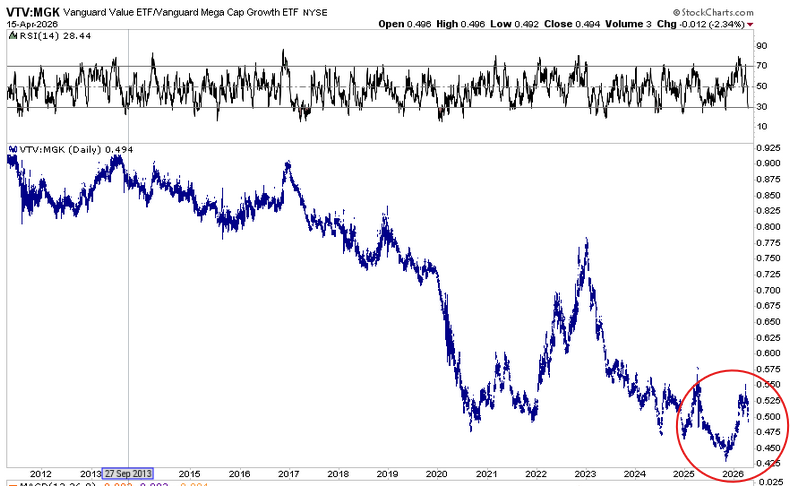
The current market environment is characterized by a significant divergence between large-cap growth stocks and value stocks. Recent performance data shows that the technology sector has surged by nearly 10% in a one-week period, while traditional defensive sectors like consumer staples and utilities have declined.
The price ratio between value-oriented ETFs and growth-oriented ETFs indicates that growth has outperformed value for the better part of 15 years. While there was a brief period of value outperformance starting in late 2023, the recent AI-driven surge has erased much of that progress. This trend reinforces the "AI or nothing" sentiment currently dominating Wall Street, where companies perceived to have even a tangential connection to artificial intelligence receive a disproportionate share of investor interest.
Warning Signs in Market Breadth
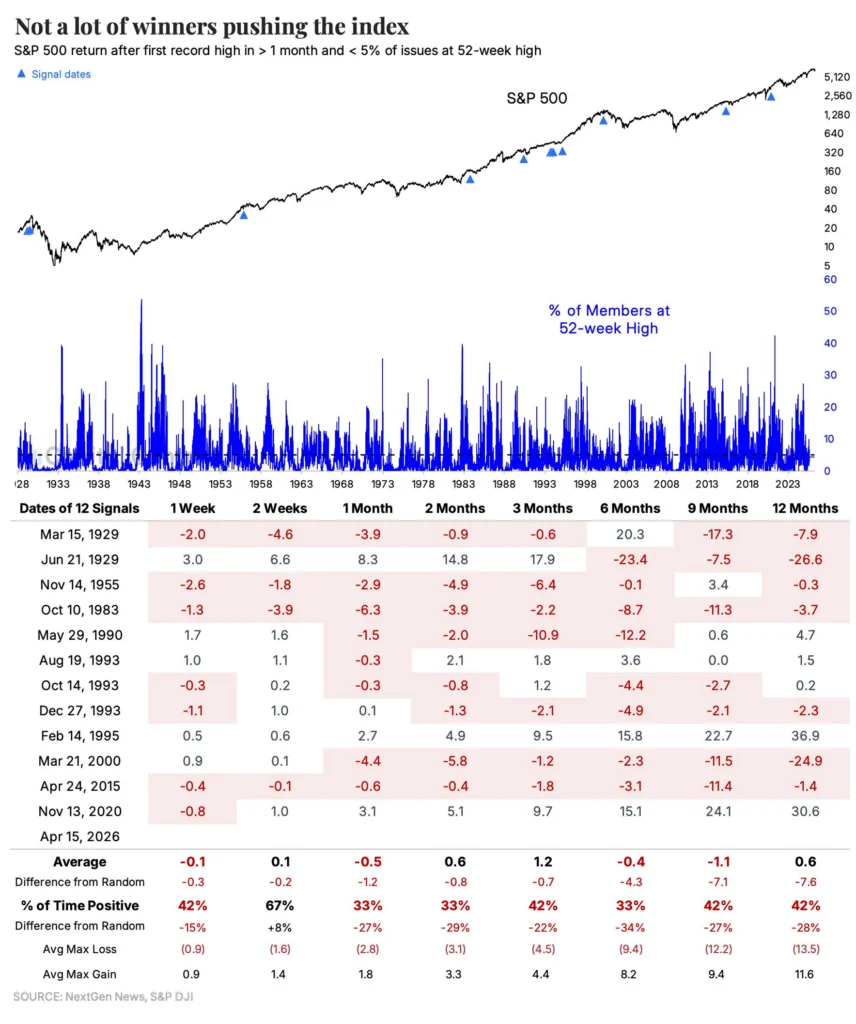
Despite the record highs in the major indices, there are underlying concerns regarding market breadth—the number of individual stocks participating in the rally. Analysis provided by Jason Goepfert suggests that when the S&P 500 hits a record high while fewer than 5% of its constituent stocks are at their own 52-week highs, future returns tend to be below average.

This lack of breadth suggests that the market is being propped up by a handful of mega-cap technology names, rather than a broad-based economic recovery. Historically, periods of "poor breadth" have preceded significant market corrections, notably in 1929 and 2000. For investors, the question remains whether the NewBird AI phenomenon is an isolated speculative event or a symptom of a broader market bubble driven by the AI narrative.
Implications for the Future
The transformation of Allbirds into NewBird AI represents one of the most drastic corporate pivots in recent memory. While the 700% increase in share price has provided a temporary reprieve for the company’s valuation, the long-term viability of the venture remains tied to its ability to deploy $50 million effectively in an industry where competitors spend that amount in a single day.
For the broader market, the event serves as a reminder of the power of "narrative-driven" investing. As long as the word "AI" continues to drive speculative frenzies, struggling companies may continue to use rebranding as a tool for capital generation. However, if history is any guide, the "magic" of a name change eventually fades, leaving investors to face the reality of the company’s bottom line.
Financial advisors continue to urge caution, suggesting that while the momentum in the AI sector is undeniably strong, the first meaningful dip in the market should be viewed as a signal to reassess exposure rather than a reason to chase speculative "penny-stock" pivots. As the S&P 500 and Nasdaq continue their historic runs, the disconnect between high-flying narratives and fundamental business reality remains the primary risk for the year ahead.