EUR/USD Navigates Volatility Amidst Shifting Economic Fortunes and Geopolitical Crosscurrents


The EUR/USD currency pair experienced a week of significant fluctuations, ultimately demonstrating resilience and a pro-euro bias, despite initial turbulence. The US dollar commenced the period on a weak footing, descending to multi-year lows before staging a partial recovery. This initial dollar weakness was attributed to a confluence of factors, including heightened geopolitical concerns and emerging questions surrounding the independence of the Federal Reserve (Fed). However, market sentiment received a boost mid-week as President Trump and the Senate successfully navigated legislative hurdles, averting a potential government shutdown, a development that provided a much-needed stabilization for the dollar.
Further bolstering the dollar’s stability was the nomination of former Federal Reserve Governor Kevin Warsh as the potential next Fed Chair. This appointment was largely interpreted by financial markets as a signal of continued commitment to central bank autonomy and sound monetary policy, a narrative that resonated positively with investors. The prospect of a leader who prioritized price stability and institutional independence appeared to assuage some of the anxieties that had been weighing on the dollar.
Economic data emanating from the United States presented a mixed picture throughout the week, offering conflicting signals to analysts and traders. On the positive side, US factory orders significantly exceeded market expectations, indicating robust demand in the manufacturing sector. This data point suggested underlying strength in industrial production and a potential tailwind for economic growth. However, this optimism was tempered by an uptick in initial jobless claims, which rose more than anticipated, signaling a potential softening in the labor market. Furthermore, the US trade deficit widened, pointing to an increased reliance on imports and potentially posing a challenge to domestic industries.
Adding to the complexity of the economic landscape, Producer Price Index (PPI) figures revealed persistent inflationary pressures, reinforcing the view that inflation remains "sticky" and is not dissipating as rapidly as some policymakers might have hoped. Both the headline PPI and the Core PPI (which excludes volatile food and energy prices) readings came in stronger than forecast. This data underscored the challenges the Federal Reserve faces in its pursuit of price stability and provided a strong rationale for a cautious approach to monetary policy easing.
Atlanta Fed President Raphael Bostic’s commentary further amplified this cautious stance. Bostic emphasized that inflation levels are still "too high" and reiterated the Federal Reserve’s need for patience. He underscored that the bar for initiating near-term interest rate cuts remains elevated, suggesting that any significant easing of monetary policy would likely require more compelling evidence of disinflationary trends. This hawkish undertone from a prominent Fed official reinforced the market’s expectation that the central bank will err on the side of caution, delaying any aggressive rate reductions.
Across the Atlantic, the economic fundamentals in the Eurozone offered modest support for the euro. Key macroeconomic indicators painted a picture of resilient, albeit subdued, growth. Eurozone Q4 Gross Domestic Product (GDP) and German GDP both exceeded forecasts, indicating that the region’s economy continues to expand, defying some earlier predictions of a sharper slowdown. This continued growth, even if modest, provided a solid foundation for the euro’s performance.
Inflationary trends within the Eurozone also aligned with the European Central Bank’s (ECB) objectives. German inflation remained close to the ECB’s target of "below, but close to, 2%." Both the Harmonised Index of Consumer Prices (HICP) and core inflation measures in Germany exhibited broad stability. This sustained inflation at a desirable level reduced immediate pressure on the ECB to alter its monetary policy stance, contributing to the euro’s stability.
In anticipation of future monetary policy decisions, analysts from prominent financial institutions such as Rabobank, TD Securities, and Brown Brothers Harriman have collectively projected that the ECB will maintain its current deposit rate at approximately 2.00% for an extended period. This consensus view suggests that the central bank perceives little immediate urgency to either cut or hike interest rates. While the recent strength of the euro has raised some concerns among policymakers and businesses regarding its impact on export competitiveness, it has not yet reached a level that would necessitate a significant policy response from the ECB. The prevailing sentiment is that the ECB will continue to adopt a data-dependent approach, prioritizing price stability while acknowledging the evolving economic landscape.
Conversely, strategists at Nordea and UOB have put forth a more pronounced view, highlighting the potential for a multi-year US dollar depreciation cycle. Their analysis draws upon historical patterns of prolonged dollar declines that have historically followed significant peaks in the currency’s value. Furthermore, they point to a discernible shift in foreign investor behavior, suggesting a potential recalibration of global capital flows away from the dollar. This perspective implies that the recent dollar weakness may not be a temporary anomaly but rather the beginning of a sustained downtrend. Their projections therefore indicate ample room for further appreciation of the EUR/USD pair in the coming years. This optimistic outlook for the euro is contingent on the Eurozone maintaining its current trajectory of contained growth and stable inflation, coupled with the ECB’s continued adherence to a broadly steady monetary policy stance.
Looking ahead, the upcoming week is poised to be a pivotal period for EUR/USD traders, with a dense calendar of high-impact economic releases on both sides of the Atlantic.

EUR/USD Key Events Next Week:
United States:
- Tuesday: Retail Sales figures will provide crucial insights into consumer spending patterns, a significant driver of US economic activity.
- Wednesday: Producer Price Index (PPI) data will offer further indications of inflationary pressures within the manufacturing sector.
- Thursday: Weekly Initial Jobless Claims will offer a timely snapshot of the labor market’s health.
- Friday: The highly anticipated Non-Farm Payrolls (NFP) report, alongside the Unemployment Rate and Average Hourly Earnings, will be the focal point for assessing the strength and direction of the US labor market.
Eurozone:
- Tuesday: German Factory Orders will shed light on manufacturing sector activity and future production expectations.
- Wednesday: The German Harmonised Index of Consumer Prices (HICP) will offer the latest inflation readings for Europe’s largest economy.
- Thursday: Eurozone Industrial Production data will provide an update on the performance of the manufacturing and industrial sectors.
- Friday: Eurozone Retail Sales will offer insights into consumer demand across the bloc.
The European Central Bank’s upcoming monetary policy meeting is expected to see the ECB maintain its current interest rates. However, market participants will be closely scrutinizing the accompanying statement for any indication of a shift in tone. Any subtle hints of concern regarding the euro’s appreciation or forward guidance that suggests a more hawkish stance could trigger significant market reactions. Conversely, a continuation of the ECB’s cautious, data-dependent approach would likely reinforce the current trading dynamics.
On the US front, the labor market data scheduled for release on Friday will be paramount in refining market expectations regarding the Federal Reserve’s future monetary policy trajectory. Any substantial deviation from consensus forecasts in the Non-Farm Payrolls report or the Unemployment Rate could trigger sharp movements in EUR/USD as traders reassess the relative policy outlooks of the Fed and the ECB. A surprisingly strong jobs report could reignite expectations of a later and slower pace of Fed rate cuts, potentially bolstering the dollar. Conversely, a weaker-than-expected report might fuel speculation of earlier or more aggressive Fed easing, providing further support for the euro.
EUR/USD Weekly Technical Forecast: Corrective Downside Under 1.19
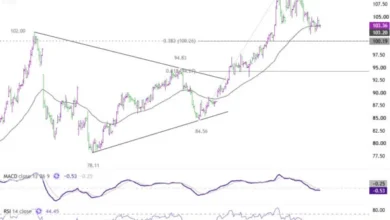
Analysis of the EUR/USD daily chart reveals a recent correction from multi-year highs exceeding the 1.2000 psychological mark. The pair has retreated below a previously broken supply zone, indicating a shift in short-term momentum and a move back below the 1.1900 level. The Relative Strength Index (RSI), a momentum indicator, has moved away from overbought territory and is gradually declining, suggesting a degree of underlying weakness in the current upward trend. However, the key moving averages on the daily chart remain in a bullish configuration, offering significant support to the pair and suggesting that the broader upward trend may still be intact.
Potential downside support levels are identified at the bullish gap observed near 1.1830, followed by the established horizontal support level at 1.1800. These levels represent areas where buying interest may emerge, potentially stemming further declines.
On the upside, for the bullish momentum to be sustained and for the pair to aim for higher targets, acceptance and consolidation above the 1.2000 psychological level are crucial. A decisive break and hold above this significant resistance would pave the way for further gains, with immediate upside targets projected at 1.2100, followed by a more ambitious target at 1.2200.
The interplay of geopolitical developments, evolving economic data, and central bank policy signals will continue to shape the trajectory of EUR/USD. Traders will be keenly watching for any shifts in these fundamental drivers to navigate the currency pair’s path in the coming weeks and months. The potential for a sustained US dollar down cycle, as suggested by some strategists, adds another layer of complexity and potential upside for the euro, provided the Eurozone’s economic performance remains robust and the ECB maintains its measured approach to monetary policy.