
This recent development marks a potentially transformative moment for the leading cryptocurrency, moving beyond a prolonged period of consolidation and bearish pressure that characterized much of the preceding market cycle. The confirmation of a breakout above the macro downtrend line, observed on linear price charts, is a technical signal historically associated with the conclusion of bear markets. Following yesterday’s daily close, prominent crypto analyst Scient highlighted this decisive breach of the primary trendline, suggesting a fundamental shift in market dynamics. This structural change has naturally ignited renewed optimism among market participants and technical analysts, prompting a strategic reassessment for high-potential setups across various altcoins, which often correlate strongly with Bitcoin’s directional movements.
However, the path forward is not without its complexities, as the price simultaneously confronts a major resistance zone on the logarithmic scale. This divergence between linear and logarithmic chart interpretations creates a critical juncture, introducing an element of caution into an otherwise bullish narrative. The coming sessions are therefore deemed crucial, as they will determine whether this upward trajectory evolves into a sustained bullish trend, potentially ushering in a new phase of market expansion, or if it ultimately proves to be a "bull trap," a deceptive rally that ensnares buyers before a swift reversal. The interplay of these two analytical perspectives underscores the current volatility and the heightened need for careful observation by traders and investors alike.
Understanding the Macro Downtrend and Charting Methodologies
To fully appreciate the significance of Bitcoin’s recent move, it is essential to understand the concept of a "macro downtrend" and the differences between linear and logarithmic charting. A macro downtrend, in technical analysis, represents a prolonged period where an asset’s price consistently registers lower highs and lower lows over an extended timeframe, typically months or even years. This trendline acts as a significant resistance level, and a decisive break above it, especially with strong volume, is often interpreted as a foundational shift from a bearish to a potentially bullish market structure. Historically, Bitcoin’s major bear markets—such as those observed in 2014, 2018, and 2022—have concluded only after the price managed to establish a sustained climb above such defining downtrend lines on linear charts, signaling the end of the accumulation phase and the beginning of recovery.
Linear charts plot price movements at equal intervals, reflecting absolute price changes. This can sometimes obscure the true magnitude of percentage-based movements, especially for assets like Bitcoin that experience exponential growth over long periods. In contrast, logarithmic charts plot price on a proportional scale, where equal vertical distances represent equal percentage changes. This makes them particularly useful for visualizing long-term trends and identifying key resistance or support levels that might not be as apparent on a linear scale, especially when dealing with assets that have experienced significant price appreciation or depreciation. The fact that Bitcoin has broken its linear macro downtrend but is simultaneously facing resistance on the logarithmic chart highlights a critical technical conflict. While the linear breakout suggests an end to the bear cycle in absolute terms, the logarithmic resistance indicates that, on a percentage-change basis, Bitcoin is still contending with a significant overhead barrier. This dual perspective necessitates a more nuanced interpretation of the current market structure.

Chronology of Recent Price Action and Market Dynamics
The current market juncture follows a period of intense activity and anticipation within the cryptocurrency space. For several months, Bitcoin had been navigating a complex landscape characterized by fluctuating sentiment, macroeconomic headwinds, and the transformative impact of new financial products. The approval of spot Bitcoin Exchange-Traded Funds (ETFs) in the United States in January 2024 injected unprecedented institutional capital and legitimacy into the market, driving significant price appreciation and pushing Bitcoin to new all-time highs earlier in the year. However, following this initial surge, the market entered a phase of consolidation, with Bitcoin’s price experiencing several pullbacks and retesting key support levels. This consolidation period, while frustrating for some, was seen by many long-term investors as a necessary cooling-off phase after a parabolic ascent.
Leading up to the "yesterday’s daily close" mentioned by Scient, Bitcoin had been trading in a narrower range, testing the macro downtrend resistance multiple times. Each attempt was closely watched by analysts, as a sustained break was widely anticipated as a key indicator for the next phase of the bull market. The decisive close above this trendline, accompanied by robust trading volume, provided the confirmation many were awaiting. This move was not an isolated event but rather the culmination of building buying pressure and improving market sentiment, underpinned by factors such as continued institutional interest, anticipation of the upcoming Bitcoin Halving event, and a generally more optimistic macroeconomic outlook compared to the previous year. However, even as the linear breakout was confirmed, cautious voices quickly emerged, pointing to the formidable resistance now encountered on the logarithmic chart, setting the stage for the pivotal days ahead.
Divergent Technical Perspectives: Linear vs. Logarithmic
The current market scenario is defined by a crucial divergence in technical analysis: a clear breakout on the linear chart juxtaposed with a major resistance level on the logarithmic chart. This discrepancy is central to the prevailing uncertainty and the differing interpretations among market analysts. The linear breakout, as observed and noted by Scient, is a powerful signal. It implies that Bitcoin has definitively moved beyond the gravitational pull of its previous downtrend, suggesting that the asset has entered a new phase of accumulation or upward momentum. Historically, such breakouts have often preceded significant bullish runs, making the current situation particularly exciting for those anticipating a major market reversal. The search for high-potential altcoin setups, a common consequence of Bitcoin’s upward movement, further underscores this optimistic sentiment.
However, the logarithmic chart presents a more conservative outlook. On this scale, where percentage gains are weighted equally, Bitcoin is currently positioned exactly at a major resistance level. This logarithmic resistance often represents a critical ceiling that, if not breached with conviction, can lead to significant retracements. The "validity" of the entire upward move, therefore, hinges heavily on how Bitcoin’s price reacts to these overlapping and often conflicting technical levels in the immediate future. If the current move is indeed a "fakeout" or a "bull trap," as some analysts caution, the price would likely lose momentum rapidly, failing to establish a firm foothold above the combined resistance. In such a scenario, Bitcoin would likely fall back below the linear resistance, potentially retesting lower support levels and forcing a re-evaluation of the broader market outlook. The coming seven to ten days, as highlighted by analysts, represent a critical window for this conflict to resolve, determining whether the current breakout can overcome the formidable logarithmic resistance or if the market requires further consolidation before a sustained upward trend can truly materialize.
Key Support, Resistance, and Momentum Indicators
Amidst this technical tug-of-war, specific price levels and market indicators are being closely monitored. To confirm true strength across both linear and logarithmic perspectives, Bitcoin’s price needs to push decisively into the mid-$80,000 region and sustain that level for several daily closes. This action would effectively flip the macro structure from bearish to unequivocally bullish, transforming any subsequent price dips into high-conviction buying opportunities for long-term investors looking to accumulate. The $80,000 mark is not merely a psychological barrier; it often aligns with significant Fibonacci extension levels or previous historical price ceilings, making its breach particularly impactful.
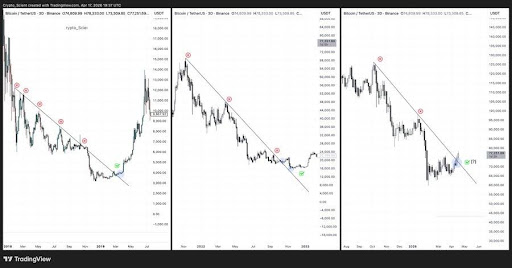
Supporting this bullish potential, analyst Crypto Candy notes that Bitcoin is currently moving in alignment with previous projections, demonstrating strong momentum as it nears the primary target of $80,000. This sustained buying pressure suggests that the asset is well-positioned to enter the $80,000 zone shortly. While minor pullbacks are expected as natural market breathers before the final target is hit, these are generally not seen as derailing the broader bullish outlook. The current bullish bias remains firmly intact as long as Bitcoin maintains its position above the $73,000 level. This price point serves as a definitive line in the sand; a sustained break below it would signal a weakening of the current momentum and potentially invalidate the immediate bullish thesis. Key momentum indicators, such as the Relative Strength Index (RSI) and Moving Average Convergence Divergence (MACD), will also be crucial in assessing the underlying strength of the current rally. A healthy RSI, not excessively overbought, coupled with a bullish MACD crossover, would lend further credibility to the upward move. Conversely, signs of divergence or a rapid loss of momentum on these indicators could signal an impending correction.
Broader Market Context and Influencing Factors
Beyond the immediate technicals, several broader market and macroeconomic factors are influencing Bitcoin’s trajectory. The period leading up to and immediately following the Bitcoin Halving, which typically occurs every four years and reduces the supply of new bitcoins, has historically been a catalyst for significant price appreciation. The most recent Halving event, occurring in April 2024, has further tightened supply at a time when demand, particularly from institutional investors via the newly launched spot Bitcoin ETFs, remains robust. These ETFs have seen billions of dollars in inflows, representing a structural shift in how large capital pools access the cryptocurrency market. This institutional adoption provides a consistent demand floor that was largely absent in previous cycles, contributing to market stability and upward pressure.
Globally, the macroeconomic environment also plays a role. While inflation concerns and interest rate policies from central banks continue to create volatility in traditional markets, Bitcoin’s narrative as a "digital gold" or an inflation hedge often gains traction during periods of economic uncertainty. Furthermore, geopolitical events can influence investor sentiment, sometimes driving capital towards decentralized assets perceived as safe havens. The increasing regulatory clarity in various jurisdictions, coupled with technological advancements within the Bitcoin network, also contributes to a more mature and resilient market. The confluence of these factors – reduced supply from Halving, strong institutional demand, a potentially improving macroeconomic outlook, and growing regulatory acceptance – forms a powerful backdrop for Bitcoin’s current price action, lending credence to the idea that the breakout on the linear chart is not merely a fleeting technical anomaly but rather a reflection of deeper, fundamental shifts in its market value proposition.
Implications for Investors and the Path Forward
The current market situation presents both opportunities and risks for investors. For those with a long-term bullish outlook, a confirmed flip of the macro structure to bullish, signified by Bitcoin holding the mid-$80,000 region, would validate the strategy of accumulating during dips. In this scenario, any subsequent price corrections would be viewed as healthy retests of support, offering advantageous entry points for further investment. Such a development would likely pave the way for Bitcoin to target new all-time highs, potentially pushing well into the six-figure range in the coming months, in line with historical post-Halving cycles. This would have significant implications not only for Bitcoin holders but also for the broader altcoin market, which typically follows Bitcoin’s lead, often with magnified gains during a strong bull run.
Conversely, the possibility of a "bull trap" demands caution. If Bitcoin fails to overcome the logarithmic resistance and falls back below the linear downtrend, it would signal a false breakout. This could lead to a period of renewed consolidation, or even a deeper correction, as market confidence wanes. Investors would need to re-evaluate their positions, with a focus on risk management and potential downside protection. The $73,000 level remains a crucial support; a definitive breach below this mark would necessitate a re-assessment of the immediate bullish bias. The implications extend beyond individual portfolios; a failed breakout could temporarily dampen institutional enthusiasm, slow down further ETF inflows, and potentially delay the broader adoption narrative. Therefore, the upcoming seven to ten days are not just pivotal for Bitcoin’s medium-term trajectory but also for the overall sentiment and direction of the entire cryptocurrency ecosystem. The market awaits with bated breath to see if Bitcoin can truly solidify its position above the macro downtrend and transform the current uncertainty into a clear path towards sustained growth.