Dogecoin Navigates Crucial Technical Juncture as Analyst Flags Imminent Volatility Below Key $0.10 Threshold

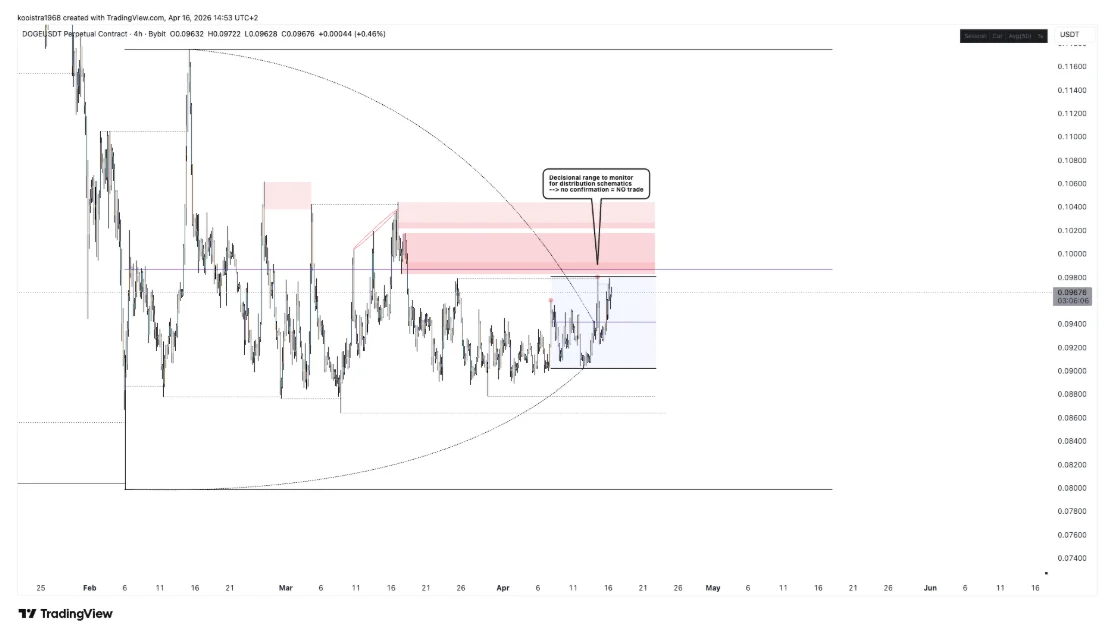
The popular meme cryptocurrency Dogecoin currently finds itself in a state of heightened anticipation, with its price meticulously compressed into a narrowing range just below the psychologically significant $0.10 mark. This sustained period of consolidation has prompted a detailed technical update from prominent crypto analyst Lars, who has been diligently tracking a specific framework for several weeks. His latest assessment suggests an impending and significant price movement for Dogecoin, though its direction and magnitude are critically dependent on a specific technical confirmation that has yet to materialize. The market remains poised, awaiting the definitive signal that will dictate Dogecoin’s immediate trajectory.
The Context of Dogecoin: A Brief History and Market Dynamics
Dogecoin, born in 2013 as a lighthearted parody of Bitcoin, quickly evolved from a niche internet joke into a formidable cryptocurrency, driven largely by its vibrant community and, more recently, by high-profile endorsements from figures like Elon Musk. Its journey has been characterized by extreme volatility, punctuated by meteoric rallies and sharp corrections. Unlike many foundational cryptocurrencies that boast extensive utility or groundbreaking technological advancements, Dogecoin’s value often correlates strongly with social media sentiment, speculative trading, and broader market trends, particularly those of Bitcoin. This inherent characteristic makes its technical analysis particularly intriguing, as fundamental drivers often take a backseat to market psychology and momentum.
In the current landscape, the broader cryptocurrency market has largely been influenced by Bitcoin’s performance. Recent periods have seen significant inflows into Bitcoin, often acting as a bellwether for altcoin movements. While many altcoins have mirrored or amplified Bitcoin’s momentum, Dogecoin has, to date, not fully capitalized on this broader market enthusiasm. It experienced a brief surge above $0.10 within the last 24 hours of the initial analysis but subsequently retreated below this level, solidifying $0.10 as a pivotal resistance point. This resistance is not merely a numerical barrier but a critical determinant of whether Dogecoin’s price will remain confined within its current range or embark on a more decisive directional shift.
Lars’s TCT Model: Unpacking the Technical Framework
Crypto analyst Lars, known for his incisive technical commentary, recently shared an updated chart on X (formerly Twitter), detailing adjustments to his long-standing technical framework. Central to his analysis is a revised interpretation of Dogecoin’s current trading range, which has altered how the compression structure is viewed. Lars’s model, referred to as a "TCT model," focuses on identifying key distribution schematics within specific price ranges. He is now specifically awaiting what he terms a "TCT model 1 distribution confirmation." This confirmation is not merely a theoretical construct but a specific pattern or set of conditions that, if met, would validate a particular market outcome, in this case, a potential downside distribution.
The charts shared by Lars illustrate Dogecoin’s price action moving upward into a discernible "pink resistance band." This band spans from approximately $0.098 to the lower end of the $0.10 region. Critically, this resistance zone sits above a series of progressively rising local lows on the one-hour candlestick chart, a pattern that typically suggests increasing buying pressure or accumulation beneath a strong overhead resistance. The projected path outlined by Lars suggests that Dogecoin might attempt one more push higher, aiming for a "third tap" of this resistance band before a potential rejection. This "third tap" often serves as a crucial test of resistance strength, where buyers either break through with conviction or capitulate.
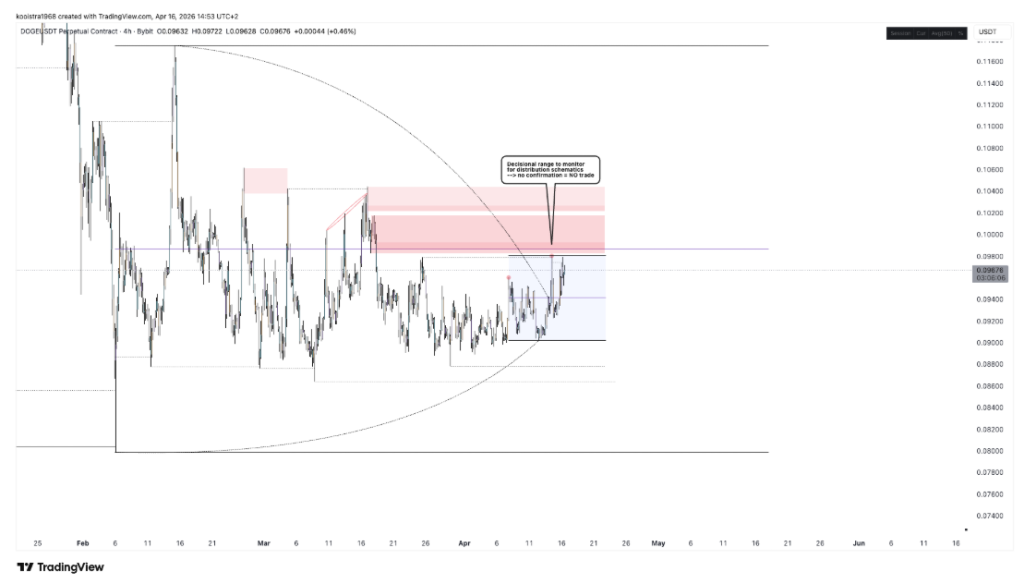
Expanding on this concept, the four-hour chart presents a broader perspective, with Lars labeling the current region as a "decisional range." This term underscores the critical nature of the prevailing price action, implying that the market is at an inflection point where significant decisions regarding trend continuation or reversal are being made by large market participants. Within this decisional range, Lars is specifically monitoring for "distribution schematics." Distribution, in technical analysis, refers to a period where large institutional holders gradually sell off their assets, often without causing a significant price drop initially, but setting the stage for a future decline. Lars’s explicit caveat, "no confirmation means no trade," highlights the prudent, risk-averse approach characteristic of professional technical analysis, emphasizing that until the specific distribution confirmation is observed, the outcome remains uncertain and speculative.
Chronology of Resistance and Recent Price Action
The $0.098 to $0.100 price band has served as a formidable and stubborn resistance level for Dogecoin since late March. This period has seen repeated attempts by bulls to break through, only to be met by consistent selling pressure. Over the weeks, Dogecoin has exhibited a pattern of forming lower highs while simultaneously maintaining a relatively stable base or higher local lows. This particular price action, often indicative of an ascending triangle pattern, suggests a dynamic equilibrium where sellers remain active near the resistance, preventing significant upward movement, but buyers are also stepping in at increasingly higher levels, indicating that the downside pressure has diminished.
A significant point in this timeline was around April 6, when Dogecoin’s price tapped the $0.10 level, as some analysts had previously predicted. This retest of resistance, however, did not lead to a sustained breakout. More recently, the price action over the past three days has shown a notable development: Dogecoin registered a higher high compared to its peak on April 6. While still within the broader resistance band, this move suggests renewed bullish intent or at least a weakening of the selling pressure that previously capped rallies.
Further elaborating on recent events, Lars also recounted an attempt to short Dogecoin during an extended TCT distribution phase. This trade was initiated following a bearish break of structure observed at the New York open. Initially, this breakdown appeared to confirm a potential downside continuation. However, Lars identified two plausible explanations for the subsequent price action, highlighting the complexities and ambiguities inherent in short-term market movements. One scenario suggested a genuine breakdown, orchestrated by market makers actively pushing the price lower immediately at the session’s open. The alternative posited a manipulative sell-off, potentially orchestrated to create liquidity for Bitcoin accumulation, a common tactic in a highly interconnected crypto market where large players often move capital between assets. This dual interpretation underscores the challenge of distinguishing genuine market sentiment from orchestrated price manipulation, particularly in assets like Dogecoin.
Supporting Data and Broader Market Context
Beyond Lars’s specific TCT model, a broader look at Dogecoin’s technical indicators reveals a decidedly mixed outlook. At the time of writing, a nearly even split exists between bearish and bullish signals, with 16 indicators signaling bearish conditions against 14 suggesting bullish momentum, according to various aggregators. The Relative Strength Index (RSI), a popular momentum oscillator, sits at a neutral 61.45. An RSI reading between 40 and 60 typically indicates a lack of strong directional momentum, reinforcing the idea of a range-bound or consolidating asset. Readings above 70 typically suggest overbought conditions, while those below 30 point to oversold conditions. The current neutral stance further underscores the market’s indecision at this critical juncture.
Market capitalization data also provides crucial context. Dogecoin consistently ranks among the top cryptocurrencies by market cap, often fluctuating between the eighth and twelfth positions. Its substantial market capitalization, typically in the tens of billions of dollars, means that any significant price movement requires substantial capital flows, making large-scale manipulation more challenging but not impossible. Trading volume also remains a key metric; sustained high volume accompanying a breakout (either upward or downward) would lend credibility to the move, whereas a low-volume break might indicate a false signal or a temporary fluctuation. Observing the volume profile as Dogecoin approaches the $0.10 resistance or the rising local lows will be crucial for confirming the validity of any impending move.
Comparing Dogecoin’s performance to Bitcoin is also essential. While Bitcoin’s recent inflows and overall bullish sentiment have lifted the broader market, Dogecoin has not always followed suit with the same intensity. This divergence can sometimes indicate that capital is flowing more selectively into assets perceived to have stronger fundamentals or higher growth potential, or simply that meme coins operate on a slightly different emotional and speculative cycle. The upcoming Bitcoin halving event, for instance, has historically been a significant catalyst for the crypto market, and its indirect impact on altcoins like Dogecoin could also play a role in its future price action.
Inferred Statements and Expert Perspectives
While Lars’s analysis is central, other market strategists would likely echo the sentiment regarding the importance of confirmation. "In any range-bound environment, the breakout is only as strong as its confirmation," states a hypothetical senior market analyst from a major crypto research firm. "Traders who jump in prematurely often get caught in false breakouts. Observing increased volume, a decisive close above or below the range, and a successful retest of the broken level are fundamental for validating the move."
Regarding the two scenarios Lars presented – a genuine breakdown versus manipulative sell-off – another inferred expert, perhaps a quantitative analyst, might suggest, "Distinguishing between genuine market dynamics and manipulative tactics is a constant challenge, particularly in assets with high retail participation. Large orders at session opens or closes can often be liquidity grabs. Observing the order book depth and the nature of subsequent price action, whether it immediately reverses or continues, can offer clues." The consensus among seasoned traders and analysts would likely be to prioritize risk management and await clear signals rather than betting on ambiguous price movements.
Broader Impact and Implications
The outcome of Dogecoin’s current compression below $0.10 carries significant implications for various market participants. For short-term traders, a decisive break above $0.10, especially with confirmation, could signal a strong buying opportunity, potentially targeting higher resistance levels that have not been tested in weeks or months. Conversely, a confirmed breakdown below the rising local lows could trigger a wave of selling, leading to a retest of lower support zones. Lars’s TCT model, with its emphasis on distribution schematics, points towards the possibility of the latter if the confirmation arrives.
For long-term holders, the current consolidation period might be viewed as a healthy re-accumulation phase before the next leg up, assuming the broader bull market persists. However, a significant downward move could test their conviction and potentially lead to further price depreciation. The psychological barrier of $0.10 is not just a technical level; it represents a significant milestone for many Dogecoin enthusiasts and investors. A sustained move above it could reignite widespread optimism and attract new retail interest, a crucial driver for meme coins. Conversely, continued failure to breach it could lead to investor fatigue and a shift of capital to other, more performing assets.
The broader implications extend to the meme coin ecosystem as a whole. Dogecoin’s price action often influences sentiment across other meme-inspired cryptocurrencies. A strong breakout could inject renewed vigor into the sector, while a significant decline could dampen enthusiasm. Ultimately, Lars’s analysis underscores a critical principle in trading: patience and reliance on validated signals. In a market often driven by hype and emotion, waiting for clear technical confirmation, as advocated by Lars, remains a cornerstone of a disciplined and effective trading strategy, especially as Dogecoin navigates this pivotal moment. The coming days will be crucial in determining whether Dogecoin breaks free from its current confines and which direction it ultimately chooses.