Analyst Weekly: Navigating Market Volatility Amidst Shifting Macro Drivers

The global financial markets are currently experiencing a complex interplay of forces, with oil prices emerging as a primary macro driver shaping equity outcomes more significantly than domestic economic data. While geopolitical tensions, particularly in the Middle East and between the United States and China, cast a persistent shadow, the resilience of certain markets, notably China equities, is becoming a focal point for investors. Historically, energy shocks have triggered rotations and repricing within Chinese markets, but not fundamental deterioration, underscoring the importance of strategic positioning over directional bets.
Resilience Amidst Global Upheaval
Despite China’s deep integration into the global economy, making it inherently susceptible to international volatility, analysts suggest it may be better positioned than many of its peers to weather current storms. This relative strength is attributed to several key buffers that have historically supported its market stability. The most significant of these is the enduring role of the state as a crucial marginal buyer in China’s equity market. Following substantial interventions over the past two years, state funds have recently moderated their buying activity. This pullback, however, is interpreted not as an exit, but as the existence of "dry powder" – capital readily available to be deployed should market weakness re-emerge, providing a crucial safety net.
The Dominant Influence of Oil Prices
The current market narrative is undeniably dominated by the fluctuations in oil prices. Historical parallels, such as the Arab Spring in 2010-2011 and the escalation of the Russia-Ukraine war in early 2022, when oil prices surged above $80 per barrel, offer valuable insights. During these periods of significant energy price spikes, China equities have demonstrated remarkable earnings resilience. While forward earnings revisions were only modest, the primary adjustment observed in the market was a compression of valuation multiples. This suggests that while corporate profitability remained relatively stable, investor sentiment and risk appetite, influenced by the broader economic implications of higher energy costs, led to a re-evaluation of stock prices.

Strategic Portfolio Repositioning in an Energy-Driven Landscape
From a portfolio construction standpoint, energy shocks necessitate a strategic shift rather than an outright reduction in exposure. The focus must pivot towards assets exhibiting cash flow resilience and robust pricing power. In an environment characterized by escalating energy costs, investors are increasingly rotating into sectors that can either benefit from higher energy prices directly or effectively pass on increased operational expenses to consumers. Crucially, these sectors must also maintain strong balance sheet stability to navigate potential economic headwinds.
This strategic repositioning favors companies with defensive earnings profiles, those deeply entrenched in domestic consumption, and entities closely aligned with government policy objectives. This contrasts sharply with a previous emphasis on high-beta growth stocks, which are often more sensitive to economic downturns and interest rate fluctuations. Sectors that typically benefit include traditional energy producers, utilities with regulated pricing mechanisms, and companies with strong brand loyalty enabling them to maintain pricing power.
Enduring Structural Growth Themes
Notwithstanding the immediate macroeconomic headwinds, long-term structural growth themes remain a critical consideration for investors. The ongoing digital transformation, driven by advancements in artificial intelligence (AI), continues to offer significant growth potential. Furthermore, the global imperative to transition towards sustainable energy sources presents a multi-decade investment opportunity. Companies at the forefront of these transitions, developing innovative technologies or providing essential services, are likely to demonstrate sustained growth, irrespective of short-term market volatility.
Geopolitical Risk: A Persistent Premium
The current geopolitical landscape is characterized by persistent tensions in the Middle East and ongoing trade dynamics between the United States and China. These factors contribute a significant and enduring risk premium to global markets. Tariffs and trade restrictions between the world’s two largest economies remain elevated. While diplomatic overtures and potential meetings may offer temporary sentiment boosts, expectations for meaningful breakthroughs in resolving these complex issues remain subdued.
Beyond immediate trade disputes, a broader strategic layer is at play. Shifts in global power dynamics stemming from ongoing conflicts could potentially re-intensify trade tensions, particularly impacting critical sectors such as technology and industrials. Investors are therefore advised to view geopolitics not as a transient concern, but as a structural overhang that will continue to influence market sentiment and drive headline volatility. This necessitates a cautious and informed approach, focusing on companies with diversified supply chains and resilient business models.
Investment Takeaway: A Balanced and Selectively Positioned Approach
From an investment perspective, a balanced approach is paramount. This involves strategically pairing areas of structural growth, such as artificial intelligence and the energy transition, with defensive, cash-generative sectors like energy and banking. Oil prices serve as a key indicator for sector rotation, while ongoing policy support in various economies continues to act as a stabilizing force during periods of heightened volatility. Geopolitical developments may trigger short-term market swings, but the underlying fundamentals of many companies remain robust. Consequently, the emphasis for investors should be on careful stock selection and strategic positioning, rather than attempting to predict the overall market direction with precision.
TSMC on the Cusp of a Record High
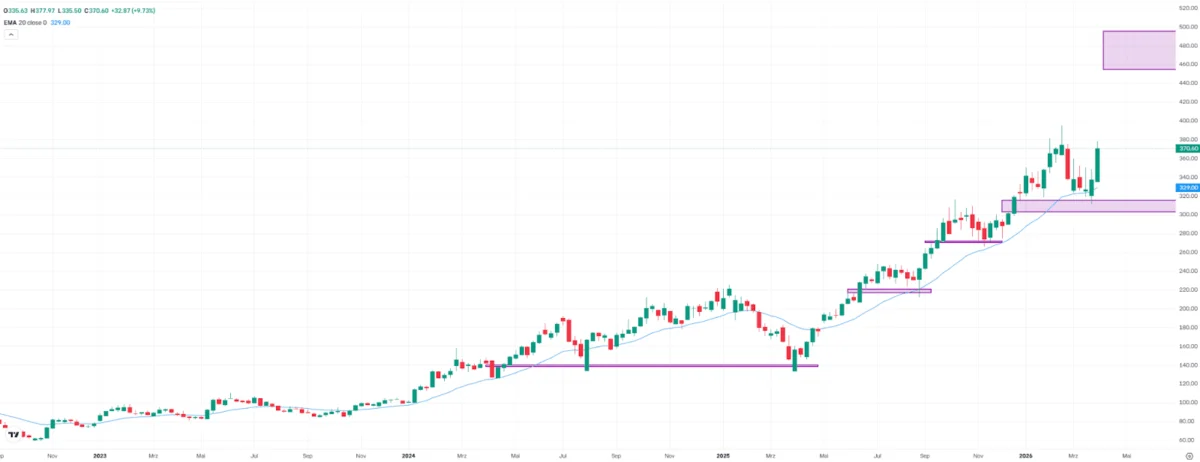
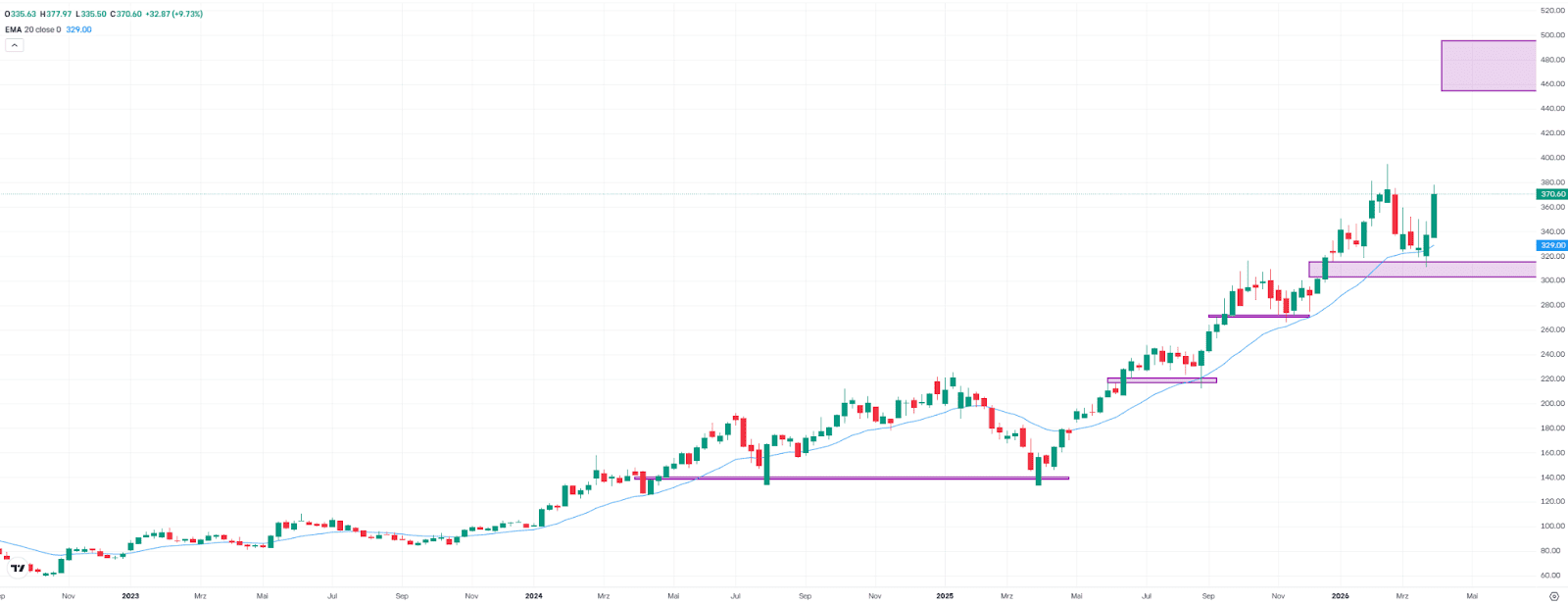
Taiwan Semiconductor Manufacturing Company (TSMC) shares have demonstrated a compelling rebound, closing the past week up 9.7% at $370.60. This surge has narrowed the gap to its all-time record high to approximately 6%, a significant improvement from a 21% deficit just two weeks prior. Many investors appear to have interpreted this upward momentum as a fresh entry opportunity, particularly following the successful defense of the fair value gap between $302.90 and $315.64.
The prospect of TSMC testing its record high now appears within reach. Alongside developments in the geopolitical arena, particularly concerning the Iran conflict, market attention is increasingly turning to TSMC’s upcoming quarterly results and guidance, scheduled for release on Thursday. A decisive upside breakout beyond its previous peak could trigger a follow-through move of 15% to 25%, potentially propelling the stock into the $455 to $497 range in the medium to long term, according to technical analysis.
However, the short-term outlook remains somewhat delicate. Any deterioration in market sentiment could lead to downside pressure, especially given the recent rapid recovery. Key support levels to monitor include the 20-week moving average, currently situated at $329, and the aforementioned support zone. As long as the stock price remains sustainably above these levels, buyers are likely to retain control.
Netflix Navigates Key Resistance Levels
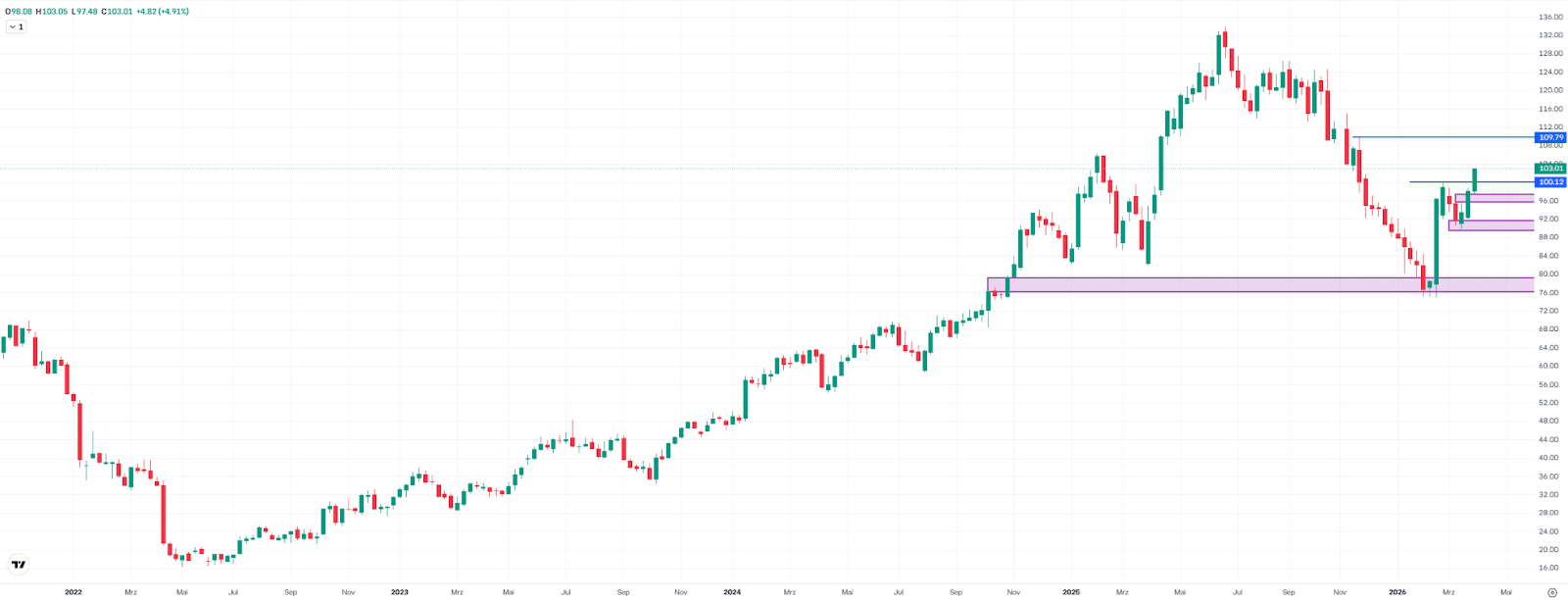
Netflix shares have also experienced a notable rebound, closing last week 4.9% higher at $103, reaching their highest point since early December. Since hitting a low in February, the stock has recovered approximately 37%, a significant turnaround after a preceding 44% decline. This recovery has reduced the total decline from its all-time high to roughly 23%.
To further enhance its medium-term chart outlook, Netflix needs to achieve a sustained move above the resistance level near $110. This price point marked the beginning of the previous major sell-off, suggesting that sellers may be poised to defend it. The chances of testing this level appear favorable, given the stock’s current approach with strong upward momentum.
The outcome of this resistance test will likely hinge on Netflix’s first-quarter earnings report and forward guidance, expected on Thursday after market close. On the downside, the fair value gap between $95.84 and $92.48 would represent the next significant area of interest. The crucial short-term support level remains the March low at $89.75.
Bitcoin: Patience Over Precision in a Maturing Market
Bitcoin is currently trading around the $71.6K mark. However, the paramount concern for investors is not necessarily the immediate geopolitical climate, but rather the absence of structural signals that have historically defined every cycle bottom in the cryptocurrency market. Key indicators such as a clear supply crossover, negative MVRV (Market Value to Realized Value), and a price well above key cost bases are still not in place. At present, Bitcoin remains considerably distant from the $54K aggregate cost basis and the deeper on-chain level of $39K – zones where previous cycle lows have historically formed.
This observation suggests a distinct possibility: the market may require further adjustment before a genuine bottom is established. While not a certainty, this scenario warrants serious consideration by investors. Concurrently, the underlying structure of the Bitcoin market appears to be improving. Long-term capital is demonstrating accumulation rather than exit, and distribution is expanding through institutional players like Morgan Stanley, indicating a strengthening foundation beneath the surface.
This presents a fundamental tension: the base may be forming, but it has not yet been definitively validated by the key structural indicators. For investors, this situation calls for discipline and patience rather than a pursuit of precision. Maintaining existing exposure is a reasonable strategy, but forcing new risk is not advisable. The optimal entry point, or "edge," will emerge once the data unequivocally confirms the formation of a sustainable bottom. Until then, patience remains a prudent and valid strategy.
Disclaimer: This communication is for informational and educational purposes only and should not be construed as investment advice, a personal recommendation, or an offer or solicitation to buy or sell any financial instruments. This material has been prepared without considering the investment objectives or financial situation of any particular recipient and has not been prepared in accordance with the legal and regulatory requirements to promote independent research. Any references to past or future performance of a financial instrument, index, or packaged investment product are not, and should not be taken as, a reliable indicator of future results. eToro makes no representation and assumes no liability as to the accuracy or completeness of the content of this publication.