AUD/USD Faces Headwinds as Inflation Stubbornness and Shifting Market Sentiment Dampen Australian Dollar’s Momentum


The Australian dollar (AUD) has experienced a notable deceleration in its upward trajectory at the commencement of the year, now trading significantly below its recent peaks in the vicinity of 0.7100. While robust domestic economic data initially provided a tailwind for the Australian currency, a confluence of market positioning and prevailing external risks suggests that further substantial gains may be constrained in the near term. This analysis delves into the key economic indicators, central bank expectations, and global financial currents influencing the AUD/USD exchange rate.
RBA’s Tightening Dilemma: Inflation Persistence and Market Expectations
Australia’s labor market has demonstrated remarkable resilience, with recent data surprising to the upside and underscoring a tight employment environment. Concurrently, inflation figures continue to exhibit a stubborn persistence, remaining above the Reserve Bank of Australia’s (RBA) target band of 2-3%. The Trimmed Mean Consumer Price Index (CPI), a key measure of underlying inflation, stands at 3.3% year-on-year. This figure not only surpasses the RBA’s stated objective but also significantly exceeds its November forecast of 2.7% by the fourth quarter.
In response to this inflationary backdrop, financial markets have largely priced in a high probability of a monetary policy tightening at the upcoming RBA meeting. Current market sentiment suggests a 70-75% likelihood of a 25-basis-point (bps) interest rate hike, which would elevate the official cash rate to 3.85%. This expectation aligns with a consensus among major Australian banks, all of whom anticipate further monetary policy tightening. However, divergence exists regarding the extent and duration of this tightening cycle, with differing views on whether this potential hike represents a solitary adjustment or the initiation of a more extended series of rate increases.
Market’s Reaction to Inflation Data: A Signal of Caution
The market’s reaction to the most recent inflation data has provided a critical insight into investor sentiment and positioning. The sharp decline in Australian three-year government bond yields following the CPI release suggests that market participants were anticipating an even higher inflation print. This implies that a significant portion of the market was already positioned for aggressive inflationary pressures. Consequently, if the RBA proceeds with a rate hike, there is a discernible risk that the market might interpret it as a "one and done" event, failing to generate sustained upward momentum for the Australian dollar. Conversely, a surprise decision to hold interest rates steady, even if accompanied by hawkish forward guidance from the RBA, would likely exert downward pressure on the AUD/USD pair in the short term.
US Dollar Rebound and Global Economic Crosscurrents
The Australian dollar’s fortunes are also intrinsically linked to the performance of the US dollar. The greenback has recently witnessed a rebound, partly attributed to the nomination of Kevin Warsh as the next Federal Reserve Chair. This appointment is widely interpreted by market participants as a signal of a less dovish monetary policy stance than initially anticipated. This development has consequently lowered expectations for near-term US interest rate cuts, a sentiment reinforced by robust US Producer Price Index (PPI) data and the Federal Reserve’s characteristically cautious rhetoric.
The economic landscape in the United States remains a critical determinant of the AUD/USD trajectory. Upcoming key economic releases, including the Institute for Supply Management (ISM) Manufacturing and Services Purchasing Managers’ Index (PMI) and the Non-Farm Payrolls (NFP) report, carry asymmetric risk. Any positive surprise emanating from these data points could further bolster the strength of the US dollar, thereby exerting additional downward pressure on the AUD/USD pair.

Shifting Speculative Positioning: A Potential Vulnerability
Further underscoring the potential for a pullback in the AUD/USD, recent data from the Commodity Futures Trading Commission (CFTC) reveals a significant shift in speculative positioning. Large speculators have moved to a net long AUD position for the first time since late 2024. This reversal in sentiment, coupled with gross long positions nearing multi-year highs, suggests a degree of crowdedness in the Australian dollar market. Such concentrated positioning can amplify vulnerability to sharp reversals and pullbacks, particularly if market sentiment shifts or unexpected negative news emerges.
AUD/USD Technical Outlook: Navigating Key Moving Averages
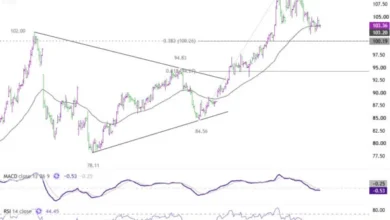
From a technical perspective, the AUD/USD 4-hour chart illustrates a currency pair navigating a critical juncture, oscillating between key moving averages. The chart indicates mild support in the vicinity of the 0.6920 level, an area that coincides with a significant order block and the 50-period Moving Average (MA). However, the price is currently trading below the 20-period MA, which is situated near the 0.7000 mark. Furthermore, the Relative Strength Index (RSI) has dipped below the 50.0 level, a technical indicator that often signals a bearish bias and waning upward momentum.
In the event of a sustained bearish continuation, the AUD/USD pair would require a decisive break below the 0.6920 support zone. Such a move could pave the way for further declines, with the next significant support level identified at the 100-period MA, which is currently hovering around 0.6810. Conversely, any upward movement from current levels is likely to encounter interim resistance around the 0.6950 area before confronting the more significant psychological and technical barrier at 0.7000.
Broader Economic Context and Implications
The interplay of domestic inflation, central bank policy, and global economic forces creates a complex environment for the AUD/USD. The Australian economy, while demonstrating resilience in its labor market, faces the persistent challenge of elevated inflation. The RBA’s response will be keenly watched, with a potential rate hike serving as a pivotal moment for market sentiment.
On the global stage, the US dollar’s strength, influenced by Fed policy expectations and robust US economic data, presents a significant headwind for risk-sensitive currencies like the Australian dollar. Geopolitical developments and global economic growth prospects also continue to play a crucial role in shaping currency markets.
The positioning of large speculators, now net long the Australian dollar, introduces an additional layer of complexity. This crowded trade could lead to accelerated price movements in either direction, depending on how market participants react to incoming data and central bank pronouncements. Traders and investors will be closely monitoring upcoming economic data from both Australia and the United States, as well as any official statements from the RBA and the Federal Reserve, for further clarity on the future direction of the AUD/USD exchange rate. The currency pair’s ability to decisively break through key technical levels will also be a critical determinant of its short-to-medium term trajectory. The current environment suggests a period of heightened volatility and careful observation is warranted.