LendingClub Rebrands to Happen Bank, Signaling a Strategic Pivot Towards Integrated Digital Banking and the "Motivated Middle"

LendingClub, a pioneering name in the fintech landscape, has officially announced its rebranding to Happen Bank, a strategic move designed to align its public identity with its comprehensive evolution into a full-service digital bank. This transformation marks a significant departure from its origins as a marketplace lending platform, reflecting years of strategic acquisitions and product development aimed at creating a seamless, interconnected financial ecosystem for its users. The change underscores a broader trend within the fintech sector, where the focus is shifting from unbundled, standalone services to integrated, coordinated financial solutions.
From Marketplace Lender to Full Digital Bank: A Transformative Journey
LendingClub’s journey began in the aftermath of the 2008 financial crisis, a period ripe for disruption in traditional banking. Launched in 2007, the company quickly established itself as a prominent peer-to-peer (P2P) lending platform, connecting borrowers with investors through an online marketplace. This innovative model offered an alternative to conventional bank loans, often characterized by greater transparency and efficiency. For over a decade, LendingClub primarily focused on personal loans, building a substantial user base and reputation in the lending space.
However, the strategic vision for the company began to broaden significantly with a pivotal moment in 2021: the acquisition of Radius Bancorp. This acquisition was not merely an expansion; it was a fundamental reorientation. By acquiring a federally chartered bank, LendingClub gained a crucial bank charter, transforming its operational capabilities overnight. This allowed the company to transition from being primarily a lending facilitator to a fully licensed, regulated digital bank. The bank charter enabled LendingClub to offer a wider array of traditional banking products, including checking accounts, savings accounts, credit cards, and Certificates of Deposit (CDs), directly to consumers.
CEO Scott Sanborn articulated the essence of this rebrand, stating, "This is really about the brand catching up with the business. The old [LendingClub] name no longer describes everything we offer – reflecting where we began, not where we are today." This sentiment highlights a common challenge for rapidly evolving companies: maintaining a brand identity that accurately represents their current offerings and future ambitions. The original brand, while iconic for its initial purpose, had become an anachronism in light of the company’s expanded mandate. The acquisition of Radius Bancorp provided the foundational infrastructure, and the subsequent layering of diverse banking products onto its core lending technology created a sophisticated, multi-faceted financial institution that transcended its initial lending-centric identity.
The Mismatch and the Mandate for a New Identity
The need for a rebranding became increasingly apparent as the company diversified its product portfolio. As Sanborn pointed out, "Having a LendingClub-branded debit card was never going to make sense." The name "LendingClub" inherently suggested a focus on borrowing, which was incongruent with offering comprehensive banking services like checking and savings accounts. The brand architecture itself was creating a cognitive dissonance for consumers and stakeholders alike.
Historically, early fintech companies, particularly those emerging after the 2008 crisis, often adopted aesthetics and nomenclature that mimicked traditional banks. This strategy was largely driven by a desire to project stability, trustworthiness, and familiarity in a nascent industry. Conservative colors, institutional language, and conventional cues were employed to signal reliability to consumers wary of non-traditional financial entities. However, as the fintech industry matured and digital banking became more widely accepted, this logic began to dissipate.
The new identity as Happen Bank signifies a departure from merely trying to "look like a traditional bank." Sanborn emphasized this shift: "We’re no longer trying to look like a traditional bank because we don’t operate like one." This statement underscores a strategic move towards differentiation. Happen Bank aims to signal direction and distinction, reflecting a business model built around deep integration and a holistic approach to financial management, rather than a collection of disparate, standalone products. The new brand is intended to evoke a sense of proactive financial progress and empowerment, aligning with its mission to help customers improve their financial health.
Happen Bank’s Differentiated Model: Serving the "Motivated Middle"
At the core of Happen Bank’s strategy is its laser focus on a specific demographic: the "Motivated Middle." This segment comprises digitally fluent, financially active consumers who possess strong credit profiles but often grapple with fragmented financial lives. These individuals typically have multiple accounts across various institutions – a checking account here, a savings account there, a credit card from another provider, and perhaps a personal loan from somewhere else. While financially capable, they lack a unified system that integrates and optimizes their financial activities.

Happen Bank’s product strategy is meticulously designed to address this fragmentation by building a "connected financial loop." This is not merely a bundle of products, but rather a synergistic system where each component informs and enhances the others. While the specific list of products was not detailed in the original excerpt, a logical inference based on the description of a full digital bank and the target demographic would include:
- Integrated Checking Accounts: Offering daily transaction capabilities, often with features like early direct deposit and no monthly fees.
- High-Yield Savings Accounts: Designed to encourage wealth accumulation and provide a clear view of savings progress.
- Personal Loans: Leveraging LendingClub’s original expertise, but now fully integrated within the banking ecosystem, allowing for more personalized rates and terms based on the customer’s overall financial picture within Happen Bank.
- Credit Cards: Offering rewards or benefits that align with the customer’s spending habits and financial goals, potentially with dynamic credit limits tied to overall financial health.
- Certificates of Deposit (CDs): Providing secure, fixed-rate investment options for customers looking to grow their savings over time.
- Budgeting and Financial Planning Tools: Integrated within the platform, these tools would leverage data from all connected accounts to provide personalized insights, recommendations, and automated savings features.
- Credit Monitoring and Building Tools: Directly tied to the lending and credit products, helping customers understand and improve their credit scores through responsible financial behavior.
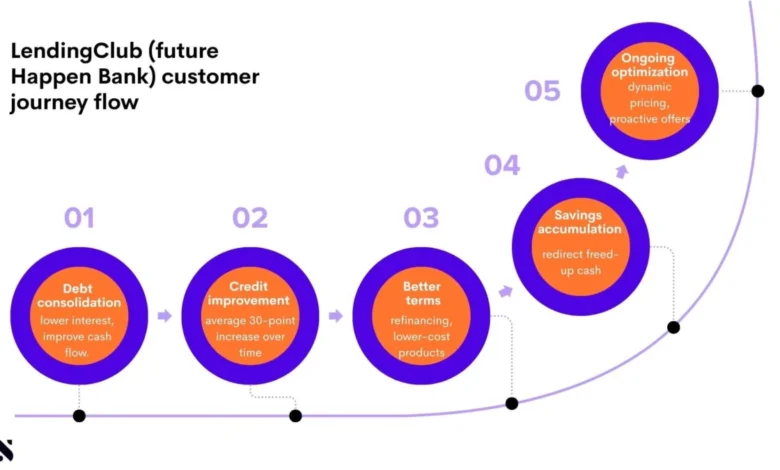
The power of this model lies in the creation of a continuous feedback loop between behavior and outcomes. As CEO Sanborn aptly put it, "If those products don’t inform each other, it’s just a bundle – not a system." This distinction is critical. A mere bundle might offer convenience, but a true system provides actionable intelligence and optimizes financial outcomes. For instance, a customer using a Happen Bank checking account might receive personalized insights on how to allocate funds to a Happen Bank savings account, which in turn could lead to better rates on a Happen Bank personal loan or credit card. This integrated approach fosters better financial habits and measurable improvements in financial health.
Chief Customer Officer Mark Elliot provided compelling evidence of this model’s effectiveness. He reported that members typically see an average of 30-point credit score improvements. Even more striking, over 20% of savings accounts originate from users who initially joined with an average of $15,000 in credit card debt and subsequently managed to build up $15,000 in savings within the Happen Bank ecosystem. This data powerfully illustrates the transformative potential of a coordinated financial system, demonstrating how users can transition from debt accumulation to wealth creation through integrated product usage and guided financial management.
Broader Industry Implications: The Re-bundling Wave
The emergence of Happen Bank is not an isolated event but rather a significant manifestation of a broader pattern unfolding across the fintech industry. The evolution of fintech can be understood in distinct waves:
- First Wave: Unbundling (Post-2008 Crisis to Mid-2010s): This era was characterized by fintech companies specializing in specific financial services, often excelling where traditional banks lagged. We saw the rise of dedicated lending platforms (like early LendingClub), specialized payment solutions (e.g., Square, PayPal), and companies offering superior user experiences (UX) for single services. The focus was on "doing one thing better."
- Second Wave: Re-bundling with Coordination (Mid-2010s to Present): This wave saw fintechs begin to integrate complementary services, recognizing that consumers often needed more than just one specialized product. Companies started offering a "bundle" of services, but often these were still somewhat siloed or loosely connected. The challenge was to make these bundles truly cohesive.
- Current Wave: Re-bundling around Coordination and Integration: This is where Happen Bank positions itself. The competitive edge is no longer about offering more products, or even just "better" individual products, but about making all products function as a single, intelligent system. This paradigm shift emphasizes the symbiotic relationship between different financial tools, where data from one product can dynamically influence and optimize another. The goal is to create a seamless, intuitive, and highly personalized financial experience that guides users toward better outcomes.
Happen Bank’s gamble is that this coordinated, systemic approach will be the next frontier in digital banking. By targeting the "Motivated Middle" – a demographic that values efficiency, digital fluency, and financial progress – the bank aims to capture a significant market share. This strategy presents a direct challenge to both traditional banks, which often struggle with legacy systems and fragmented customer experiences, and other neobanks, which may offer bundles but lack the deep integration and data-driven feedback loops that Happen Bank promises.
The Road Ahead: Challenges and Opportunities
While the rebranding to Happen Bank presents a clear strategic direction, it also comes with inherent challenges. Establishing a new brand identity in a crowded financial market requires significant investment in marketing and customer education. Happen Bank will need to effectively communicate its unique value proposition – the integrated, systemic approach – to differentiate itself from competitors. Brand recognition and trust, painstakingly built under the LendingClub name, will need to be re-established under the new banner.
Moreover, the competitive landscape is fierce. Traditional banks are investing heavily in digital transformation, and other well-funded fintechs and neobanks are vying for the same "Motivated Middle" demographic. Regulatory scrutiny, particularly concerning data privacy and financial health claims, will also remain a constant factor.
However, the opportunities are substantial. By focusing on a clear target market and offering a truly differentiated, integrated experience, Happen Bank has the potential to carve out a significant niche. The demonstrable success metrics, such as credit score improvements and savings accumulation, provide powerful testimonials to the efficacy of their model. As consumers increasingly seek convenience, personalization, and genuine financial guidance from their banking providers, Happen Bank’s approach of making products "work as one system" could resonate strongly.
The rebranding of LendingClub to Happen Bank is more than a mere name change; it is a declaration of purpose, a reflection of a profound strategic evolution, and a bold bet on the future of integrated digital banking. As the financial industry continues its rapid transformation, Happen Bank stands poised to play a pivotal role in shaping how consumers manage their money, moving beyond simple transactions to fostering genuine financial well-being through a cohesive, intelligent financial ecosystem.