The Rising Cost of a Middle-Class Lifestyle and the $408,000 Income Threshold for Urban Families

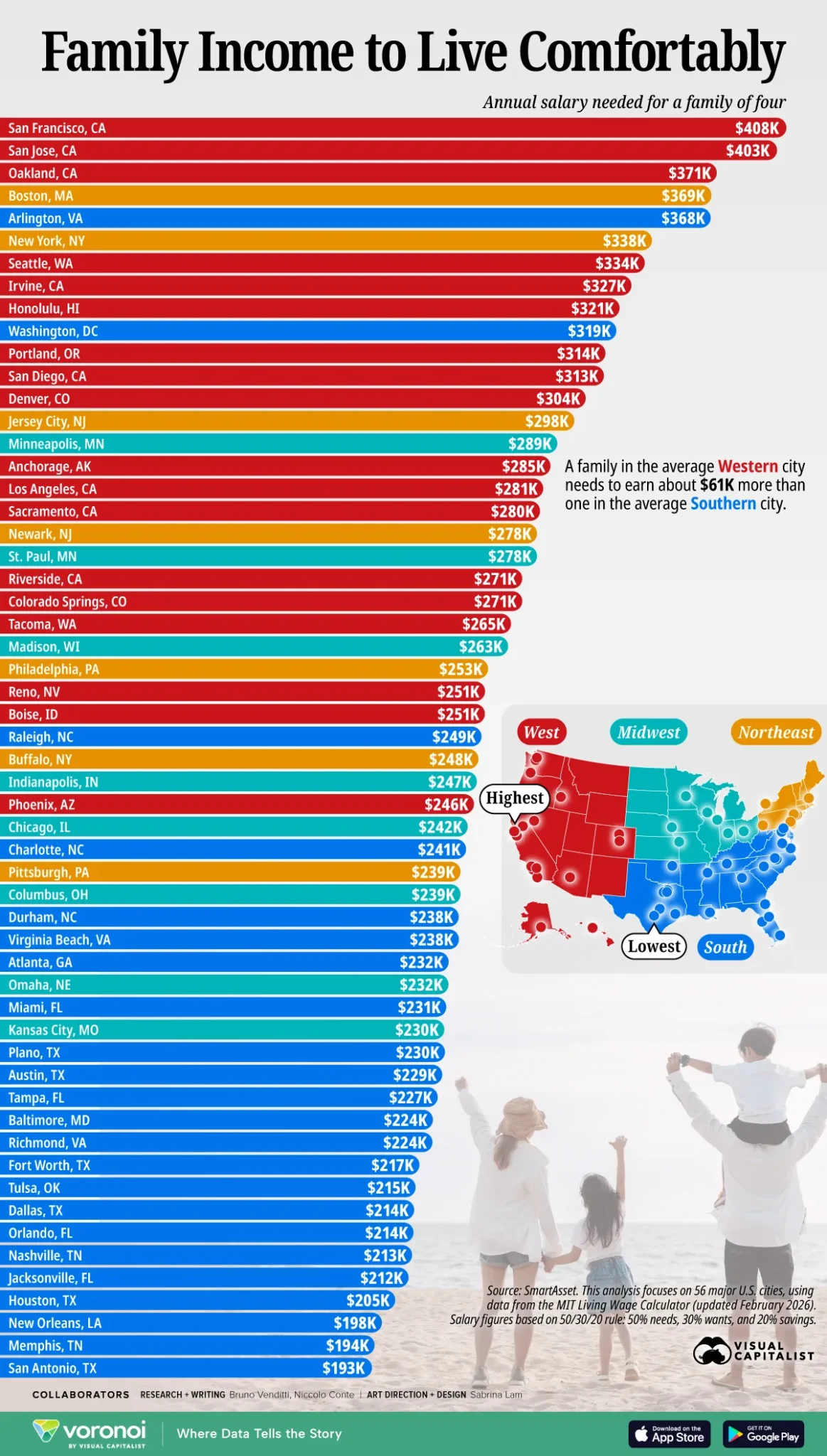
The benchmark for maintaining a middle-class lifestyle in the United States’ most expensive metropolitan areas has undergone a significant upward revision, with new financial models indicating that a family of four in San Francisco now requires an annual household income of approximately $408,000 to live comfortably. This figure represents a substantial increase from previous years and highlights the widening gap between stagnant median wages and the escalating costs of essential services, including housing, education, and healthcare. For residents of high-cost-of-living (HCOL) coastal cities, the traditional definition of "middle class" is increasingly being associated with the top 5% of earners in the United States, raising questions about the long-term sustainability of urban residency for professional families.
The $408,000 threshold reflects a broader trend of "personal inflation," which often outpaces the Consumer Price Index (CPI) reported by federal agencies. While standard inflation metrics track a broad basket of goods, families in HCOL areas are disproportionately affected by the soaring costs of private education, comprehensive medical insurance, and premium real estate. In San Francisco, often cited as the most expensive city in the nation, this income level is no longer viewed as a mark of extreme wealth but rather as the baseline for a lifestyle characterized by financial security, homeownership, and the ability to save for retirement.
A Chronology of Escalating Costs
The trajectory of the "comfortable" income threshold has risen sharply over the past decade. In 2018, financial analysts estimated that a household income of $300,000 was necessary to sustain a middle-class existence in a major coastal city. At the time, this figure was met with skepticism and public debate, as it sat significantly above the national median household income. However, by late 2019, following shifts in the economic landscape and the birth of a second child for many millennial households, that estimate was revised upward to $350,000.
The current projection of $408,000 for 2026 represents a 36% increase since 2017. This calculates to a compound annual growth rate (CAGR) of approximately 3.5% in the cost of living for a typical family unit. While this percentage may appear modest in isolation, its cumulative effect on gross income requirements is profound. The transition from $300,000 to over $400,000 in less than a decade underscores the "sneaky" nature of inflation, where incremental increases in property taxes, insurance premiums, and service costs aggregate into a significant financial burden.
Dissecting the $408,000 Budget
To understand how a top-tier income can be absorbed by standard living expenses, it is necessary to examine the post-tax reality of a high-earning household. In a state like California, a gross income of $408,000 is subject to significant federal and state taxation. After accounting for an effective tax rate of roughly 32%, the take-home pay is reduced to approximately $277,440. This figure serves as the actual starting point for all annual expenditures.

A realistic budget for a family of four in San Francisco reveals that no single expense is necessarily extravagant; rather, it is the accumulation of essential costs that drives the requirement for high earnings.
- Housing and Utilities: Real estate in the San Francisco Bay Area remains a primary driver of expense. Mortgage payments, property taxes, and maintenance for a modest three-bedroom home can easily exceed $100,000 annually.
- Education: A significant variable in these budgets is the cost of private grade school tuition. For families who opt out of the public school system, tuition for two children can reach $90,000 per year. Proponents of this expense often view it as a long-term investment in linguistic and academic competitive advantages, yet it remains the "elephant in the room" for urban budgets.
- Savings and Retirement: To maintain financial health, a family must allocate funds toward 401(k) contributions and college savings (529 plans). In the $408,000 model, approximately $30,000 is directed toward retirement and $16,000 toward education savings, representing a savings rate of roughly 11.4%. While stable, this rate is often considered the minimum required for those not intending to work indefinitely.
- Lifestyle and Sustenance: Food costs for a family of four can average over $3,000 per month when accounting for groceries and occasional dining out. When combined with healthcare premiums, transportation, and a modest annual vacation budget of $9,000, the remaining discretionary income is remarkably thin.
Tax Efficiency and Passive Income
The financial requirements for those living off investment income—often associated with the FIRE (Financial Independence, Retire Early) movement—differ from those relying on W-2 wages. Investment income is typically taxed at a lower rate than earned income. For instance, qualified dividends, long-term capital gains, and rental income sheltered by depreciation may face an effective tax rate of 26%, compared to the 32% faced by traditional employees.
Because of this 6% differential, a family living on passive income might only need a gross intake of $380,000 to match the lifestyle of a family earning $408,000 in wages. However, the necessity of growing that passive income by 3% to 5% annually to combat inflation remains a critical challenge for retirees. Analysts note that many individuals planning for retirement fail to account for the fact that they will no longer need to "save for retirement" once they have reached their goal, which can effectively lower their required annual income by 30% to 50%.
Regional Variations and the Sunshine Premium
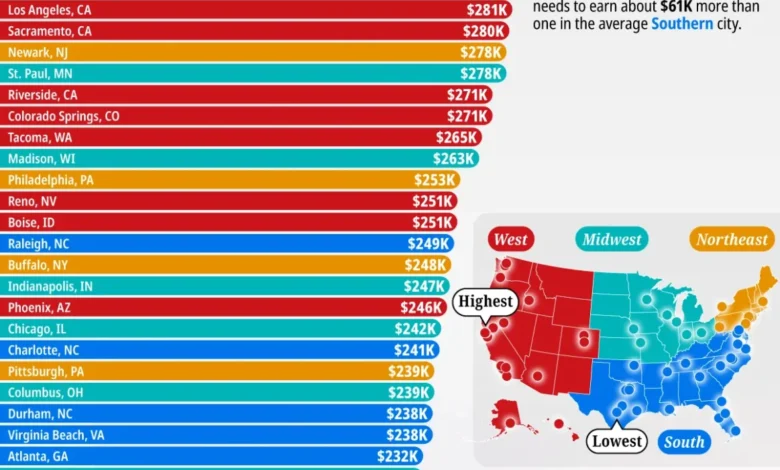
San Francisco leads the nation in cost-of-living requirements, but other major cities follow closely. Data indicates that a family of four requires $321,000 in Honolulu, $313,000 in San Diego, and $281,000 in Los Angeles to achieve a comparable level of comfort.
There is a documented "lifestyle premium" associated with the Western United States. On average, a family needs to earn $61,000 more per year in a Western state than in a Southern state to maintain the same standard of living. This premium is attributed to a combination of factors, including desirable weather, proximity to natural beauty, and access to robust job markets in technology and finance. For example, relocating from San Francisco to Honolulu could theoretically save a family $87,000 annually. At a 4% withdrawal rate, this reduction in annual expenses equates to a $2.2 million reduction in the total capital required for financial independence.
The Strategy of Geoarbitrage
For households unable to meet the $408,000 income threshold, "geoarbitrage"—the practice of moving to a location with a lower cost of living while maintaining a high income—remains a popular solution. However, experts suggest a tiered approach to relocation to minimize social and professional disruption.
The "Proper Geoarbitrage Strategy" recommends looking first for intra-city opportunities. Most expensive cities have neighborhoods that are undervalued or irrationally dismissed by the local populace. Moving just a few miles within the same city can often reduce housing expenses by 30% to 40% without requiring a change in social circles, medical providers, or employment. Only after exhausting local options should a family consider moving to a different state or a different country, as the "hidden costs" of moving—such as the loss of a support network and professional connections—can be substantial.
Societal and Economic Implications
The fact that a "middle-class" lifestyle now requires a top 5% income in certain regions has profound implications for urban planning and social mobility. If teachers, first responders, and mid-level managers cannot afford to live comfortably within the cities they serve, the social fabric of those metropolitan areas may begin to fray.
Furthermore, the rise of work-from-home (WFH) culture has altered the perception of "career comfort." The ability to work remotely has allowed some to maintain high HCOL salaries while living in lower-cost regions, though many firms are now instituting "return-to-office" mandates or adjusting salaries based on the employee’s location. The period between 2020 and 2023 saw a surge in "daytime leisure" among knowledge workers, which some analysts believe made the traditional concept of early retirement obsolete by providing a better work-life balance within the traditional career path.
Conclusion and Future Outlook
As inflation persists and the demand for housing in premier coastal hubs remains high, the $408,000 income requirement may soon become the norm rather than the exception for urban families. Financial independence in this environment requires a multi-pronged approach: maximizing career earnings, optimizing tax efficiency through passive investments, and remaining flexible regarding geography.
While the figures presented in recent cost-of-living studies are often met with disbelief, they reflect the objective reality of the modern American economy in elite zip codes. For the modern family, the path to a comfortable middle-class life is no longer a matter of simple budgeting; it is a complex feat of financial engineering that requires constant adjustment to the shifting tides of the global and local economy. Whether through intra-city relocation or the aggressive pursuit of passive income, the goal remains the same: achieving the freedom to live on one’s own terms in an increasingly expensive world.