AI May Not Cause Total Jobs Armageddon Afterall: Google Reports on How AI Is Being Used at Work

The narrative surrounding artificial intelligence has undergone a significant transformation over the past twenty-four months. In the wake of the public release of generative AI tools in late 2022, a wave of "doom-and-gloom" forecasting dominated the economic discourse. Founders of AI startups, venture capitalists, and industry promoters initially warned of a "job-destruction Armageddon," suggesting that white-collar professions, from legal clerks to software engineers, would be rendered obsolete in short order. However, as 2024 progresses, these dire predictions are being replaced by a more nuanced reality. Employment data and new behavioral research suggest that rather than replacing humans, AI is being integrated as a sophisticated co-pilot, enhancing productivity across a vast and diverse array of sectors.
A comprehensive new analysis from Google, titled the AI & Economy ATLAS (Activity, Task, Landscape, and Adoption Study), provides a detailed empirical look at how these technologies are actually being utilized in the workforce. The 100-page report reveals that AI adoption has reached a critical mass, touching nearly every corner of the American economy. Yet, the data suggests that the "automation" of entire job roles remains a fringe phenomenon, with the vast majority of interactions focused on collaborative assistance and task augmentation.
The Broad Diffusion of AI Across the US Workforce
The most striking finding of the ATLAS report is the sheer breadth of AI integration. The study indicates that AI is now utilized in 68% of all occupations, which collectively represent approximately 88% of total employment in the United States. This diffusion is not limited to the technology sector or high-level professional services. Instead, it spans the entire economic spectrum, including construction, leisure, hospitality, and traditional industries like agriculture and forestry.
While software developers and market researchers remain high-frequency users of AI, the technology has found a foothold in less-discussed professions. Farmers are utilizing AI for crop yield optimization and weather pattern analysis; industrial engineers are leveraging it for process efficiency; and foresters are using machine learning models to monitor forest health and timber inventories. This broad adoption suggests that AI is becoming a general-purpose technology, akin to the introduction of the personal computer or the internet, rather than a niche tool for data scientists.
Depth of Use: A "Shallow" but Significant Integration
Despite the high percentage of occupations using AI, the ATLAS data highlights a critical distinction between adoption and total replacement. For the median occupation that utilizes AI, the technology is only applied to approximately 21% of total tasks. This "shallow" integration suggests that while AI is ubiquitous, its role is currently limited to specific components of a job rather than the entirety of a professional role.
The report identifies a small subset—roughly 3% of occupations—where AI usage exceeds 75% of total tasks. These roles typically involve high-volume data processing or standardized documentation, such as software quality assurance analysts, human resources specialists focused on document management, and specialized testers. For the remaining 97% of the workforce, AI serves as a supplemental tool that handles specific sub-tasks, leaving the core responsibilities and decision-making processes in human hands.
From Automation to Collaboration: The Shift in Intent
One of the central myths of the AI era is that the primary goal of the technology is end-to-end automation. The Google analysis challenges this, categorizing the intent behind AI interactions. The data shows that non-routine cognitive tasks—such as hypothesis testing, creative design, and strategic ideation—account for 65% of work-related AI interactions.
In these contexts, the "intent" is rarely to replace the worker. Instead, the usage is categorized into four primary collaborative functions:
- Partial Drafting and Generation: Creating initial versions of reports, emails, or code snippets.
- Review and Refinement: Using AI to check for errors, summarize long documents, or polish existing work.
- Ideation and Strategy: Brainstorming new concepts or simulating different business scenarios.
- Information Retrieval and Learning: Using conversational agents to navigate complex internal databases or learn new technical skills.
Remarkably, attempts to automate tasks end-to-end represent less than 10% of AI conversations in the realm of non-routine cognitive work. This suggests that the value proposition of AI for most businesses lies in increasing the speed and quality of human output rather than reducing headcount.
Blue-Collar Integration and Multimodal Advancements
A common misconception is that AI is exclusively a white-collar phenomenon. The ATLAS report debunks this by highlighting the rise of AI in physical and manual trades. While about one-third of heavily physical occupations show no observed AI usage, many technical trades are early adopters of "multimodal" AI—systems that can process images and video alongside text.
Automotive technicians and industrial mechanics, for example, are using AI to interpret complex diagnostic results. By feeding images of machinery or electrical wiring diagrams into AI models, these workers can debug systems and inspect for wear more accurately than with traditional manuals alone. The report finds that the usage rate of multimodal AI in these technical trades is more than double the overall work baseline. In these scenarios, AI acts as a digital "master craftsman" providing real-time troubleshooting and learning support to workers on the shop floor.
The Economic Correlation: Wages, Education, and Expertise
The adoption of AI is not evenly distributed across income brackets. The research shows a strong positive correlation between AI usage and higher earnings. In the U.S. workforce, a 1% increase in an occupation’s median earnings is associated with a 2.5% increase in AI usage intensity. The median salary across observed AI-using occupations is approximately $83,000—roughly $20,000 higher than the national employment-weighted median.
This relationship persists even when controlling for educational attainment. While workers with higher degrees are more likely to use AI, the technology is also showing a unique "upskilling" effect for middle-tier expertise. The ATLAS data suggests that tasks requiring lower-to-middle levels of expertise often see higher AI usage than the most elite, high-expertise tasks. This indicates that AI may be acting as a "great equalizer," allowing workers with moderate experience to perform at a level previously reserved for senior experts, while the most complex, high-stakes decisions remain the exclusive domain of human specialists.
Labor Market Resilience and the "Entry-Level Paradox"
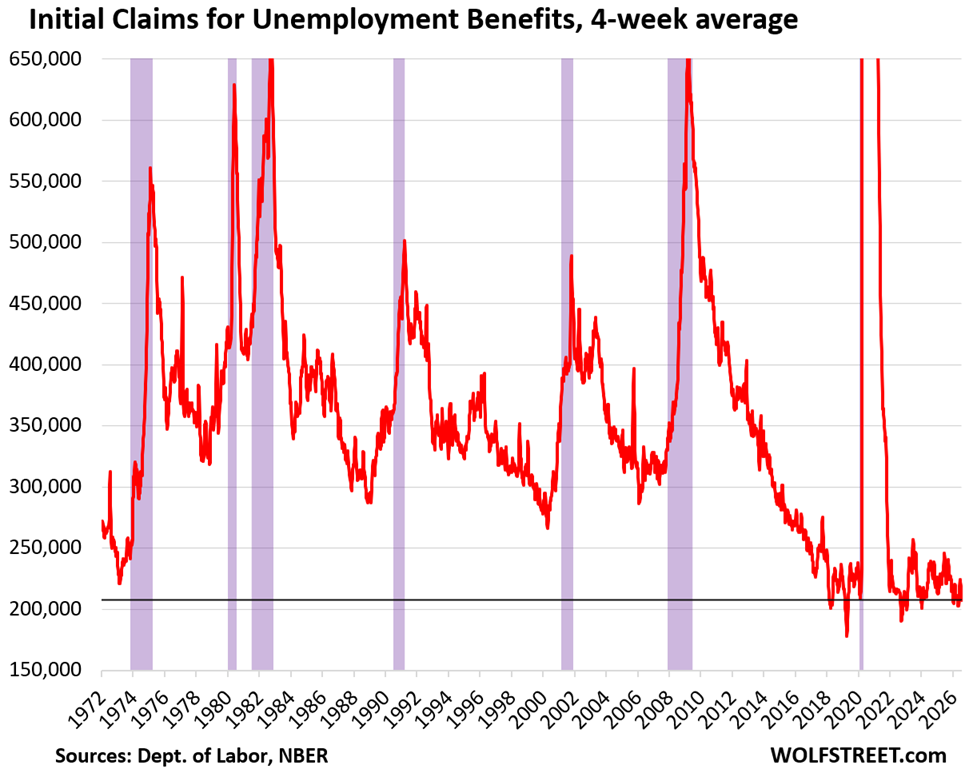
The data on AI adoption arrives against a backdrop of surprising resilience in the U.S. labor market. Despite high-profile layoff announcements from global technology and media firms, the actual impact on the domestic job market has been muted. Initial unemployment insurance claims remain at historic lows, often falling even as the total labor force grows.
Several factors explain this discrepancy. Many corporate "layoffs" have targeted vacant positions or global roles outside the U.S. Furthermore, workers in the U.S. who have been displaced are often finding new employment before their severance periods end, effectively holding two salaries and never appearing in unemployment statistics.
However, a new challenge is emerging: the "entry-level paradox." As experienced workers use AI to automate the "grunt work"—the repetitive drafting and data entry tasks typically assigned to junior employees—the traditional pathway for fresh-out-of-college workers is being disrupted. If a senior analyst can use AI to do the work of two junior associates, companies may hire fewer entry-level staff, making it harder for young workers to gain the foundational experience necessary to advance. This shift in the "apprenticeship" model of professional work is a burgeoning issue that economists are only beginning to track.
Chronology of the AI Economic Narrative
To understand the current state of AI in the workforce, it is helpful to view the timeline of its integration:
- Late 2022 – Early 2023: The "Shock Phase." The release of ChatGPT leads to widespread speculation of mass unemployment.
- Mid-2023: The "Experimental Phase." Corporations begin internal trials of AI, often through "walled garden" versions of LLMs to protect proprietary data.
- Late 2023: The "Integration Phase." Major software providers (Google, Microsoft, Adobe) integrate AI directly into productivity suites, leading to price increases (e.g., Google’s 16.7% subscription hike for Workspace with Gemini).
- 2024: The "Evidence Phase." Data from reports like ATLAS and labor statistics show that while the way we work is changing, the demand for workers remains high.
Implications for the Future of Work
The findings of the Google ATLAS report suggest that the "Job Armageddon" was a premature conclusion. Instead, the US economy is entering a period of AI-driven augmentation. For businesses, the focus has shifted from "How many people can we replace?" to "How can we make our current people 20% more effective?"
For the workforce, the implications are twofold. First, the ability to collaborate with AI is becoming a fundamental requirement for high-wage employment. Second, the nature of expertise is changing. As AI handles the routine and the "drafting," human value will increasingly be defined by judgment, ethical oversight, and the ability to ask the right questions—qualities that AI, in its current state, cannot replicate.
While the threat of mass automation has receded for now, the structural shifts in how young workers enter the market and how wages are distributed across the "AI-capable" workforce will likely be the defining economic stories of the next decade. The labor market is not shrinking; it is evolving into a more tech-integrated, multimodal, and highly productive landscape.