World Liberty Financial Scales USD1 Stablecoin to $5.3 Billion Peak Amidst Pivotal Regulatory Review and Institutional Expansion

The digital asset landscape is witnessing a stark divergence between the utility of stablecoin infrastructure and the speculative value of governance tokens, a trend exemplified by the recent performance of World Liberty Financial. This year, the project’s dollar-backed stablecoin, USD1, reached a peak circulating supply of $5.3 billion, securing a critical role as a direct settlement asset on Binance’s perpetual futures markets. Simultaneously, the organization is navigating a high-stakes regulatory process with the Office of the Comptroller of the Currency (OCC) for a national trust bank charter. Despite these operational milestones, the project’s governance token, WLFI, remains in a protracted consolidation phase, trading significantly below its post-launch highs of late 2025 and highlighting a disconnect between ecosystem growth and token valuation.
The Evolution of USD1 as a Tier-1 Settlement Asset
The most significant driver of USD1’s recent growth has been its integration into the core trading infrastructure of Binance, the world’s largest cryptocurrency exchange by volume. For much of its early existence, USD1 functioned as a secondary collateral option; traders could hold the asset, but they were required to borrow Tether (USDT) against it to open active positions. This dynamic shifted fundamentally on May 18, when Binance introduced a BTC/USD1 perpetual contract with up to 100x leverage. This move allowed profits, losses, and funding fees to be settled directly in USD1, effectively elevating it to the same status as USDT and USDC within the Binance ecosystem.
The expansion continued through the summer, with Ethereum-based perpetuals launching on July 3. Perhaps more indicative of the project’s long-term ambitions was the July 20 listing of a SpaceX equity-referenced perpetual that also settles in USD1. This represents a strategic foray into the intersection of traditional equity derivatives and blockchain-based settlement. By moving from a passive collateral asset to an active settlement asset, USD1 generates organic turnover based on trading volume rather than mere holding. For institutional counterparties and regulators, this transition is a key metric in determining whether a stablecoin possesses genuine utility beyond retail speculation.
Further cementing this relationship, Binance opened "Flexible Earn" products for USD1 on July 24. Offering yields of up to 8.5% (capped at 1,500 USD1 per user), these products serve to migrate the stablecoin from the high-velocity trading loop into the exchange’s savings architecture. While slower than trading volume, this "sticky" demand provides a foundational floor for the asset’s circulating supply, which stood at approximately $4.4 billion in mid-June according to data from The Block.
The Quest for a National Trust Charter and Regulatory Independence
While market integration proceeds on exchanges, World Liberty Financial is engaged in a transformative legal effort to internalize its financial plumbing. Currently, USD1 relies on BitGo as its primary custodian and issuer. However, on January 5, 2026, a subsidiary known as WLTC Holdings LLC filed an application with the OCC to charter the World Liberty Trust Company. If approved, this would allow World Liberty to handle the issuance, custody, and redemption of USD1 in-house, effectively removing BitGo from the operational loop.

The strategic advantages of a national trust charter are twofold. First, it would allow the entity to operate under a single federal regulatory framework, bypassing the cumbersome "patchwork" of state-by-state money transmitter licenses. Second, it eliminates counterparty risk by consolidating the issuer and custodian roles. This move follows a precedent set in December 2025, when the OCC granted conditional approvals for trust charters to major industry players including Circle, Ripple, Paxos, and Fidelity Digital Assets.
However, the application has become a lightning rod for political scrutiny. OCC Comptroller Jonathan Gould, who was appointed by a president who serves as World Liberty’s co-founder emeritus, has faced questions regarding potential conflicts of interest. During a February Senate Banking Committee hearing, Senator Elizabeth Warren questioned whether the application accurately disclosed a reported 49% stake held by UAE-based interests, citing OCC rules that require the naming of any shareholder with a 10% or greater stake. While Gould has maintained that all charter applications are processed on a strictly nonpartisan basis, the decision has been delayed. Despite reports in mid-June suggesting an imminent ruling, the application remained listed as "pending" as of late July, creating a period of uncertainty for the project’s most critical strategic pillar.
Institutional Partnerships and the Move Toward Tokenized Funds
Beyond the retail and exchange markets, World Liberty Financial is aggressively pursuing institutional use cases through a partnership with Apex Group. As a global fund administrator managing approximately $3.5 trillion in client assets across 52 countries, Apex Group provides a massive sandbox for testing USD1’s utility in fund operations. The collaboration aims to explore the use of USD1 for subscriptions, distributions, and redemptions within tokenized fund structures.
In traditional finance, these processes often rely on correspondent banking networks, which are subject to multi-day settlement cycles, weekend downtime, and intensive manual reconciliation. By utilizing a stablecoin for these transactions, fund managers can theoretically achieve near-instant settlement and reduce the capital drag associated with "money in transit." While the viability of USD1 as the specific standard for this industry remains to be seen, the partnership signals an intent to move the stablecoin into the "plumbing" of global asset management, far removed from the volatility of the crypto-native markets.
Marketing Initiatives and the Shadow of Investigation
The project’s public-facing efforts reached a climax on June 14 at the UFC Freedom 250 event, held on the White House South Lawn. World Liberty Financial served as the official partner, sponsoring a $250,000 "Performance of the Night" bonus pool paid out entirely in USD1. While the event provided high-profile exposure, it coincided with renewed scrutiny regarding the project’s financial structure.
A Reuters investigation published in early June estimated that the Trump family has earned approximately $2.3 billion across various crypto ventures, while a significant number of investors—estimated at over one million—have faced collective losses of a similar magnitude. Within the World Liberty ecosystem specifically, disclosures indicate that 75% of the proceeds from WLFI token sales flow to DT Marks DEFI LLC, a Trump-controlled entity. These figures have fueled a debate regarding the alignment of interests between the project’s high-level stakeholders and its retail token holders.

Technical Analysis: WLFI Token Struggles for Momentum
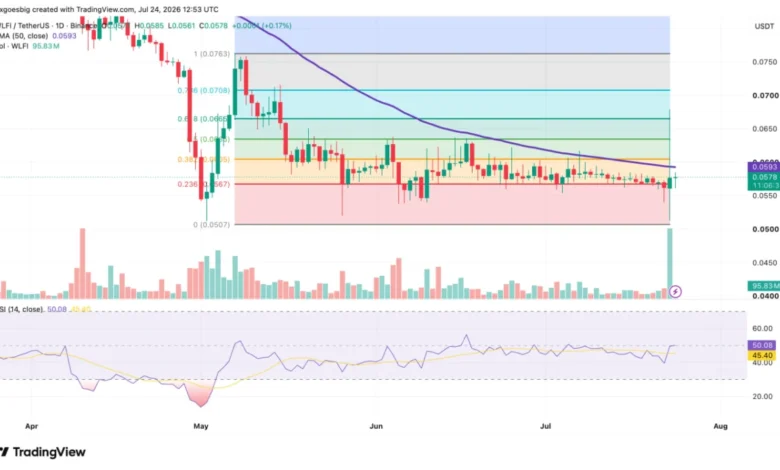
Despite the rapid expansion of the USD1 stablecoin, the WLFI governance token has struggled to regain its footing following a significant market correction in May. After falling from a high of $0.0763 to a low of $0.0507, the token has spent three months oscillating between two key Fibonacci retracement levels: the 38.2% line at $0.0605 and the 23.6% line at $0.0567.
As of July 24, WLFI was trading at $0.058, reflecting a modest 2% gain over the week. However, the technical indicators remain cautious:
- Moving Averages: The token is currently trading below its 50-day exponential moving average (EMA) of $0.0593, which continues to slope downward, suggesting a persistent bearish trend.
- Relative Strength Index (RSI): The RSI is hovering near 48, indicating a neutral market sentiment with no immediate signs of overbought or oversold conditions.
- Volume: Trading turnover has significantly decreased since the May crash, with only minor upticks during brief recovery attempts.
Market analysts suggest that a daily close above the $0.0605 resistance level would be necessary to signal a potential trend reversal toward the $0.0665 range. Conversely, a failure to hold the $0.0567 support could see the token revisit its May lows of $0.0507.
Multi-Chain Expansion and the Path Ahead
The broader narrative for World Liberty Financial is now centered on multi-chain dominance and infrastructure control. WhaleFactor data indicates that USD1’s market capitalization on the Solana blockchain has surged from $115 million to over $1 billion this year. The project is also eyeing native deployments on Aptos and Monad, while the WLFI Markets protocol is working to integrate USD1 as direct collateral for decentralized lending.
The confluence of these factors—the Binance settlement status, the Solana growth, the Apex Group partnership, and the pending OCC charter—paints a picture of a project attempting to vertically integrate its stablecoin ecosystem. By controlling the issuance, the custody, and the primary lending markets for USD1, World Liberty Financial aims to build a self-sustaining financial loop.
The eventual decision by the OCC remains the most significant catalyst on the horizon. A successful charter would provide a level of regulatory legitimacy and operational efficiency that few competitors possess. For investors and observers, the key question remains whether this institutional-grade infrastructure will eventually translate into value for the WLFI token, or if the stablecoin and its governance asset will continue to trade on entirely separate trajectories. For now, the "utility" story of USD1 is outpacing the "value" story of WLFI, a dynamic that reflects the maturing—and increasingly complex—nature of the global stablecoin market.
Related posts: