Brent Crude Regains Traction Above $108 Amid Middle East Supply Anxieties and Geopolitical Escalations


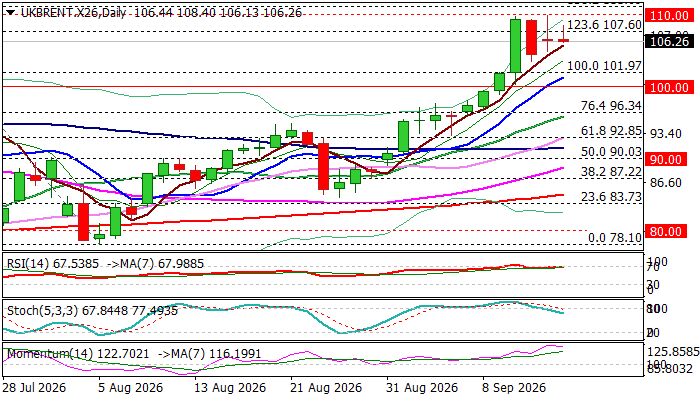
Global energy markets experienced renewed volatility as Brent crude futures clawed their way back above the psychologically significant $108 per barrel threshold. This latest upward movement partially offsets technical warning signals generated by a long upper shadow on the preceding session’s candlestick pattern. Although that session ultimately formed a Doji—reflecting market indecision and a temporary standoff between buyers and sellers—subsequent buying pressure successfully pushed prices toward the upper boundary of a tight three-session congestion range. As traders re-engage, attention has firmly shifted back toward the formidable $110 psychological barrier, a level that has repeatedly tested the resolve of market bulls.
The underlying fundamentals driving the current bullish momentum remain robustly supportive, anchored by a series of high-stakes geopolitical disruptions in the Middle East. Recent escalations along the Saudi-Yemeni border zone, alongside reported physical damage to a critical pipeline infrastructure asset inside Saudi Arabia, have reignited fears over the security of vital energy supply chains. Compounding these physical vulnerabilities are ongoing strategic concerns regarding the Bab el-Mandeb strait—a critical maritime chokepoint for global oil transit—while commercial traffic through the equally vital Strait of Hormuz remains severely depressed. Together, these compounding variables have created an environment of acute supply anxiety, keeping energy traders on high alert and underpinning sustained risk premiums across international crude benchmarks.
Technical Landscape and Price Action Dynamics
During the prior session, international benchmark prices came within mere ticks of touching the coveted $110 mark before encountering substantial headwinds. This selling pressure in the upper pricing tiers was largely attributed to overbought technical indicators and the sheer historical significance of the resistance zone. However, the absence of aggressive selling has been notable. Pullbacks thus far have remained shallow, reliably contained by the rising 5-day moving average (5DMA). This resilience strongly implies that underlying upside pressure persists and that market participants are not yet prepared to abandon their bullish bets.
At the same time, the emergence of a Doji candlestick formation underscores a period of tactical hesitation. Traders appear increasingly cautious about committing to larger, directional plays without confirmation of a decisive breakout. Consequently, market participants are closely monitoring key technical pivot points to gauge the next leg of the journey.
Immediate downside support is currently pegged at $104.80, corresponding to the previous session’s intraday low. Should selling momentum pick up, secondary support levels rest near Friday’s swing low of $103.48, followed by the former resistance-turned-support level at $101.97, established during the July 23 trading session. Market analysts note that any potential deeper corrections should theoretically find firm footing around these thresholds, ultimately preserving the integrity of the crucial $100 psychological support floor. Conversely, resistance is staked out at $108.40, with heavier ceilings waiting at $110.00, $111.09, and the extended target of $112.70.
Background Context: Geopolitical Flashpoints and Maritime Vulnerabilities
To fully understand the gravity of the current pricing environment, one must examine the cascading series of security incidents that have plagued key Middle Eastern energy corridors over recent months. The Arabian Peninsula remains the beating heart of global petroleum supply, and any disruption to its extraction and export infrastructure reverberates instantly across international exchanges.

The recent flare-up along the Saudi-Yemeni frontier introduces renewed threats to domestic energy installations. While security forces have historically maintained a robust defense perimeter around critical facilities, sporadic asymmetric threats—including drone and missile activity—continue to pose systemic risks. The reported damage to a key internal pipeline highlights the persistent vulnerability of vast, overland energy grids to localized conflict and sabotage.
Equally critical to the current market narrative are the maritime routes through which millions of barrels of crude transit daily. The Bab el-Mandeb strait, connecting the Red Sea to the Gulf of Aden, serves as a vital artery for tanker traffic heading toward the Suez Canal and European markets. Control and security within this narrow waterway have become major talking points for defense analysts and shipping conglomerates alike. When combined with depressed transit volumes through the Strait of Hormuz—the world’s most critical oil transit chokepoint, situated between Oman and Iran—the cumulative effect is a severe bottleneck in global oil logistics. Shippers are increasingly forced to factor in higher insurance premiums, longer transit times, and heightened security risks, all of which translate directly into elevated landed costs for crude consumers.
Chronology of Recent Market Movements
The progression of Brent crude’s recent rally illustrates a market caught between powerful fundamental drivers and formidable technical resistance:
- Mid-July: Prices consolidate following earlier summer volatility, with technical attention focused on establishing a firm base above the $100 mark. The July 23 session sets a notable peak at $101.97, which later transforms into a vital support reference.
- Late July to Early August: Geopolitical tensions in the Middle East begin to escalate. Reports filter into mainstream terminals detailing heightened security incidents along the Saudi-Yemeni border and localized disruptions to pipeline operations.
- Early Trading Week: Brent crude initiates a sharp upward surge, breaking through intermediate resistance levels and probing the round-figure $108 mark. The momentum reflects growing unease over restricted maritime traffic in the Bab el-Mandeb and Hormuz straits.
- The Preceding Session: Prices spike toward the doorstep of $110, coming within ticks of the milestone before meeting stiff resistance from profit-takers and overbought technical algorithms. A Doji candlestick forms, capturing market indecision, though shallow pullbacks supported by the 5-day moving average signal that buyers remain in control of the short-term trend.
- Current Session: Brent regains upward traction, successfully clearing the $108 level once again and putting renewed pressure on the upper boundaries of the recent congestion zone as traders eye a renewed test of the $110 barrier.
Supporting Data and Key Technical Levels
For traders and risk managers navigating the current commodity landscape, quantitative metrics provide a structured framework for decision-making. The technical parameters defining the current trading range are delineated by clear boundaries:
Resistance Levels:
- First Resistance: $108.40 (Immediate intraday ceiling)
- Second Resistance: $110.00 (Major psychological barrier)
- Third Resistance: $111.09 (Extended technical target)
- Fourth Resistance: $112.70 (Upper band of projected medium-term momentum)
Support Levels:
- First Support: $104.80 (Recent session low)
- Second Support: $103.48 (Previous Friday bottom)
- Third Support: $101.97 (Former top from the July 23 session)
- Fourth Support: $101.16 (Buffer zone ahead of critical psychological floor)
Official Responses and Industry Reactions
While direct statements from state-owned energy conglomerates and governmental ministries have emphasized operational resilience and ongoing security enhancements, industry insiders note a palpable shift in risk management strategies. Major shipping lines and energy trading houses have convened emergency risk-assessment committees to review transit protocols through the Red Sea and the Persian Gulf.
Independent energy analysts point out that the market is currently pricing in a "geopolitical risk premium" that could persist indefinitely if diplomatic breakthroughs remain elusive. Speaking anonymously due to the sensitive nature of commercial trading positions, a senior commodities strategist at a major London-based brokerage observed that the physical realities on the ground currently outweigh macroeconomic headwinds. "Traders are looking past standard demand-destruction narratives for the moment," the strategist noted. "When you have confirmed infrastructure concerns in Saudi Arabia and restricted flows through critical maritime chokepoints, the path of least resistance for prices tends to be skewed to the upside, even when technical indicators flash overbought signals."
Furthermore, insurance underwriters have begun adjusting maritime war-risk premiums for vessels transiting the southern Red Sea and adjacent waters. These rising operational costs are inevitably absorbed into the final pricing structure of delivered crude cargoes, reinforcing the elevated baseline for international benchmarks like Brent.
Broader Economic Impact and Macroeconomic Implications
The resurgence of Brent crude toward the $110 threshold carries significant macroeconomic repercussions for the global economy. Energy prices act as a foundational input cost across virtually all industrial, manufacturing, and transportation sectors. A sustained elevation in petroleum costs threatens to reignite inflationary pressures at a time when central banks worldwide have been meticulously attempting to guide their respective economies toward a soft landing.
Importing nations, particularly across Europe and Asia, face renewed pressure on trade balances and domestic energy bills. Higher fuel costs directly translate into elevated prices at the retail pump, increased utility expenses, and inflated logistics charges for consumer goods. This supply-side cost-push inflation complicates the policy calculus for monetary authorities, who must weigh the risks of persistent energy-driven inflation against the dampening effects of high borrowing costs on broader economic growth.
Conversely, oil-producing nations within and outside the Middle East stand to record substantial fiscal windfalls from the higher price environment. However, regional producers remain acutely aware that prolonged volatility and extreme price spikes can accelerate long-term structural shifts toward alternative energy sources and accelerated electrification in major consumer markets.
As the trading week progresses, all eyes remain fixed on the $110 barrier. Whether Brent crude possesses the sustained fundamental catalysts required to decisively breach this psychological ceiling—or whether overbought conditions and profit-taking will trigger a deeper correction toward the established support cushions at $104.80 and below—will depend largely on incoming news feeds from the Middle East and the resilience of buyers at key moving average thresholds.