EUR/USD Navigates Turbulence Amid Shifting Global Economic and Political Currents


The EUR/USD currency pair experienced a week of considerable volatility, ultimately leaning towards a pro-euro sentiment, despite initial weakness in the US dollar that saw it dip to multi-year lows. This fluctuation was influenced by a complex interplay of geopolitical concerns, questions surrounding the Federal Reserve’s independence, and the subsequent stabilization of the greenback following a near government shutdown and a key nomination for the Fed’s leadership.
Dollar’s Initial Vulnerability and Subsequent Resilience
The US dollar’s retreat was exacerbated by heightened geopolitical anxieties and persistent concerns about the Federal Reserve’s autonomy. These factors created an environment of uncertainty for investors, prompting a reassessment of the dollar’s strength. However, a significant turning point arrived with the averted government shutdown, a development that brought a measure of relief to financial markets. President Trump and the Senate’s agreement to avoid a lapse in federal funding was widely interpreted as a positive step, reducing immediate political risk and offering a reprieve for the dollar.
Further bolstering the dollar’s stability was the nomination of former Federal Reserve Governor Kevin Warsh as the next Fed Chair. This choice was perceived by market participants as a signal of commitment to central bank independence, a principle highly valued by investors seeking predictable monetary policy. The prospect of a leader less aligned with aggressive easing policies provided a sense of reassurance, contributing to the dollar’s recovery.
Mixed Economic Signals from the United States
The economic data emerging from the United States presented a nuanced picture, offering mixed signals to policymakers and market analysts. On the positive side, factory orders exceeded expectations, indicating a degree of underlying strength in the manufacturing sector. This suggested that businesses were investing and expanding, a potentially bullish sign for economic growth.
However, this optimism was tempered by a rise in initial jobless claims, a metric that tracks the number of individuals filing for unemployment benefits for the first time. An uptick in jobless claims can signal a softening in the labor market, a key component of economic health. Furthermore, the US trade deficit widened, indicating that the country was importing more goods and services than it was exporting. A persistent and widening trade deficit can pose challenges to domestic industries and contribute to currency depreciation over the long term.
Of particular note were the Producer Price Index (PPI) figures, which pointed towards persistent inflationary pressures. Both the headline PPI and the Core PPI (which excludes volatile food and energy prices) came in stronger than anticipated. These readings reinforced the view that inflation, while not necessarily spiraling out of control, remained elevated. This sticky inflation environment suggested that the Federal Reserve would likely maintain a cautious approach to monetary policy, being reluctant to aggressively cut interest rates in the near future.
Atlanta Fed President Raphael Bostic’s comments underscored this sentiment, emphasizing that inflation levels were still too high and advocating for patience from the Federal Reserve. His remarks suggested that the bar for any significant easing of monetary policy would remain high, implying that interest rate cuts would likely be gradual and data-dependent. This hawkish undertone from a prominent Fed official contributed to the narrative of a Fed less inclined towards rapid rate reductions.
Eurozone’s Steady Growth and ECB’s Stance
In contrast to the mixed signals from the US, the Eurozone presented a more consistently supportive fundamental backdrop for the euro. The fourth-quarter Gross Domestic Product (GDP) figures for both the Eurozone and Germany surpassed forecasts. These positive economic indicators pointed to a resilient, albeit modest, growth trajectory for the region. The fact that major economies within the Eurozone were expanding at a better-than-expected pace provided a solid foundation for the euro’s performance.
German inflation data also offered a degree of stability, hovering close to the European Central Bank’s (ECB) target. Both the Harmonised Index of Consumer Prices (HICP) and core inflation measures remained broadly stable, indicating that price pressures in Europe were not overheating. This controlled inflation environment allowed the ECB to maintain its current policy stance without immediate pressure to either hike or cut rates.
Analysts at prominent financial institutions such as Rabobank, TD Securities, and Brown Brothers Harriman have largely concurred on the ECB’s likely policy path. Their consensus view is that the ECB will maintain the deposit rate at its current level of approximately 2.00% for an extended period. This suggests a policy of continuity, with little immediate impetus for either aggressive rate cuts or hikes. While the strength of the euro has raised some concerns about its impact on the competitiveness of Eurozone exports, the overarching view among these analysts is that the ECB sees no urgent need to alter its interest rate policy.
The Specter of a Multi-Year US Dollar Downturn
Beyond the immediate week’s events, strategists at Nordea and UOB have raised the possibility of a prolonged, multi-year downturn for the US dollar. Their analysis is rooted in historical patterns, which often show extended periods of dollar decline following significant peaks. Furthermore, they point to a potential shift in foreign investor behavior, suggesting that a reallocation of capital away from the dollar might be underway.

This perspective implies that the recent dollar weakness could be the precursor to a more substantial and sustained depreciation. If this scenario unfolds, it would create further upward potential for the EUR/USD pair over the coming years. However, this bullish outlook for the euro is contingent on several factors. Crucially, Eurozone growth and inflation must remain contained, preventing the ECB from feeling compelled to tighten monetary policy. Additionally, the ECB’s commitment to a broadly steady policy stance is seen as vital to supporting this projection.
Key Events to Watch for EUR/USD in the Coming Week
The upcoming week promises a dense calendar of high-impact economic releases that will be closely scrutinized by EUR/USD traders. These events have the potential to trigger significant price movements as markets re-evaluate the relative economic outlooks and monetary policy trajectories of the United States and the Eurozone.
For the Eurozone:
- ECB Monetary Policy Meeting: The European Central Bank’s upcoming meeting is of paramount importance. While a rate hike or cut is not anticipated, the accompanying statement and press conference will be closely watched for any shifts in tone or forward guidance. Any indications of concern regarding the euro’s strength, or a subtle change in the language used to describe inflation and growth prospects, could influence the euro’s direction. Traders will be particularly attentive to any "pushback against euro strength," which could signal a desire by the ECB to see a more competitive exchange rate for exports.
For the United States:
- Non-Farm Payrolls (NFP): This is arguably the most closely watched economic indicator in the US. The NFP report provides a comprehensive snapshot of the labor market, including job creation, unemployment rate, and average hourly earnings. A significantly stronger-than-expected NFP report would likely reinforce expectations of a hawkish Federal Reserve, potentially supporting the dollar. Conversely, a weaker-than-expected reading could fuel speculation of an earlier or more aggressive rate cut, putting downward pressure on the dollar.
- Unemployment Rate: Alongside NFP, the unemployment rate offers another critical gauge of labor market health. A sustained low unemployment rate generally supports a tightening monetary policy, while a rising rate could signal economic headwinds.
- Average Hourly Earnings: This component of the jobs report provides insights into wage inflation. Strong wage growth can contribute to broader inflationary pressures, influencing the Fed’s rate decisions.
The interplay between these US labor market data points and the ECB’s policy pronouncements will be crucial in shaping the EUR/USD exchange rate. Any considerable surprises in the NFP or unemployment figures could trigger sharp, immediate moves in the pair as markets rapidly reassess the relative policy outlooks of the Federal Reserve and the European Central Bank.
EUR/USD Weekly Technical Forecast: Corrective Downside Under 1.19
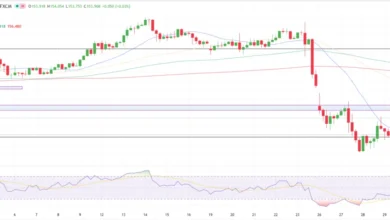
From a technical perspective, the EUR/USD daily chart indicates a corrective phase following the pair’s ascent to over four-year highs above the 1.2000 level. The recent price action has seen EUR/USD fall back below a previously broken supply zone, correcting below the significant psychological mark of 1.1900.
The Relative Strength Index (RSI), a momentum oscillator, has retreated from its overbought territory. This gradual decline in the RSI suggests a waning of upward momentum and points to underlying weakness in the current price trend. However, despite this corrective movement, the key moving averages (MAs) on the daily chart remain in a bullish configuration. These MAs are currently providing robust support for the pair, acting as a potential floor for any further downside.
The immediate downside could find significant support at the bullish gap observed around the 1.1830 level. This gap represents a price zone where trading was unusually active, often acting as a magnet for prices during pullbacks. Further down, a horizontal support level at 1.1800 presents another critical area of contention for the bears.
On the upside, for the bullish momentum to regain traction and sustain further gains, the price needs to achieve a decisive acceptance above the 1.2000 psychological mark. A sustained breach of this level would open the door for potential targets at 1.2100, followed by a more ambitious objective at 1.2200. However, the current technical setup suggests that the immediate outlook favors a corrective downside bias as long as the price remains below the 1.1900 level.
Broader Implications and Market Sentiment
The week’s developments highlight a complex and evolving global economic landscape. The US dollar’s sensitivity to geopolitical events and domestic policy decisions underscores its role as a barometer of global risk sentiment. The Federal Reserve’s cautious stance, driven by persistent inflation concerns, suggests a divergence in monetary policy paths compared to potential easing cycles elsewhere.
For the Eurozone, the confirmation of steady growth and a stable inflation outlook provides a solid foundation for the euro. However, the potential for a prolonged US dollar downtrend, as suggested by some analysts, could see EUR/USD climb higher, provided the Eurozone’s economic narrative remains consistent. This scenario would imply a significant reallocation of global capital, with investors seeking alternatives to the depreciating dollar.
The upcoming week’s economic data releases, particularly the US labor market figures and the ECB’s policy guidance, will be critical in clarifying the near-term direction of EUR/USD. Markets will be closely monitoring any signals that could alter the current policy divergence narrative, potentially leading to sharp adjustments in currency valuations. The ability of the Eurozone to maintain its growth momentum while keeping inflation in check will be crucial for sustaining the euro’s strength against a potentially weaker dollar in the longer term.