Canada Inflation Holds Steady at 3.0% in August as Underlying Pressures Shift Beneath the Headline

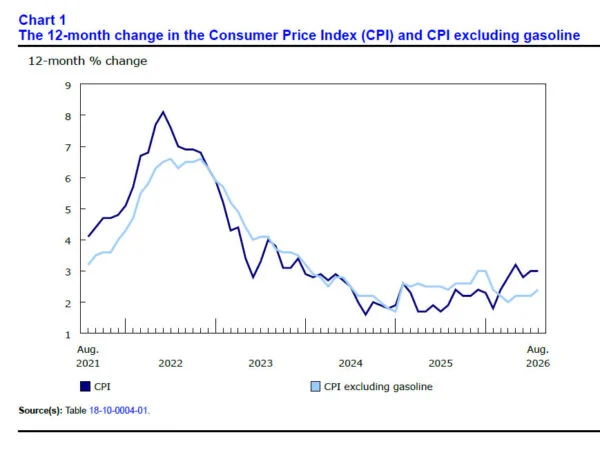
Canada’s headline consumer price index (CPI) held firm at 3.0% year-on-year in August, matching both market expectations and the rate recorded in July. While the stability at the headline level might suggest a straightforward continuation of prevailing economic trends, a closer examination of the underlying data reveals a complex interplay of opposing inflationary forces. A cooling energy sector helped offset persistent domestic price pressures, while core measures provided central bankers with a nuanced picture of ongoing economic adjustments.
On a non-seasonally adjusted basis, the consumer price index reversed direction, moving from a 0.5% monthly increase in July to a 0.1% decline in August. This contraction undershot consensus forecasts, which had anticipated a flat month-on-month reading. However, when adjusted for seasonality, the CPI actually rose 0.2% month-on-month. This discrepancy clarifies that the unadjusted monthly decline did not signify a broad-based, systemic fall in consumer prices, but rather reflected predictable seasonal shifts that were masked in raw data calculations.
Beneath the steady 3.0% annual headline figure, significant cross-currents were at play across major consumer categories. The most prominent downward pressure originated in the energy sector, where gasoline inflation decelerated notably from 25.7% year-on-year in July to 22.8% in August. This moderation in fuel prices provided essential relief to household budgets, preventing the broader index from climbing higher.
Conversely, inflation metrics excluding gasoline accelerated, climbing from 2.2% to 2.4% over the same period. This divergence underscores that while relief at the pump was tangible, the cost of living continued to edge upward across several core domestic sectors.
Sector Breakdown: Travel, Rent, and Groceries
The acceleration in non-gasoline inflation was driven in large part by sharp increases in specific categories, most notably travel-tours and shelter. Travel-tour inflation experienced a dramatic surge, jumping from 15.2% to 26.1% year-on-year. Analysts attribute this steep upward movement to a combination of base-year effects from the previous year and the introduction of new fuel surcharges by carriers, even as prices for travel-tours fell 2.9% on a month-on-month basis.
Shelter costs also added upward momentum to the report, with rent inflation accelerating from 2.5% to 2.8% year-on-year. The rental market increases were heavily concentrated in the provinces of Manitoba and Ontario, where tight housing supply and steady demographic demand continued to exert pressure on tenants.
In contrast, other essential consumer categories offered constructive relief for Canadian households. Grocery inflation slowed perceptibly from 3.1% to 2.8% year-on-year. Significantly, this marked the first time since July 2024 that the annual increase in food prices fell below the headline inflation rate. Within the food basket, dairy inflation slowed dramatically, dropping from 3.1% to 0.7%. Meanwhile, clothing and footwear prices reversed course, moving from a 0.9% increase in July to a 1.1% decline in August, offering temporary respite to retail shoppers.
Bank of Canada Core Measures and Underlying Trends
For policymakers at the Bank of Canada, the August consumer price report offered reassurance that underlying inflationary pressures were not experiencing a broad reacceleration. The central bank’s preferred suite of core inflation measures remained relatively well-contained, keeping within or near the upper bounds of the institution’s target range.
The CPI median measure held steady at 2.0% year-on-year, right at the midpoint of the Bank of Canada’s 1% to 3% control bracket. Similarly, the CPI trimmed measure remained unchanged at 1.9% year-on-year. Meanwhile, the CPI common measure eased slightly, moving down from 2.7% to 2.6%.
These core readings indicate that while specific components—such as travel services and rental housing—experienced accelerated price growth, the general momentum of price increases across the broader economy is not spiraling out of control. Nevertheless, the firmer trajectory of rent and non-gasoline components suggests that the path back to a sustainable 2% target will require continued vigilance from monetary authorities.
Data Summary: August vs. July Comparison
| Indicator | August | July |
|---|---|---|
| CPI y/y | 3.0% | 3.0% |
| CPI m/m | -0.1% | 0.5% |
| CPI excluding gasoline y/y | 2.4% | 2.2% |
| Gasoline y/y | 22.8% | 25.7% |
| CPI common y/y | 2.6% | 2.7% |
| CPI median y/y | 2.0% | 2.0% |
| CPI trimmed y/y | 1.9% | 1.9% |
Economic Chronology and Background Context
To understand the current positioning of Canada’s inflation trajectory, it is necessary to examine the economic timeline leading up to the late-summer data releases. Over the preceding twelve months, the Canadian economy navigated a complex transition characterized by elevated borrowing costs, cooling labor markets, and fluctuating global commodity prices.
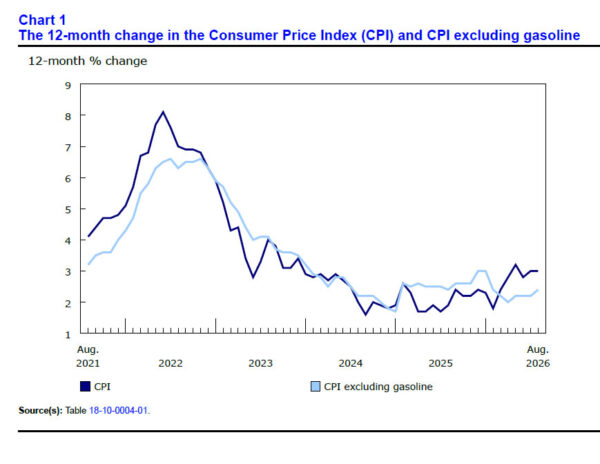
In early 2024, inflation showed stubborn persistence above the central bank’s comfort zone, driven largely by shelter costs and robust consumer demand. As the Bank of Canada maintained its policy interest rate at restrictive levels, economic growth began to cool visibly by mid-year. By the summer of 2024, headline inflation had begun to moderate more consistently, paving the way for the central bank to initiate a cycle of interest rate cuts aimed at supporting economic momentum without reigniting price pressures.
However, the journey toward price stability has been uneven. While goods inflation—particularly for groceries and durable items—has largely normalized, service-sector inflation has remained sticky. The persistence of high shelter costs, compounded by structural housing deficits in major urban centers like Toronto and Vancouver, has created a domestic floor for inflation that energy price fluctuations alone cannot dismantle.
Macroeconomic Implications and Market Reactions
The August inflation report carries significant weight for financial markets and monetary policymakers as they prepare for the final quarter of the year. With headline inflation tracking precisely at 3.0% and core measures showing overall containment, the data supports a narrative of a stabilizing, albeit structurally altered, economy.
Fixed-income markets responded cautiously to the release. The stability in core metrics reduces the immediate probability that the Bank of Canada will feel compelled to re-accelerate monetary tightening. Conversely, the stickiness in rent and non-gasoline components cautions against overly aggressive monetary easing. Analysts suggest that the central bank is likely to maintain a measured, data-dependent approach to future rate adjustments, balancing the risk of an economic slowdown against the threat of entrenched service-sector inflation.
Economists note that while consumers continue to feel the pinch of cumulative price increases from previous years, the monthly dynamics point to a cooling inflationary psychology. Businesses are finding less room to pass on sweeping price hikes, and consumers are increasingly pushing back against exorbitant costs, forcing a more competitive pricing environment in retail and grocery sectors.
As Canada moves deeper into the second half of the year, tracking the balance between easing goods prices and persistent shelter inflation will remain the primary focus for economic forecasters. The August data demonstrates that while the headline figure remains anchored, the underlying battle against domestic cost pressures is far from over, requiring careful calibration from both fiscal and monetary authorities.