US Treasury and Department of Justice Target Xinbi Guarantee in Massive $24 Billion Crypto Laundering Crackdown

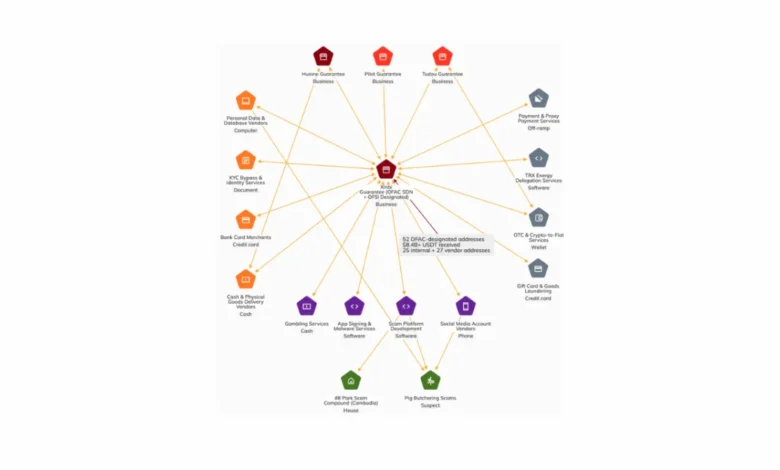
The United States Department of the Treasury, acting in coordinated enforcement with the Department of Justice, has officially sanctioned Xinbi Guarantee, a prominent Chinese-language online escrow marketplace that federal authorities have identified as a central financial clearinghouse for international cyber scams, massive financial fraud, and sophisticated money laundering operations.
According to federal investigators, the platform successfully processed more than $24 billion in both cryptocurrency and fiat currency transactions since its inception in 2022. This sweeping enforcement action underscores a strategic shift by global law enforcement agencies, moving away from merely targeting individual perpetrators of cybercrime toward dismantling the complex financial and technical infrastructure that enables illicit networks to operate at a global scale.
Concurrently, the U.S. Department of Justice executed a sweeping disruption campaign that seized Xinbi’s core operational Telegram infrastructure and legally restrained more than $52 million in digital assets directly linked to the marketplace and its extensive network of third-party vendors. Law enforcement agents successfully seized approximately $12 million across two primary cryptocurrency wallets, while ongoing legal petitions seek to freeze an additional 47 associated wallets suspected of holding millions more in illicit proceeds.
Anatomy of an Illicit Escrow Marketplace
Xinbi functioned far beyond a standard peer-to-peer exchange, operating instead as a sophisticated, underground escrow marketplace. The platform acted as a vital bridge connecting transnational cyber scam operators with specialized vendors offering illicit services, including technology infrastructure, automated laundering tools, and specialized cash-out pathways.
Among the platform’s diverse clientele were criminal networks closely associated with state-sponsored hackers, including North Korean threat groups notorious for stealing hundreds of millions of dollars from decentralized finance protocols and cryptocurrency exchanges.
Federal investigators revealed that Xinbi’s laundering mechanism relied primarily on substitution rather than traditional obfuscation. Rather than running traceable funds through complex mixing services or privacy coins, the marketplace utilized a specialized class of vendors known within the underground economy as "Black U" launderers.
These vendors accept traceable, state-linked stolen funds—such as cryptocurrency assets associated with North Korean cyberattacks—and seamlessly replace them with stablecoins sourced from entirely separate illicit revenue streams. These alternative streams frequently comprise the proceeds harvested from "pig butchering" scams, romance frauds, and widespread investment schemes flowing through the very same marketplace ecosystem.

Through this substitution method, the provenance of the stolen funds becomes obscured as they are absorbed into a much larger, highly active pool of illicit financial transactions. Meanwhile, the North Korean-linked threat actors receive nominally "clean" stablecoins. These cleansed digital assets can subsequently be converted into sovereign fiat currency through a network of unlicensed over-the-counter (OTC) digital asset desks, allowing rogue states and criminal cartels to monetize their cyber operations with relative impunity.
The Broader Regulatory and Geopolitical Context
The public takedown of Xinbi Guarantee arrives amid an increasingly aggressive regulatory climate worldwide, as central banks and financial watchdogs clamp down on illicit crypto flows used for sanctions evasion. The U.S. Treasury has repeatedly emphasized that digital assets remain a tool of choice for heavily sanctioned nation-states, such as Iran and North Korea, seeking to bypass traditional international banking controls and SWIFT network monitoring.
International jurisdictions are rapidly aligning their regulatory defenses to match this evolving threat matrix. Notably, financial authorities across Europe and emerging markets have begun implementing stringent compliance measures. For instance, the Italian Central Bank recently mandated rigorous sanctions screening protocols for all cryptocurrency transfers originating within or passing through its jurisdiction. Similar legislative and administrative frameworks are taking shape globally, including proposed capital flow management draft regulations in South Africa and stricter compliance mandates across Asian financial hubs.
These cumulative regulatory and enforcement pressures illustrate a synchronized international effort to close regulatory loopholes that cybercriminals and rogue nation-states have historically exploited to launder illicit capital across borders.
Strategic Implications for the Digital Asset Ecosystem
The dismantling of Xinbi Guarantee serves as a watershed moment in modern financial forensics, demonstrating the formidable capabilities of advanced blockchain tracing and cross-border law enforcement cooperation. By mapping out the complex web of vendors, Telegram communication channels, and stablecoin liquidity pools, investigators were able to map the operational blueprint of a multi-billion-dollar criminal enterprise.
Industry analysts note that actions like the Xinbi crackdown highlight the growing vulnerability of centralized online marketplaces that rely heavily on messaging applications like Telegram for operational coordination. While decentralized protocols present unique enforcement challenges, underground centralized escrow platforms remain vulnerable to traditional investigative techniques, asset seizures, and targeted financial sanctions.
As federal authorities continue to pursue the remaining 47 wallets tied to the Xinbi network, the message to the underground cybercrime economy is clear: the infrastructure supporting transnational fraud and state-sponsored sanctions evasion is increasingly exposed, highly traceable, and subject to aggressive, multi-agency dismantlement. Financial institutions, virtual asset service providers, and global regulators will likely lean further into mandatory compliance screenings, enhanced due diligence, and real-time blockchain analytics to prevent similar marketplaces from taking root in the future.