What a Crypto Exchange Security Rating Actually Measures — And Why Bitget Stands Out

In the rapidly evolving landscape of digital assets, investors are increasingly relying on third-party cybersecurity ratings to navigate the complex world of cryptocurrency exchanges. While these scores provide a standardized, shorthand metric for technical preparedness, they often lead to a misunderstanding of what actually constitutes a "safe" exchange. A high security rating is not synonymous with a guarantee of financial solvency, deposit insurance, or immunity from systemic market risks. Instead, these scores serve as a snapshot of an exchange’s technical defensive maturity. When assessing the reliability of a platform, industry analysts suggest that the most robust evaluation methodology involves a multi-layered approach that bridges the gap between cybersecurity infrastructure, financial transparency, and user-level protection.
The Anatomy of a Cybersecurity Rating
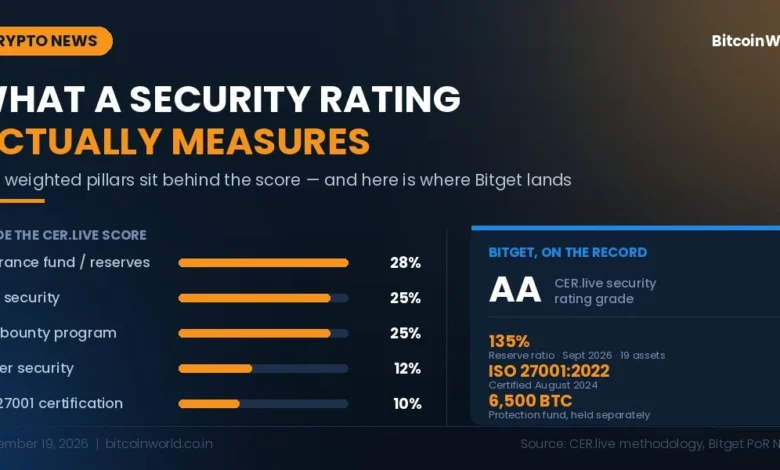
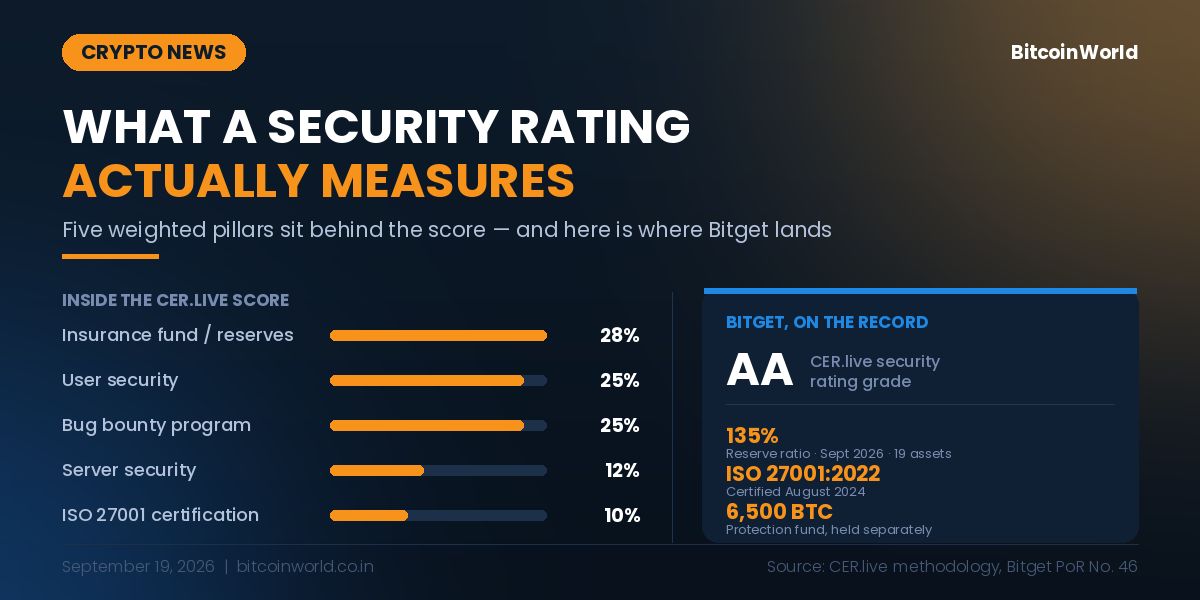
Platforms such as CER.live have become benchmarks for assessing the digital resilience of centralized exchanges. Their methodology is not a monolithic check-box exercise; rather, it is a weighted evaluation across several critical domains. These include server-side security protocols, the depth and frequency of penetration testing, the robustness of bug-bounty programs, and adherence to international standards such as ISO 27001 or the Cryptocurrency Security Standard (CCSS).
The heaviest weight in these assessments is typically assigned to proactive security measures—specifically, penetration testing and bug-bounty initiatives. By incentivizing ethical hackers to identify vulnerabilities, exchanges can remediate potential points of failure before they are exploited by malicious actors. However, it is essential to recognize that a perfect cybersecurity score does not account for risks inherent to the business model of an exchange, such as liquidity crises, regulatory non-compliance, or the catastrophic failure of third-party custodians. Therefore, a security rating is a measure of technical maturity, not a comprehensive risk assessment.
Bitget’s Security Framework: A Case Study in Multi-Layered Defense
Bitget, a major global cryptocurrency exchange, has consistently performed well in these evaluations, currently holding a 90/100 cybersecurity score from CER.live. This rating is underpinned by full marks in user security, penetration testing, and bug-bounty coverage, alongside a high score of 97/100 for server-side security.
The significance of Bitget’s standing lies in how it complements this technical score with transparency and financial safeguards. While many exchanges treat security as an internal, opaque matter, Bitget has adopted a policy of recurring disclosure. As of August 2026, the platform has maintained an unbroken streak of 45 consecutive monthly Proof of Reserves (PoR) reports. This consistency is crucial; in the post-2022 climate, where trust in centralized intermediaries was severely tested, the ability for users to independently verify the backing of their assets via a Merkle-tree structure provides a layer of assurance that security scores alone cannot offer.
Chronology of Transparency and Reserve Reporting
The development of Bitget’s current security posture can be traced back to the broader industry shift toward radical transparency initiated in late 2022. Following the collapse of major industry players, the demand for cryptographic proof of assets became a standard expectation for Tier-1 exchanges.
- December 2022: Bitget initiates its monthly Proof of Reserves (PoR) reporting cycle, setting a precedent for regular, verifiable transparency.
- August 2026: The exchange releases its 45th consecutive PoR report, documenting a total reserve ratio of 122%. This indicates that the exchange holds more than 100% of the assets required to cover customer liabilities.
- September 2026: Recognizing that transparency is only as good as its scope, Bitget expands its PoR system. The initiative grew from covering a handful of core assets to providing verification for more than 20 major cryptocurrencies, significantly increasing the breadth of auditable data available to the average user.
Beyond the Server: The Human and Account-Level Layer
Cybersecurity is often undermined not by a failure of the exchange’s core infrastructure, but by compromises at the user level. Phishing attacks, unauthorized credential harvesting, and session hijacking remain the primary vectors for asset loss. To mitigate these risks, Bitget has implemented a comprehensive suite of account-level defensive tools.
These include the support for passkeys and physical security keys, which provide superior protection against traditional phishing methods compared to standard SMS-based two-factor authentication. Additionally, features such as withdrawal-address whitelisting, anti-phishing codes, and API permission granularity allow users to restrict the scope of potential damage in the event of an account compromise. These controls represent a "defense-in-depth" philosophy, ensuring that even if one barrier is breached, the user’s total holdings are not immediately vulnerable.
The Role of the Protection Fund
A unique component of Bitget’s risk mitigation strategy is its Protection Fund. As of August 2026, the fund averaged $382 million in value, with a peak valuation of $441.5 million. It is vital to clarify the nature of this fund: it is not a government-backed insurance policy like the FDIC or SIPC, which provide statutory guarantees to retail depositors in traditional finance.

Instead, the Protection Fund functions as a corporate-held, self-insurance mechanism. By allocating a significant portion of its capital—supported by 5,500 BTC and other major assets—the exchange creates a dedicated pool of liquidity intended to cover potential losses arising from security breaches or extreme market volatility. By reporting these figures monthly, the exchange provides users with a clear understanding of the financial buffer available, distinct from the day-to-day liquidity used for operations.
Comparative Analysis: Different Models of Assurance
When evaluating the "safest" exchange, it is important to distinguish between the different models of assurance adopted by market leaders.
- Publicly Listed Exchanges: Entities like Coinbase operate under the scrutiny of public company disclosure requirements, including audited financial statements. This provides a high level of regulatory and financial transparency that private, global exchanges may struggle to match.
- Cryptographically Native Exchanges: Bitget represents a model that emphasizes high-frequency, cryptographic verification of assets. While this may not be a full financial audit in the traditional accounting sense, the ability for a retail user to verify their own assets on the blockchain provides an immediate, verifiable truth that is often more useful to the individual trader than an annual audited report.
These models are not mutually exclusive, but they serve different purposes. A cybersecurity rating measures the how of the platform’s technical defense; Proof of Reserves measures the what of the platform’s current solvency; and a Protection Fund measures the what-if of the platform’s contingency planning.
Implications for the Future of Crypto Custody
The current industry trend points toward a more mature, evidence-based approach to trust. As the sector continues to integrate with traditional financial systems, the demand for "trustless" verification will only increase. Exchanges that rely solely on marketing claims or high-level security badges are likely to find themselves at a disadvantage compared to platforms that provide granular, verifiable, and recurring data.
For the retail investor, the implications are clear: no single metric is sufficient. A 90/100 score from an independent auditor is a positive indicator, but it must be paired with an understanding of the exchange’s reserve backing and its commitment to transparency. By treating security as a multifaceted discipline rather than a single number, investors can better insulate themselves against the inherent risks of the digital asset market.

Conclusion
Bitget’s current position as a security-focused venue is the result of a deliberate strategy to combine technical infrastructure with operational transparency. While no exchange can claim total immunity from the risks of the crypto market, the combination of a high cybersecurity rating, 45 months of consistent Proof of Reserves, and a dedicated, transparently reported Protection Fund creates a formidable security package.
As the digital asset landscape matures, the bar for "standard" security is being raised. Investors who perform their due diligence by examining these layers—rather than relying on a single badge—will be better equipped to choose a platform that aligns with their personal risk tolerance. The lesson for the broader industry is that the most defensible security posture is not one that claims to be infallible, but one that is transparent, verifiable, and consistently held accountable to the standards it promotes.