Bybit Recognized by Korean National Police Agency for Contribution to Cybercrime Response and Security Cooperation


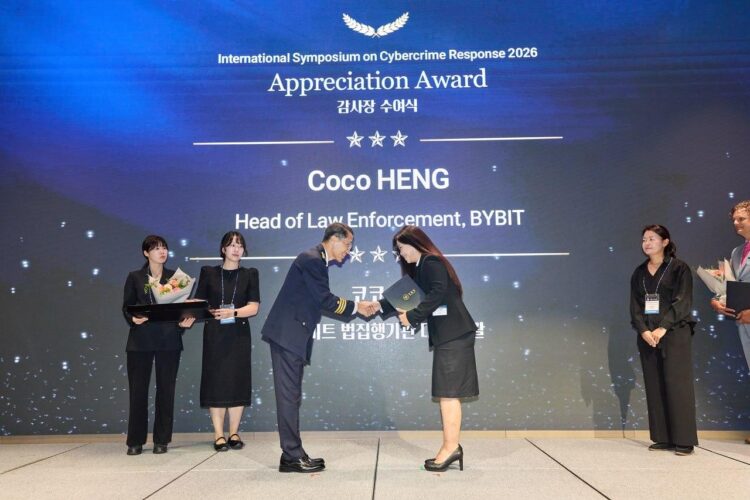
The Korean National Police Agency (KNPA) has officially honored the global cryptocurrency exchange Bybit with a Certificate of Appreciation, acknowledging its proactive collaboration in combating international cybercrime. The formal recognition was bestowed during the 27th International Symposium on Cybercrime Response (ISCR 2026), held in Seoul between August 27 and August 28, 2026. This distinction marks a significant milestone for the exchange, as Bybit was the sole cryptocurrency trading platform to receive such an honor at this year’s summit, which serves as a premier venue for government, industry, and academic discourse regarding digital safety.
The award was presented by Yoo Jae-seong, Acting Commissioner General of the Korean National Police Agency, to Coco Heng, Head of Law Enforcement at Bybit. The gesture underscores a shifting paradigm in the relationship between centralized digital asset exchanges and national law enforcement bodies, highlighting the necessity of public-private partnerships in an era of increasingly sophisticated borderless financial crime.
The Context and Significance of ISCR 2026
The International Symposium on Cybercrime Response is an annual initiative led by the Investigation Bureau of the KNPA. It acts as a critical nexus for stakeholders to harmonize strategies against illegal activities, including money laundering, fraud, and the illicit movement of assets across decentralized networks. The 2026 edition of the symposium operated under the theme, "Perfect Cube: Three Dimensions for Shaping New Digital Order," focusing on the intersection of standardized regulatory frameworks, technological innovation, and cross-border cooperation.

Bybit’s participation and subsequent recognition indicate that the platform has moved beyond passive compliance, opting instead to actively assist in the tracing of illicit funds. As cybercriminal syndicates increasingly utilize complex, multi-chain obfuscation techniques to hide the movement of stolen assets, the role of exchanges as primary data nodes becomes indispensable. The recognition from the KNPA suggests that Bybit’s internal intelligence-sharing mechanisms have met the high standards required for integration into international investigative workflows.
Chronology of Security Enhancements and Collaboration
The path to this recognition is rooted in a sustained, multi-year effort by Bybit to bolster its security posture. While the acknowledgment arrived in August 2026, the groundwork for this collaboration began significantly earlier.
- Early 2025: Bybit initiated a strategic review of its Law Enforcement Response (LER) department, focusing on reducing the latency between incoming inquiries from authorities and the delivery of actionable data.
- Late 2025: The exchange expanded its integration with global blockchain forensics providers, enabling real-time monitoring of "tainted" assets that might move through its liquidity pools.
- Q1 2026: Implementation of a revamped AI-assisted security auditing system, designed to predict and intercept malicious withdrawal attempts before they can be executed.
- August 27-28, 2026: Recognition at the ISCR 2026, marking the formal endorsement of Bybit’s collaborative methodology by Korean authorities.
Empirical Evidence of Security Performance
The efficacy of Bybit’s security infrastructure is evidenced by the metrics released in its H1 2026 Risk & Security Report. The document provides a detailed breakdown of the platform’s defensive capabilities and its commitment to user protection. During the first six months of 2026, Bybit reportedly intercepted over $700 million in potential user losses. This figure is the result of rigorous scrutiny applied to more than 30,000 suspicious withdrawal requests flagged by the platform’s internal security algorithms.
Beyond protecting its immediate user base, the exchange has played a role in broader market sanitation. The company identified approximately $212 million in on-chain funds linked to fraudulent activities and subsequently blacklisted over 10,000 malicious wallet addresses. This proactive blacklisting serves as a deterrent, making it increasingly difficult for bad actors to off-ramp illicit funds into fiat currency or trade them for other assets.

The platform has also demonstrated a significant upgrade in its technological defensive measures. By covering 100% of business-relevant on-chain activity—ranging from token contracts to internal hot and cold wallet management—Bybit has ensured that the attack surface available to hackers is consistently minimized. Notably, in the first half of 2026, the company successfully managed 10 distinct security incidents involving listed token projects with zero resulting losses to the exchange’s platform.
The Role of Artificial Intelligence in Threat Mitigation
Central to Bybit’s modern security architecture is the integration of Artificial Intelligence. Traditional manual review processes, while thorough, often lack the speed required to keep pace with automated smart contract exploits. Bybit’s deployment of AI-assisted analysis has allowed for the processing of over 100,000 security alerts in the first half of 2026 alone.
The impact of this technological shift is measurable. AI-assisted audits have identified high-severity vulnerabilities at a rate three to five times higher than traditional manual reviews. Furthermore, the operational efficiency of the security team has seen a dramatic improvement; the timeframe for moving from a security assessment to a full-scale test of a vulnerability has been reduced from two weeks to just two hours. This agility is crucial for maintaining the integrity of an ecosystem that operates 24/7 without market holidays.
Official Perspectives on Security Cooperation
The cooperation between Bybit and the Korean National Police Agency is viewed by industry observers as a blueprint for the future of digital asset regulation. In her remarks following the award, Coco Heng, Head of Law Enforcement at Bybit, emphasized that cybercrime is an inherently transnational issue. "Cybercrime does not stop at borders, and neither should the cooperation needed to fight it," Heng stated. "Our responsibility is not only to protect our users and our platform but also to work constructively with law enforcement and regulators when digital assets are connected to criminal activity."

From the perspective of law enforcement, the challenge lies in the sheer volume of data produced by decentralized finance. By establishing a reliable conduit for intelligence, Bybit effectively acts as a force multiplier for investigators who otherwise might face insurmountable hurdles in tracking assets across disparate blockchains.
Broader Implications for the Cryptocurrency Industry
The recognition of a private cryptocurrency exchange by a state-level police agency carries significant weight for the broader digital asset market. It signals a shift away from the adversarial relationship that characterized the early years of crypto-regulation. Instead, it suggests a "cooperative compliance" model where exchanges are treated as essential partners in national and international cybersecurity efforts.
This development has several key implications:
- Regulatory Legitimacy: For major exchanges, obtaining such recognition serves as a powerful argument for legitimacy. It demonstrates that the platform is not merely a trading venue but an active participant in maintaining financial order.
- Increased Barrier to Entry for Illicit Actors: As more major exchanges adopt similar rigorous standards for law enforcement cooperation and AI-driven monitoring, the "safe havens" for money launderers and scammers will continue to shrink.
- Market Stability: By demonstrating an ability to intercept hundreds of millions of dollars in fraudulent transactions, exchanges like Bybit reduce the overall level of systemic risk within the crypto-economy, potentially fostering greater confidence among institutional and retail investors.
Conclusion and Future Outlook
The Certificate of Appreciation awarded by the Korean National Police Agency is more than a formal honor; it is an endorsement of a specific, proactive approach to digital security. Bybit’s commitment to integrating advanced AI, maintaining transparency in its security reporting, and facilitating open channels of communication with global authorities has set a new benchmark for the industry.
As the digital-asset ecosystem continues to mature and integrate more deeply with global financial systems, the demand for this level of security and cooperation will only increase. Bybit has signaled its intention to continue expanding its infrastructure, aiming to make the digital-asset landscape not just more efficient, but significantly harder for criminal elements to exploit. For the industry at large, the success of this model underscores that the future of finance rests on a foundation of trust, technological sophistication, and unwavering collaboration between the public and private sectors.