The modern economic landscape frequently presents contradictory signals, none more pronounced than the persistent friction between Federal Reserve policy justifications and underlying macroeconomic reality. When evaluating the health of the United States labor market to justify consecutive interest rate hikes, Federal Reserve officials, including prominent policymakers like Kevin Warsh, have leaned heavily on historically low initial jobless claims. Citing four-week moving averages that sit comfortably within historical thresholds of full employment, the central bank has repeatedly asserted that the labor mandate of its congressional remit remains sound and resilient.

However, a granular examination of employment dynamics reveals a critical flaw in this narrative. While initial jobless claims offer an accurate gauge of corporate layoffs, they are structurally blind to the hiring side of the equation. Economists and regional Federal Reserve research branches have increasingly identified the current employment ecosystem as a "low-hire, low-fire" market. Described aptly by the Cleveland Fed as "half a misnomer," this economic environment accurately reflects historically low separation rates, but entirely masks a severe, multi-year stagnation in employment creation.
The Anatomy of a Frozen Labor Market
To understand the fragility of the current labor market, one must look beyond headline jobless claims to metrics such as the Job Openings and Labor Turnover Survey (JOLTS) hires level. Data indicates that total hires have slumped to a 12-year low, resting at virtually the same depressed levels recorded in 2014—a period when national Gross Domestic Product was nearly half of its contemporary output.
Labor market analysts, including researchers at Indeed’s Hiring Lab, have cautioned that this frozen dynamic is precarious by nature. A labor market characterized by a severe lack of hiring lacks the structural cushion required to absorb even modest increases in layoffs. Should macroeconomic headwinds force corporations to trim headcount, the absence of active hiring pipelines means displaced workers will face protracted periods of unemployment.
Compounding this structural vulnerability is a shifting incentive structure for displaced workers. Historical correlations between layoffs and unemployment filings have degraded significantly in the post-pandemic inflationary era. According to Bloomberg estimates, the average wage coverage gap—the spread between traditional unemployment insurance payouts and living wage requirements—has widened to unprecedented levels, exceeding $1,400 in many metropolitan areas. Because state unemployment benefits have failed to keep pace with cumulative inflation, newly laid-off workers frequently find themselves economically compelled to bypass the traditional welfare system entirely, opting instead for flexible, app-based gig economy and part-time work. Consequently, low initial jobless claims reflect not only a reluctance of firms to fire employees, but also a structural deterrence preventing workers from formally filing for claims.
Market Resilience Amid Federal Reserve Tightening
Against this complex macroeconomic backdrop, domestic equity markets have demonstrated remarkable resilience, navigating interest rate pressures and escalating geopolitical tensions with characteristic volatility. Following the Federal Reserve’s latest policy tightening measures, the S&P 500 experienced sharp mid-week contractions before mounting a robust recovery driven largely by heavyweights in the technology, artificial intelligence, and megacap sectors.
Despite closing the week near 7,637.76 and maintaining technical support above both its rising 50-day and 200-day moving averages, professional market analysts have voiced growing concerns regarding underlying market breadth and momentum. The recent expansion of weekly trading ranges typically signals an inflection point rather than a continuation of a healthy trend. Furthermore, narrow market leadership—where a handful of mega-capitalization entities buoy the indices while rate-sensitive sectors and regional banking institutions absorb heavy losses—suggests a higher degree of fragility than headline figures imply.
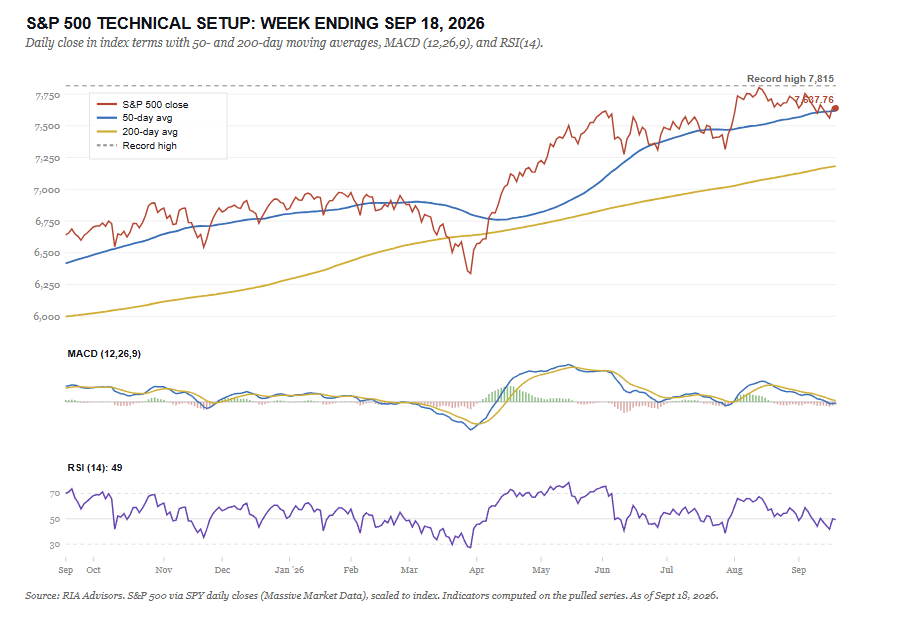
Institutional trading desks have mapped out critical technical thresholds as the third quarter draws to a close. Immediate overhead resistance stands at 7,650, followed by the psychological milestone of 7,700. On the downside, critical support rests at 7,585—the reaction low established in the wake of the Federal Reserve’s policy announcement. A decisive break below this threshold risks exposing deeper technical supports at 7,500 and 7,400, where key intermediate moving averages converge. Given that the benchmark 10-year Treasury yield remains pinned near the 5% threshold, risk management protocols suggest maintaining tight stop-losses and exercising caution against aggressive risk accumulation.
Policy Outlook and the Hawkish Stance
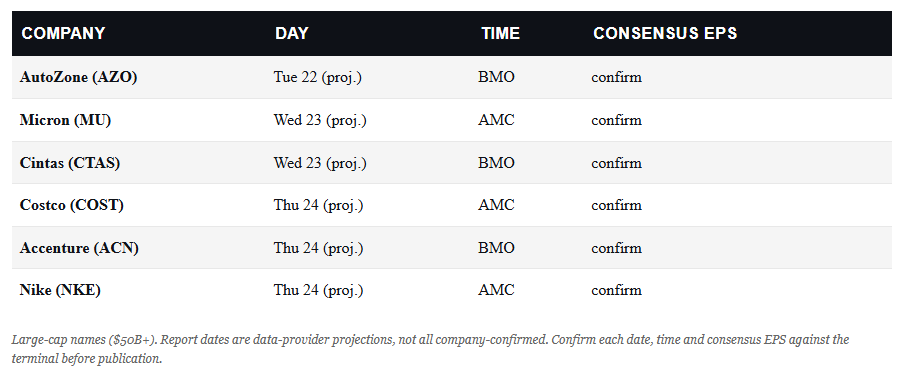
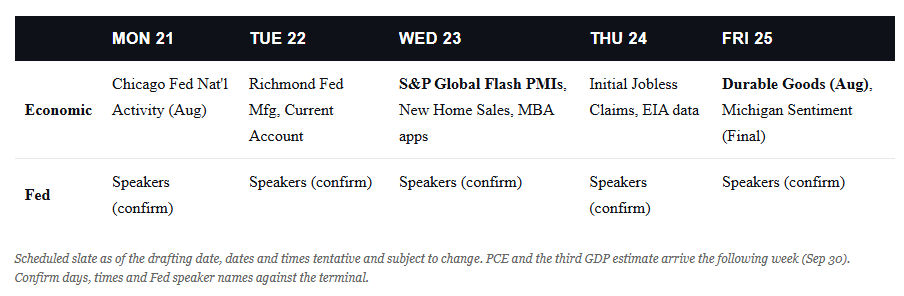
As the economic calendar transitions into a quieter phase devoid of major tier-one corporate earnings or macroeconomic data releases, market participants are shifting their focus toward upcoming commentary from Federal Reserve officials. Attention is primarily centered on Beth Hammack, President of the Cleveland Fed, whose policy stance has consistently ranked among the most hawkish within the Federal Open Market Committee.

Hammack’s previous dissents—notably her advocacy for a rate hike during the mid-summer policy deliberations—were anchored in persistent core inflation readings remaining stubbornly above the central bank’s 2% objective for more than half a decade. Her ongoing assessment highlights structural supply-side pressures emanating from energy commodity markets, compounded by broadening demand-side inflation pulses reported by businesses within the Cleveland district. Market observers will scrutinize her upcoming remarks for any indication of how the central bank plans to balance restrictive monetary policy against rising geopolitical energy shocks, particularly concerning potential escalations in the Middle East that threaten global oil supply chains.
Deconstructing the K-Shaped Recovery Narrative
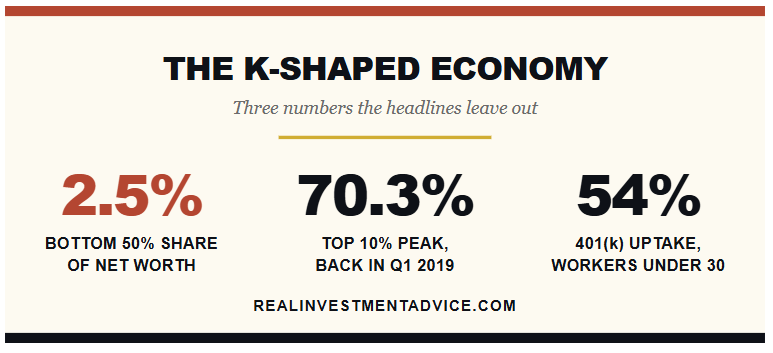
Broader socioeconomic discourse has frequently gravitated toward the narrative of a "K-shaped" economy, wherein upper-income households accumulate wealth while lower-income demographics face acute financial distress. Empirical analysis of wealth distribution statistics, however, reveals a more nuanced reality that frequently gets overshadowed by sensationalized media coverage.

Data compiled across multiple economic cycles indicates that the bottom half of American households currently holds approximately 2.5% of total national wealth. While this figure underscores persistent income inequality, historical context provides a vital counter-narrative: this percentage represents a meaningful expansion compared to levels recorded in 2019 and 2015, and stands roughly six times higher than the cyclical low of 0.4% touched in the immediate aftermath of the 2011 financial crisis. While systemic challenges across different income cohorts remain a tangible policy concern, distinguishing between structural economic realities and exaggerated media narratives is essential for long-term financial planning and investment allocation.
Strategic Implications for Investors
The intersection of sticky inflation, aggressive monetary tightening, and a deceptive labor market necessitates a disciplined approach to portfolio management. For long-term investors and short-term traders alike, the current environment rewards patience and risk mitigation over uncalculated exposure.
As the Federal Reserve navigates the delicate balance between subduing inflation and preserving economic expansion, market participants must remain vigilant. Monitoring key technical levels such as S&P 500 support at 7,585, tracking employment metrics beyond headline jobless claims, and adjusting asset allocation to account for elevated bond yields will remain paramount as the financial markets head toward the final stretch of the year.
Related posts: