The bond market has come to grips with these 5%-plus yields and is settling in.

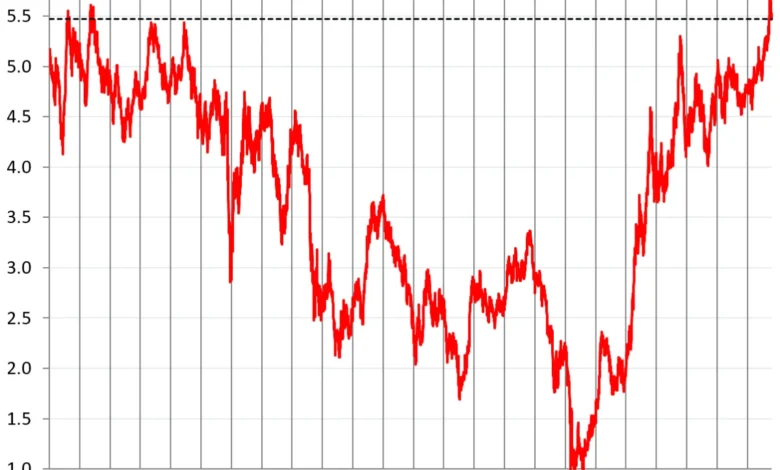
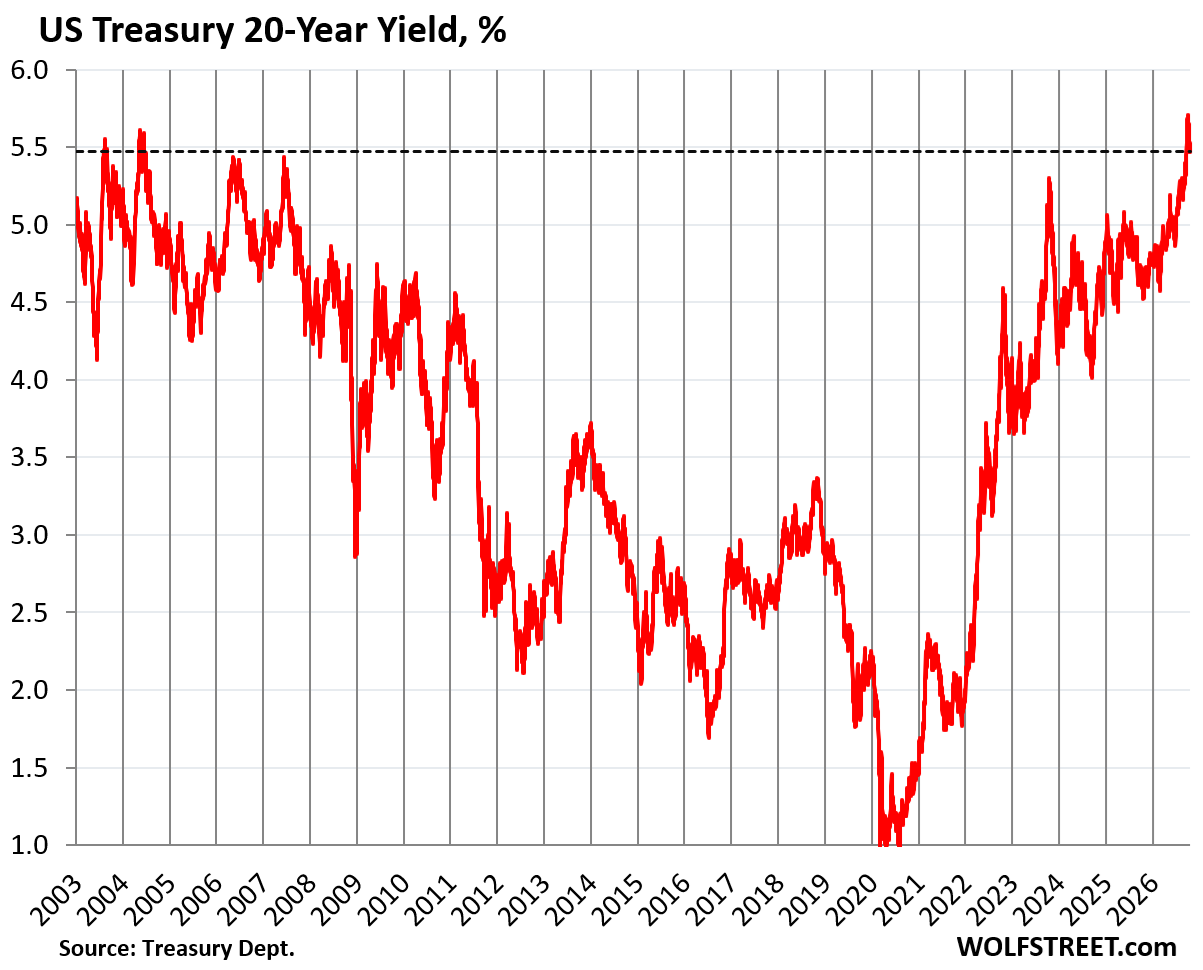
In the latest session of the U.S. Treasury’s ongoing effort to manage the national debt, the 20-year bond auction served as a stark reminder of the current interest rate environment. To secure the necessary $13 billion in funding, the Treasury was forced to accept a high yield of 5.469%. This figure represents the highest auction yield for the 20-year security since the instrument was reintroduced in May 2020. This benchmark not only signals the market’s current demand for compensation regarding duration risk but also places the yield in a historical context that many market participants have not witnessed in decades.
A Historical Perspective on Yields
While the 5.469% yield is a record for the modern iteration of the 20-year bond, it serves as a sobering reminder of the volatility inherent in long-term debt. To find a comparable period of higher yields, one must look back to 1986, the year the 20-year Treasury bond was originally discontinued. In the final auction of that era, held in January 1986, the yield sat at 9.45%.
The trajectory over the past several months has been marked by a steady climb. In the preceding month’s auction, the yield settled at 5.420%. Looking back to the summer, the rates were lower, with August auctions yielding 5.204% and July at 5.163%. This upward drift reflects a broader shift in the bond market as investors recalibrate their expectations in the face of persistent inflation and evolving monetary policy.
Comparing the current landscape to October 2023 provides further insight. Three years ago, the 20-year bond yielded 5.245%. However, this followed a rapid ascent from the 1.22% yield seen at the bond’s reintroduction in May 2020. The market at that time proved unable to sustain such velocity, leading to a period of consolidation where yields plunged by 130 basis points over the subsequent 11 months. Today, the sentiment is markedly different: the market appears to have "come to grips" with these elevated yields, suggesting a more stable, albeit expensive, environment for government borrowing.
The Institutional "Unloved" Bond
The 20-year Treasury bond occupies a unique and often precarious position in the debt hierarchy. It consistently trades at a yield higher than the 30-year Treasury, a phenomenon known as an inverted yield spread for these specific maturities. Currently, the spread sits between 4 and 5 basis points. While this is narrower than the 20-basis-point gap seen in 2020, it remains a point of contention for market analysts.
The primary challenge facing the 20-year bond is a chronic lack of appetite from institutional investors, including large-scale foreign central banks. Because institutional players often favor the 10-year or 30-year benchmarks for their liquidity and hedging utility, the 20-year is frequently categorized as the "unloved" bond. The resulting auctions are relatively small—$13 billion compared to the $39 billion often seen in 30-year issuances. This lack of secondary market liquidity creates a "thin" trading environment. For a seller, this often translates to higher transaction costs and more significant "haircuts" when attempting to exit positions.

Structural Implications and Potential Sunset
There has been growing speculation regarding the longevity of the 20-year bond program. Reports suggest that government officials are actively considering the discontinuation of the 20-year issuance once again. This uncertainty creates a self-fulfilling prophecy: if investors believe the security may be phased out, they are less likely to build long-term holdings, which further diminishes liquidity and forces the Treasury to pay a premium in yield to attract buyers.
The "on-again, off-again" nature of this bond’s history mirrors the events of 1986, when similar lack of interest and yield pressure ultimately doomed the product. If the Treasury decides to move forward with sunsetting the bond, it would mark a significant shift in the federal debt management strategy, likely redirecting issuance toward the 10-year and 30-year segments.
Analyzing the Auction Mechanics
The auction process itself offers a window into market sentiment. When a Treasury auction is announced, the "when-issued" bond begins trading, allowing for price discovery before the actual sale. In this latest auction, the when-issued bond traded at 5.460%, meaning the final auction yield of 5.469% resulted in a 0.9 basis point "tail."
In financial parlance, a "tail" occurs when the final auction yield is higher than the expected yield established in the when-issued market. While a 0.9 basis point tail is considered relatively modest, it nonetheless indicates that demand was slightly softer than what market makers had anticipated. This is a marked improvement over the previous month, which saw a 2.0 basis point tail—an event that led many analysts to characterize the auction as "ugly" or "sloppy." While the current auction was not a disaster, the higher absolute yield remains the primary headline.
The bid-to-cover ratio, a key metric for gauging demand, reached 2.73. With $35.48 billion in total bids against $13 billion in accepted tenders, this represents the highest ratio in several months, outperforming the 2.57 seen in September and the 2.53 in August.
The Role of Indirect Bidders
Indirect bidders, a category that includes foreign central banks and other institutional entities bidding through primary dealers, purchased 58.2% of the total offering. While this figure remains below the six-month average, it is a notable improvement over the 52.3% recorded in the prior month, which was the lowest level in the six-year history of the modern 20-year bond.
It is important to note that the data does not distinguish between domestic and international indirect bidders, but the uptick in this segment suggests that some institutional participants are finding the current yield environment attractive enough to participate, even if participation remains cautious.
The Strategy of Reopening Auctions
This latest auction marked the second "reopening" of the bond originally sold in August. By utilizing the same CUSIP (912810UX4), the same 5.125% coupon, and the same August 15, 2046, maturity date, the Treasury aims to consolidate liquidity. Each of the three auctions in this cycle contributed $13 billion to the total, resulting in $39 billion outstanding.
This practice of "reopening" is standard for 10-year, 30-year, and TIPS auctions, as it increases the total volume of a specific issue, making it easier for traders to buy and sell without triggering wild price swings. The Treasury’s decision to apply this to the 20-year bond is a deliberate attempt to prop up the liquidity of an otherwise neglected asset class.
Broader Economic Implications
For the individual retail investor, the 20-year bond presents a distinct opportunity. Unlike institutional investors who prioritize liquidity and rapid turnover, retail investors looking to build a Treasury portfolio with a "hold-to-maturity" strategy may find the 20-year bond highly attractive. It offers a yield premium over the 30-year bond while carrying less duration risk—meaning the price of the bond is less sensitive to interest rate fluctuations than a 30-year instrument would be.
However, the broader implications for the U.S. economy remain complex. As the Treasury continues to issue debt at these levels, the interest expense on the national debt rises, consuming a larger portion of the federal budget. The fact that the bond market has "settled in" at 5%-plus yields suggests that the era of "cheap money" is firmly in the rearview mirror.
As the market looks ahead to the November auction, the focus will remain on whether the Treasury maintains its current course or moves to restructure its long-term debt offerings. Regardless of the decision, the 20-year bond remains a primary indicator of the tug-of-war between the government’s borrowing needs and the market’s demand for risk-adjusted returns. For now, the bond market has signaled that it is prepared to live with these higher rates, provided the Treasury remains consistent in its supply—a condition that rests on the upcoming policy decisions regarding the future of the 20-year program.