The Facade of Resistance: How Claudia Sheinbaum Quietly Aligned Mexico with Washington

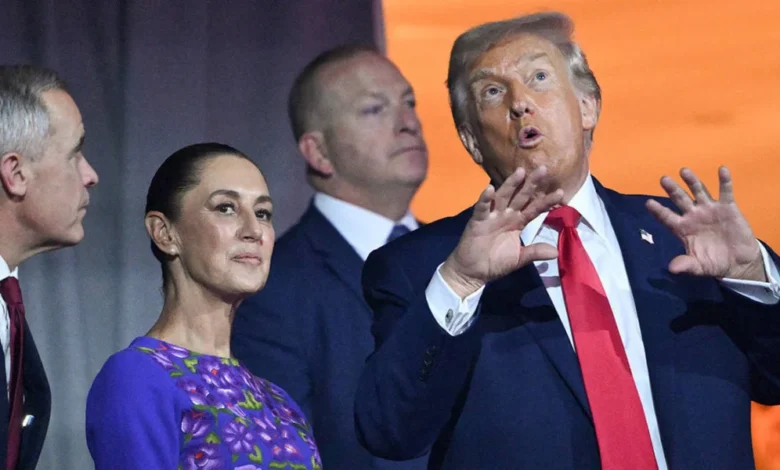
MEXICO CITY — As Mexican President Claudia Sheinbaum approaches the conclusion of her second year in office on October 1, 2026, her administration has cultivated a formidable international reputation for diplomatic resilience. Facing a second term of U.S. President Donald Trump, Sheinbaum has routinely drawn praise from domestic supporters and international observers alike for her perceived poise, measured rhetoric, and ability to stand up to Washington’s aggressive trade and immigration demands.
However, a closer examination of bilateral relations reveals a stark dichotomy between public posturing and policy execution. Behind a veneer of national sovereignty and diplomatic friction, Sheinbaum has systematically deferred to the White House across nearly every major policy domain, trading strategic concessions for domestic political capital.
This pragmatic alignment has unfolded against a backdrop of mounting domestic challenges. Two years into her mandated six-year term, Sheinbaum’s economic stewardship has yielded lackluster results, marked by sluggish growth, persistent fiscal deficits, and cautious investor sentiment. Concurrently, her administration’s domestic security agenda—focused heavily on curbing organized crime, reducing cartel-driven violence, and dismantling corruption—continues to face intense scrutiny from security analysts. Perhaps most alarmingly for institutional watchdogs, critics argue that Sheinbaum is steadily accelerating the authoritarian governance model inherited from her predecessor and political mentor, Andrés Manuel López Obrador.
A Chronology of Pragmatic Compliance
The trajectory of the Sheinbaum-Trump relationship cannot be understood without examining the compounding pressures that characterized the early months of her administration. Following her decisive electoral victory and subsequent inauguration in late 2024, Sheinbaum inherited an economic and geopolitical landscape heavily constrained by the United States-Mexico-Canada Agreement (USMCA) and escalating migration pressures at the shared southern and northern borders.
In the opening months of 2025, the Trump administration quickly signaled its intention to leverage tariffs as a primary instrument of economic and political coercion. Threatening blanket tariffs on Mexican exports unless Mexico drastically curtailed the flow of Central American and Asian migrants moving northward, Washington placed Mexico City in an immediate defensive posture.
Rather than engaging in prolonged public retaliation or seeking multilateral arbitration, Sheinbaum’s administration quietly initiated a series of high-level security and trade negotiations. By the spring of 2025, Mexico had significantly ramped up enforcement operations along its southern frontier, deploying thousands of National Guard troops to intercept migrant caravans. While administration spokespersons framed these deployments as sovereign initiatives to protect migrant safety and regulate national borders, internal security assessments confirmed that the operational directives closely mirrored benchmarks established by Washington.
By late 2025 and into 2026, as preparations intensified for the upcoming joint review of the USMCA, Sheinbaum adopted a public tone of unwavering defense of Mexican sovereignty. Yet, private concessions regarding North American supply chain security, Chinese investment scrutiny, and energy market regulations told a different story. In each instance, Mexico City ultimately accommodated U.S. commercial and security preferences, successfully avoiding the punitive tariffs threatened by the White House while masking the extent of its compliance behind nationalist rhetoric.
Economic Realities and Domestic Strain
The high costs of managing a delicate balancing act with the United States have coincided with mediocre domestic economic performance. According to economic analyses published by former Mexican Finance Minister Guillermo Ortiz, the country’s macroeconomic indicators under Sheinbaum have failed to generate tangible improvements in the daily lives of average citizens.
Inflationary pressures, while stabilized relative to the post-pandemic peaks of the early 2020s, continue to erode purchasing power. Meanwhile, private investment has remained subdued. Domestic and foreign capital expenditures have been dampened by persistent legal uncertainty, regulatory overhauls in the energy and judicial sectors, and lingering concerns over the erosion of independent regulatory agencies.
Furthermore, the fiscal deficit inherited from the López Obrador administration has left Sheinbaum with limited room for countercyclical spending. Social welfare programs—the cornerstone of the ruling Morena party’s electoral coalition—continue to consume a significant share of the federal budget, crowding out much-needed public investments in infrastructure, public health, and technological modernization.
Security and Institutional Governance
Beyond economic metrics, the Sheinbaum administration’s domestic agenda faces mounting friction in the realms of law enforcement and institutional design. Despite maintaining robust public approval ratings fueled by popular social programs and effective media communication, critics contend that the administration’s security strategy lacks structural innovation.
The militarization of public security, institutionalized under the previous administration through the formal integration of the National Guard into the Secretariat of National Defense (SEDENA), has continued unabated. Human rights organizations and legal scholars have expressed growing alarm over the expanded jurisdiction of military tribunals and the reduction of civilian oversight in law enforcement operations.
Compounding these security concerns is the ongoing consolidation of political power. Recent legislative and constitutional reforms—including the controversial overhaul of the federal judiciary, which mandates the popular election of judges and magistrates—have fundamentally altered the traditional checks and balances of Mexican democracy. Domestic opponents and international democratic monitoring bodies argue that these measures systematically dismantle judicial independence, concentrating authority within the executive branch and weakening the judiciary’s capacity to act as a constitutional counterweight.
Official Responses and Political Calculations
Faced with mounting critique regarding her quiet deference to Washington, administration officials have vigorously defended Sheinbaum’s diplomatic strategy. Government spokespersons maintain that Mexico’s pragmatic approach is a masterclass in realist diplomacy, successfully shielding the national economy from catastrophic trade disruptions while preserving bilateral cooperation on security and migration on terms favorable to Mexican sovereignty.
“President Sheinbaum has demonstrated exceptional leadership in navigating a complex and unpredictable international environment,” a senior administration official stated during a recent press briefing in Mexico City. “Our engagement with the United States is grounded in mutual respect, shared responsibility, and the pragmatic defense of Mexico’s national interests. Dialogue and cooperation have yielded stability, avoiding unnecessary economic shocks that would directly harm Mexican families.”
Domestically, Morena party loyalists have similarly deflected criticisms of the administration’s economic and security record, emphasizing that Sheinbaum is methodlessly executing the mandate delivered by millions of voters in 2024. Pro-government lawmakers argue that structural reforms to the judiciary and regulatory agencies are essential steps toward rooting out historical corruption and democratizing institutions that long favored elite interests.
Implications for Regional Stability and the Future
As Mexico looks toward the remaining four years of Sheinbaum’s term, the long-term implications of her dual-track strategy—public defiance paired with private compliance—carry profound weight for the nation’s geopolitical and democratic trajectory.
On the international stage, Sheinbaum’s ability to manage the volatile dynamics of the Trump administration without triggering a full-scale trade war has undoubtedly preserved short-term macroeconomic stability. However, the recurring pattern of yielding to U.S. pressure on critical sovereignty issues exposes the structural vulnerability of the Mexican economy and highlights the limits of independent foreign policy when confronted with asymmetrical power dynamics.
Domestically, the consolidation of executive power and the erosion of independent institutional checks pose more acute challenges. While the ruling party retains formidable electoral strength, the systematic dismantling of judicial autonomy and the continued reliance on military solutions for public safety risk deepening polarization and weakening the long-term resilience of Mexican democracy.
Ultimately, Claudia Sheinbaum’s first two years in office reveal a leader of considerable tactical skill, capable of maintaining broad popular support amidst mediocre economic indicators and contentious institutional transformations. Yet, the widening chasm between her administration’s nationalist rhetoric and its submissive diplomatic reality suggests that the true test of her presidency—balancing external pressures with internal democratic integrity—is only just beginning.
Related posts: