Mastering Portfolio Stability Through Risk Parity: A Strategic Shift in Asset Allocation

Most investors focus their energy on the art of stock picking, but the true engine of long-term investment performance lies in the science of asset allocation. Research from industry giants like Vanguard has consistently demonstrated that the distribution of capital across asset classes—rather than the selection of individual securities—is the primary driver of portfolio volatility and returns. As market complexity increases, professional quantitative managers are moving away from traditional, subjective allocation models toward more systematic frameworks. Among these, the Risk Parity strategy has emerged as a robust methodology for balancing portfolios by equalizing the risk contribution of each asset, rather than merely distributing capital equally.
The fundamental flaw in many retail portfolios is an over-reliance on dollar-weighted allocation. When an investor distributes $30,000 across five stocks without accounting for their inherent volatility, the resulting portfolio is often skewed toward the most volatile assets. For instance, if an investor allocates 39% of their capital to a high-growth tech stock like NVIDIA and only 6% to a more stable entity like Apple, the portfolio becomes hypersensitive to the performance of a single company. If the highly weighted stock suffers a correction, the entire portfolio experiences a disproportionate drawdown, a phenomenon known as idiosyncratic risk. Conversely, if the under-weighted stock outperforms, the investor fails to capture the full benefit, leaving significant potential on the table.

To mitigate these imbalances, quantitative analysts utilize structured allocation strategies. The simplest of these is Equal Weighting, where capital is divided equally among all holdings. While this approach effectively eliminates the dominance of a single asset’s capital weight, it fails to address the underlying risk. If one stock in an equal-weighted portfolio is significantly more volatile than the others, it will still contribute the majority of the portfolio’s total risk.
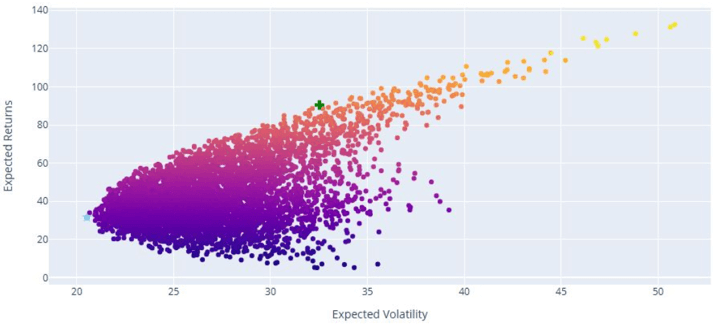
Moving further up the complexity ladder is Mean-Variance Optimisation (MVO). Rooted in Harry Markowitz’s Modern Portfolio Theory, MVO seeks to maximize expected return for a given level of risk. By calculating the expected returns and covariance matrices of various assets, MVO attempts to find the "efficient frontier"—the set of optimal portfolios that offer the highest possible expected return for a defined level of risk. While theoretically sound, MVO is notoriously sensitive to input errors. Small changes in expected return estimates can lead to wildly different, and often unstable, portfolio weights. This volatility in the model itself is why many institutional managers have sought more stable alternatives.
Risk Parity provides a compelling middle ground. Instead of focusing on capital or expected returns—which are notoriously difficult to predict—Risk Parity focuses on volatility. The core objective is to ensure that every asset in the portfolio contributes an equal amount to the total portfolio risk. In practice, this means that assets with lower volatility are given higher capital weights, while highly volatile assets are assigned lower weights.
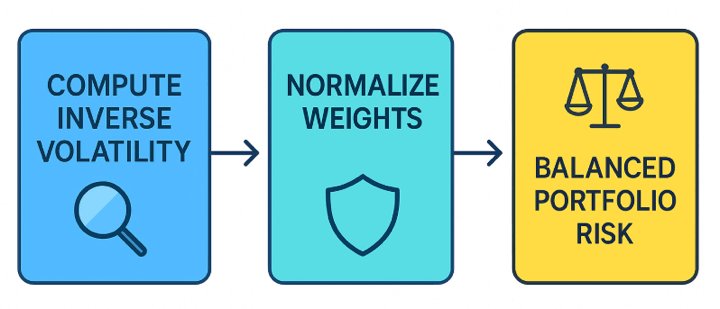
The mathematical framework for this strategy relies on the inverse of an asset’s volatility. By calculating the standard deviation of returns—a statistical measure of price dispersion—investors can derive a weight that is inversely proportional to that asset’s risk. Normalizing these inverse values ensures the total portfolio allocation sums to 100%. The resulting portfolio is inherently more balanced; no single asset is capable of destabilizing the entire fund through its individual price swings. This approach is particularly effective during market cycles where diversification is the only protection against systemic shocks.
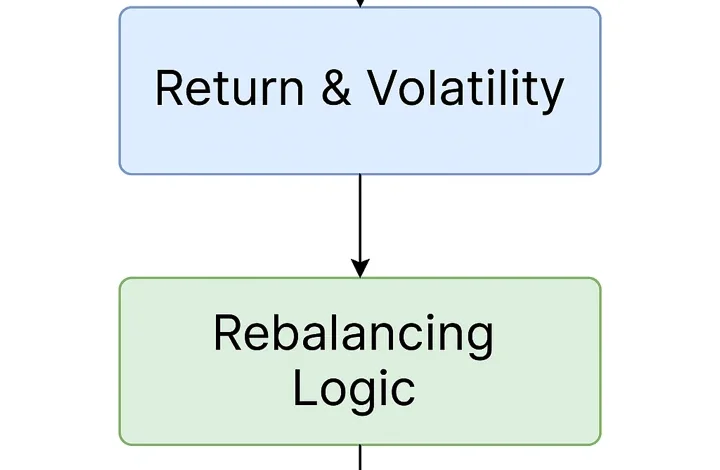
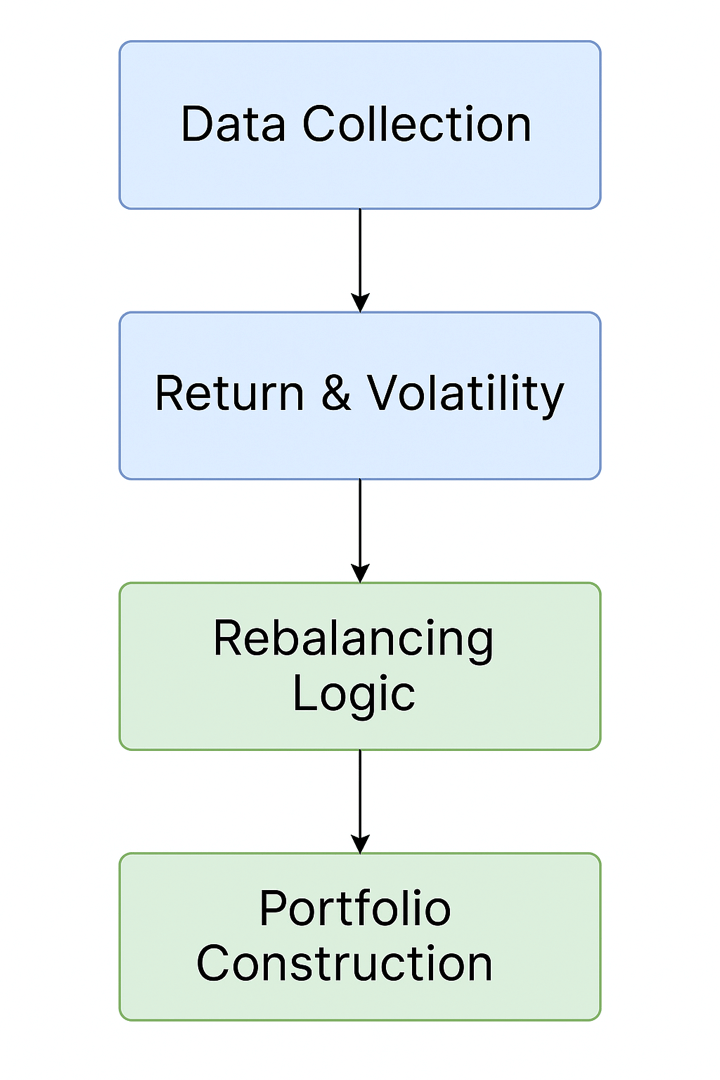
Implementing this strategy in a modern financial environment often involves the use of Python, which allows for the rapid processing of large datasets. By utilizing libraries such as pandas for data manipulation and yfinance for historical price retrieval, quantitative traders can build robust models to test Risk Parity against standard benchmarks. The workflow typically involves defining a rebalancing frequency—such as monthly or quarterly—and executing the inverse-volatility calculations to adjust positions.
The performance evaluation of these portfolios often reveals a clear divergence in risk-adjusted returns. In empirical testing using constituents of the Dow Jones Industrial Average, Risk Parity portfolios frequently exhibit lower maximum drawdowns compared to Equal-Weighted portfolios. While a simple equal-weight strategy may perform exceptionally well during extended bull markets where high-beta, high-volatility stocks lead the charge, the Risk Parity portfolio consistently demonstrates superior resilience during market corrections. The Net Asset Value (NAV) of a Risk Parity portfolio typically exhibits a smoother upward trajectory, reflecting the strategy’s ability to dampen the impact of volatile assets.
Despite its advantages, Risk Parity is not a panacea for all market conditions. One significant limitation is the reliance on historical volatility as a predictor of future performance. Market regimes are fluid; an asset that has been historically low-volatility can suddenly spike in uncertainty during a liquidity crisis or a geopolitical event. When correlations between assets spike—a common occurrence during "black swan" events—the diversification benefits of Risk Parity can evaporate, as assets that were previously uncorrelated begin to move in lockstep. Furthermore, the strategy’s requirement for frequent rebalancing can lead to increased transaction costs and tax implications, which may erode the net returns of the portfolio if not managed efficiently.
Advanced iterations of this strategy, such as Hierarchical Risk Parity (HRP), seek to address these limitations. HRP uses machine learning-based clustering algorithms to identify relationships and correlations between assets, allowing for a more nuanced allocation that accounts for market structure rather than just individual asset behavior. By grouping similar assets, HRP reduces the risk of over-concentration in assets that behave similarly, providing a more stable and theoretically sound framework than traditional Risk Parity.
For individual and institutional investors alike, the shift toward risk-based allocation represents a fundamental evolution in how capital is managed. As quantitative methods become more accessible through programming tools and financial data platforms, the ability to analyze and optimize portfolios is no longer reserved for hedge funds. However, it is essential to remember that no model can eliminate market risk entirely. The goal of Risk Parity is not to guarantee profit, but to ensure that the investor is not exposed to unintended risks arising from poor structural design.
As investors look to the future, the integration of risk-based methodologies into their broader investment strategy will remain a critical component of risk management. Whether through simple inverse-volatility weighting or more sophisticated algorithmic frameworks, the priority must remain the preservation of capital through disciplined, evidence-based construction. By understanding the levers of volatility and the mathematics of asset interaction, investors can build portfolios that are better equipped to withstand the unpredictable nature of global markets, ultimately providing a smoother and more predictable path toward their long-term financial objectives.
The ongoing academic and professional discourse surrounding these models suggests that while there is no "holy grail" of portfolio management, the transition from capital-centric to risk-centric thinking is a definitive step toward maturity for any investor. In a financial landscape characterized by constant change, the ability to quantify and distribute risk is perhaps the most valuable tool in the modern investor’s arsenal.