Statistical Arbitrage for Independent Traders: A Deep Dive into Triangulated Stat Arb

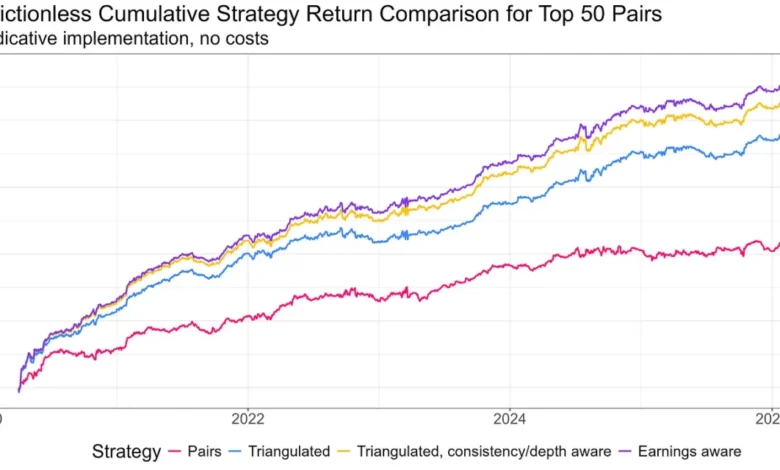
The realm of quantitative trading, often perceived as the exclusive domain of large financial institutions, is increasingly becoming accessible to independent traders. A sophisticated strategy known as Statistical Arbitrage, or Stat Arb, offers a compelling avenue for individuals to leverage market inefficiencies. At its core, Stat Arb is predicated on the principle of convergence: identifying two related assets whose prices have diverged and betting on their eventual return to a historical equilibrium. While the classic manifestation of this is pairs trading, a more advanced methodology, Triangulated Stat Arb, has emerged to enhance efficiency and profitability for the solo operator. This article delves into the three fundamental pillars of this approach, examining how a robust implementation can unlock significant alpha for independent traders.
The fundamental premise of statistical arbitrage is to exploit temporary mispricings between related financial instruments. This can involve pairs of stocks, futures contracts, or even different asset classes. The strategy aims to profit from the tendency of these instruments to revert to their historical price relationships. For instance, if two companies in the same industry typically trade with a stable price ratio, and one experiences a temporary dip while the other rises, a pairs trader would short the overvalued stock and long the undervalued one, anticipating the ratio to normalize.
However, the traditional pairs trading approach, while conceptually straightforward, can be capital-intensive and prone to signal wastage for individual traders managing their own portfolios. Triangulated Stat Arb, as developed and refined by quantitative trading researchers, addresses these limitations by shifting the focus from individual pairs to individual tickers. This methodology constructs a curated universe of high-quality pairs, then disaggregates the trading signals from these pairs to identify individual stocks that are mispriced within a broader context. Instead of trading discrete pairs, the strategy involves constructing a diversified portfolio of individual ticker trades, leading to greater capital efficiency and a more robust signal.
This advanced approach is built upon three critical components: the foundation of selecting high-quality pairs, the process of triangulation and consistency to refine signals, and the incorporation of external data to avoid trading against fundamental shifts. Each of these pillars plays a distinct role in generating actionable trading opportunities, with their importance diminishing in a hierarchical fashion.
The Cornerstone: Identifying High-Quality Pairs
The bedrock of any successful statistical arbitrage strategy lies in the rigorous selection of trading pairs. Without a universe of fundamentally sound and historically consistent pairs, any subsequent analysis or signal generation will be built on a flawed foundation. This is where Triangulated Stat Arb distinguishes itself from more simplistic methods, such as relying solely on cointegration tests, which can often generate a high number of spurious relationships.
The methodology employed focuses on two key metrics to define a pair’s quality. The first metric quantifies the potential for profitable mean reversion within a defined lookback window. It assesses whether a strategy of buying the undervalued asset and selling the overvalued one would have generated positive returns in a frictionless trading environment. Pairs that exhibit a tendency to diverge and remain diverged, thus showing a low or negative reversion factor score, are systematically excluded.

The second metric measures the consistency of convergence. It’s not enough for a spread to simply revert; it must do so reliably after diverging. This metric distinguishes between spreads that drift apart throughout a period and then coincidentally snap back at the end, versus those that demonstrate a consistent tendency to converge following periods of divergence.
By combining these two metrics, the framework effectively filters for pairs of stocks that exhibit a statistically significant and economically sensible tendency to move apart and then return to their historical relationship, providing a robust basis for profitable trading. This direct measurement of the desired outcome, rather than relying on a statistical proxy like cointegration, is a critical innovation. Further details on this methodology can be found in research exploring unconventional metrics for pair selection, akin to the "Moneyball" approach in baseball.
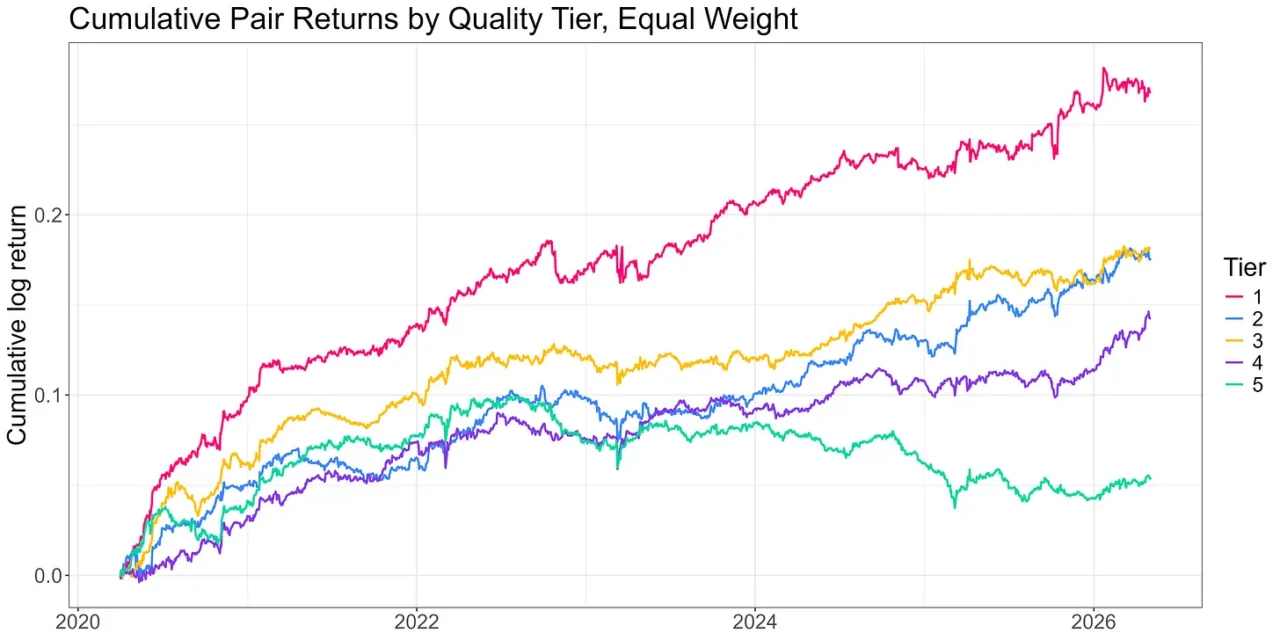
In practice, the top 10% of pairs, identified through this ranking system and further vetted for economic plausibility (e.g., belonging to similar risk factor exposures), are selected for the trading universe. This selection process is typically conducted on a monthly basis, utilizing the preceding 24 months of historical data. Within this top decile, pairs are further segmented into five tiers. Analysis of these tiers reveals a clear performance hierarchy, with Tier 1 consistently outperforming, while lower tiers exhibit diminishing returns, underscoring the efficacy of the ranking system.
Quantifying the risk-adjusted returns across these tiers highlights the substantial impact of pair selection. A nearly four-fold difference in Sharpe ratios between the top and bottom tiers, even with modest total returns (a known drawback of traditional pairs trading), illustrates the power of this upstream work. This foundational step captures the majority of the potential alpha, dwarfing any incremental gains that might be derived from subsequent signal-processing stages.
Beyond the core metrics, the operational aspects of pair universe generation and maintenance are crucial. This includes implementing liquidity filters, industry constraints, establishing appropriate refresh cadences, and developing robust protocols for handling delistings and corporate actions. While these details require careful consideration, the primary driver of success remains the meticulous and consistent effort invested in creating a clean, ranked pair universe. This painstaking, upstream work, demanding significant intellectual capital, yields tangible results, establishing the conditions for alpha generation before complex signal logic is even applied.
Triangulation and Consistency: Enhancing Signal Robustness
Once a high-quality universe of pairs is established, the next critical step is to transition from trading discrete pairs to trading individual tickers. This "triangulation" process addresses two major limitations of traditional pairs trading: capital inefficiency and signal wastage. By aggregating signals across multiple pairs that include a common ticker, Triangulated Stat Arb creates a more concentrated and reliable trading signal.
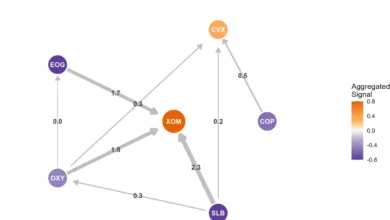
The core idea is that for each ticker within the universe, all pairs it participates in provide a per-ticker view. This view represents a directional bet (long the undervalued leg, short the overvalued leg) and a z-score indicating the magnitude of the spread’s deviation from its rolling mean. By aggregating these per-ticker views across all relevant pairs, a composite signal for that ticker emerges. A ticker that is flagged as mispriced by multiple independent pairs carries a stronger conviction signal than one identified by a single pair.
This network effect offers a significant improvement over simple pairs trading. However, the effectiveness of triangulation hinges on its intelligent implementation. Naively aggregating signals can lead to two pitfalls: overlooking the distinct characteristics of each pair’s signal and failing to properly account for the consistency of the aggregated signal.
A crucial operational decision within this framework is how to translate the ticker-level signal into actionable trades. The signal’s informativeness is most pronounced at the extremes of the distribution, while the middle tends to be noisy. Therefore, focusing on trading the most extreme signals, rather than every ticker flagged as potentially mispriced, materially enhances performance. This mirrors the practice in pairs trading, where trades are not typically initiated at a z-score of 0.5.
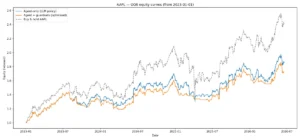
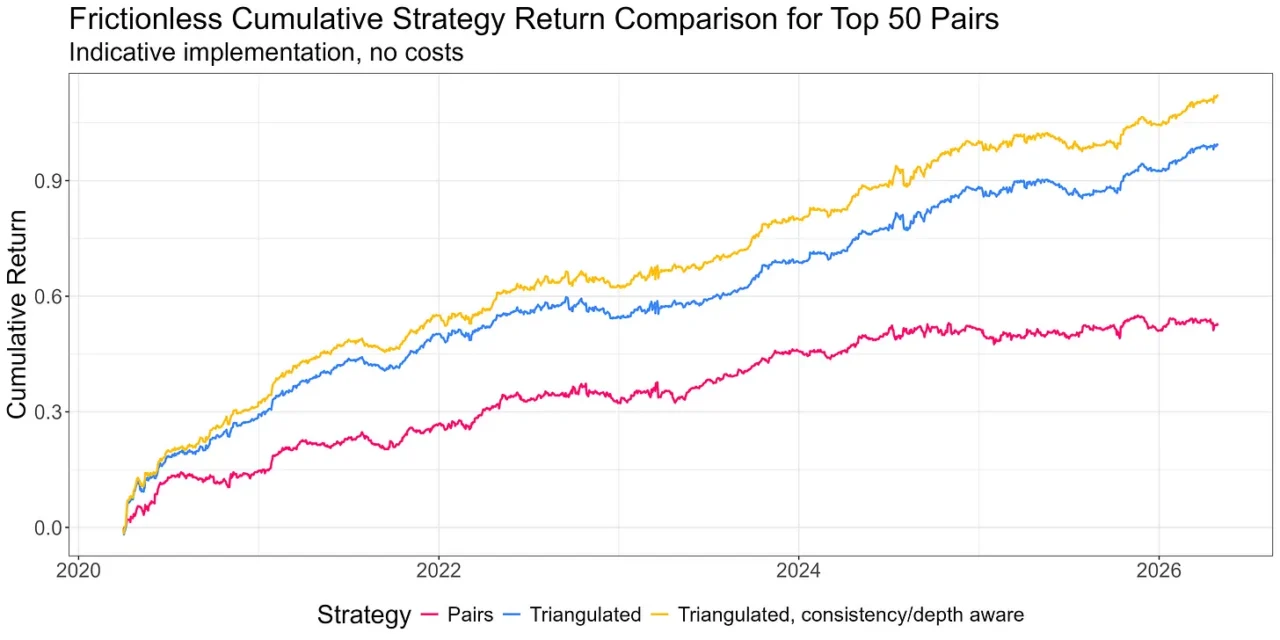
Empirical analysis demonstrates the power of this approach. Trading a portfolio of mispriced ticker legs, derived from triangulation, significantly outperforms simply trading the constituent pairs. Further refinement by incorporating measures of depth and consistency in the aggregated signal yields additional performance gains. This ticker-centric approach not only enhances signal strength but also dramatically improves capital efficiency, a critical advantage for solo traders.
Avoiding Pitfalls: The Role of Volume, News, and Events
The Triangulated Stat Arb signal effectively identifies potential mispricings based on historical price relationships. However, it cannot inherently explain the reason for a spread’s divergence. A stretched spread might signal a temporary technical anomaly ripe for reversal, or it could indicate a fundamental shift in one of the constituent assets, rendering the mean-reversion thesis invalid. Distinguishing between these scenarios is the third, and arguably most nuanced, piece of the statistical arbitrage puzzle.
This involves incorporating data from volume, news, and event analysis to discern whether a divergence is likely to be technical and reversible or fundamental and persistent. The intuition is that certain types of price movements, particularly those driven by forced flows or genuine new information, are less likely to revert to their historical norms.
Early research into volume asymmetry, based on the premise that forced selling on a depreciating leg differs from informed buying on an appreciating one, yielded promising results at the pair level. However, when integrated into the production-level Triangulated Stat Arb strategy, the incremental impact of volume features was found to be minimal. The aggregation process from pairs to tickers, it was discovered, effectively subsumed much of the information contained in volume data, as it was already implicitly captured by the upstream pair-quality assessment. Consequently, while volume features might be valuable for standalone pairs trading, they do not currently contribute significant alpha to the more complex triangulated strategy.
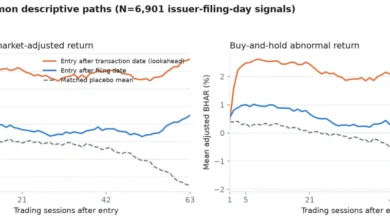
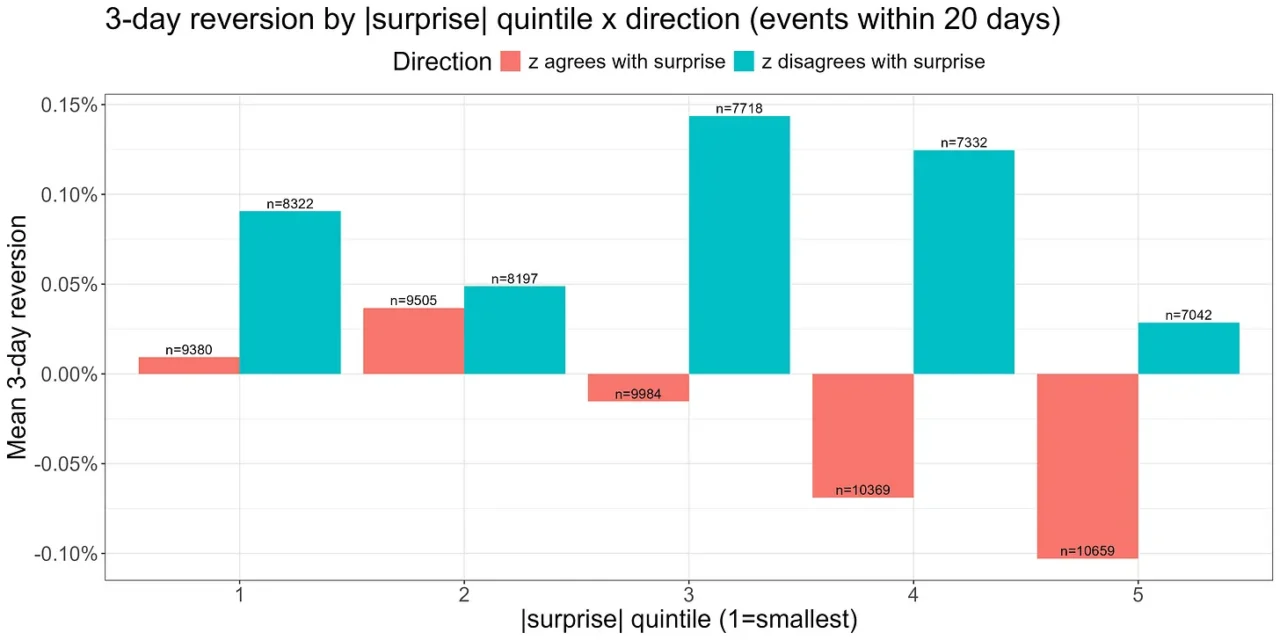
The significant breakthrough in this third pillar has come from analyzing earnings events. When a significant earnings surprise occurs during the formation period of a spread, the resulting price movement in the affected stock is likely driven by new, fundamental information rather than a temporary technical deviation. Consequently, attempting to fade such a move is ill-advised, as it often leads to continuation rather than reversion. The data strongly supports this observation: spreads exhibiting divergence in the direction of an earnings surprise, especially large surprises, show significantly reduced or even negative reversion, a phenomenon akin to the post-earnings drift effect.
This insight has led to the development of an earnings filter. By identifying and excluding trades where a divergence is correlated with a recent earnings surprise, the strategy avoids a class of trades that are predisposed to failure. This filter, while adding a modest yet meaningful uplift to the live strategy, underscores the importance of understanding the underlying drivers of price movements.
The broader integration of news features represents the next frontier. The principle that unexpected events impacting the fundamental value of one leg of a spread can disrupt mean reversion is expected to generalize beyond earnings. Any surprise event that causes a significant price adjustment based on novel information is likely to invalidate the historical price relationship. The ongoing research aims to systematically identify and incorporate such events into the strategy.
While the third piece of the puzzle offers incremental improvements, its impact is generally smaller than one might initially expect. This is a testament to the strength of the foundational pair-selection work. The initial screening process for high-quality pairs already filters out a substantial portion of fundamentally unsound relationships. The subsequent steps refine these opportunities, but the bulk of the alpha is captured in the upstream work of constructing a robust pair universe. The pattern observed is one of diminishing returns: each successive layer of sophistication adds value, but with a progressively smaller marginal impact.
Resourcing the Strategy: Infrastructure and Community
The successful implementation of Triangulated Stat Arb requires more than just a well-defined methodology; it necessitates robust infrastructure and a supportive ecosystem. For independent traders, building and maintaining such an infrastructure can be a daunting undertaking, often requiring significant capital investment and specialized expertise.
Services like Robot Wealth Pro provide an end-to-end solution, offering an API that serves both end-of-day and intraday spread data essential for live trading. Crucially, this includes historical data feeds that empower continuous research and refinement of the methodology. The upstream pipeline that generates the monthly pair universe is itself a complex operation. It involves ingesting and cleaning vast amounts of data from thousands of candidate stocks, performing computationally intensive ranking calculations across hundreds of thousands of potential pairs. The data acquisition, processing, and computational costs alone would represent a substantial barrier for individual traders.
Beyond the raw data and processing power, a research environment is provided, allowing community members to explore the full historical datasets underpinning the methodology. This fosters an environment of scientific inquiry, enabling traders to test their own hypotheses about pair quality, explore additional features for the third pillar, or devise alternative signal construction methods. An example implementation notebook further aids in this exploration, serving as a practical guide to configuring the strategy.
The adaptability of the implementation is a key strength. There is no single "canonical" signal; rather, the framework allows for configuration adjustments to suit individual account sizes, cost structures, risk tolerances, and operational capacities. This flexibility acknowledges the diverse constraints faced by independent traders, from full-time professionals managing multi-million dollar portfolios to part-time traders with smaller allocations. The ability to fine-tune parameters such as universe size, weighting schemes, no-trade buffers, signal thresholds, and leverage empowers traders to tailor the strategy to their specific circumstances. This iterative process of configuration and observation cultivates a deeper understanding, fostering the development of more independent and capable traders.
The collaborative nature of the community is another vital element. The research and development of Triangulated Stat Arb has unfolded over months within a membership, with active participation from community members who posed critical questions, challenged assumptions, and contributed their own research findings. These contributions have, in some instances, been integrated into the live strategy, demonstrating a symbiotic flow of knowledge and innovation. This collective effort accelerates progress and ensures that the methodology remains relevant and effective in evolving market conditions.
Conclusion: The Hierarchy of Alpha and the Path Forward
The Triangulated Stat Arb methodology, when properly resourced, presents a powerful framework for independent traders to capture market inefficiencies. The established hierarchy of returns is clear: meticulous pair selection at the universe level provides the most significant alpha. Aggregating signals across pairs offers a substantial uplift, while depth- and consistency-aware filtering, followed by event-driven filters like the earnings filter, provide further incremental refinements. Volume analysis, while potentially useful in other contexts, has shown limited incremental value in this specific, triangulated approach.
The Triangulated Stat Arb strategy itself democratizes equity pairs trading for the solo operator, overcoming the inherent capital inefficiencies of traditional methods. The supporting infrastructure—comprising data APIs, research environments, and a collaborative community—makes the implementation realistic without demanding the resources of a full-time engineering team.
For those who have followed this series, the conceptual map of Triangulated Stat Arb is now complete. The journey from identifying robust pairs to refining signals through triangulation and mitigating risk with event analysis reveals a systematic approach to alpha generation. The true value lies not only in the methodology itself but in the ecosystem that supports its implementation and continuous improvement, empowering traders to navigate complex markets with greater independence and confidence. The path forward involves ongoing research into areas like news sentiment analysis, further refining the ability to distinguish between technical divergences and fundamental repricing, ensuring that the pursuit of statistical arbitrage remains a dynamic and rewarding endeavor for independent traders.