Trading Signal Pool: Unlocking Deeper Market Insights Through Aggregated Indicators

A novel approach to technical analysis, the Trading Signal Pool, is emerging as a powerful tool for traders seeking to extract more consistent alpha from market data. This methodology moves beyond the limitations of individual indicators by aggregating dozens of them into a single, percentage-based meta-signal. The core principle is elegantly simple: by combining numerous signals, even those with a "tiny edge," the system aims to filter out noise and amplify reliable predictive power, embodying the philosophy of "weak predictors in, strong predictor out." This advanced technique, detailed by Build Alpha, offers a sophisticated way to navigate complex market environments and generate more robust trading strategies.
What is a Trading Signal Pool?
At its heart, a Trading Signal Pool is a sophisticated aggregation mechanism. It synthesizes the output of numerous individual trading signals into a single, cohesive percentage. For any given trading period or "bar," the pool reports the precise percentage of its constituent signals that are currently indicating a particular market condition. This aggregated percentage then becomes the basis for a trading rule. For instance, a trader might decide to initiate a trade only when the Signal Pool’s percentage exceeds a specific threshold, such as 67% or 80%, determined through rigorous data analysis and backtesting.
The fundamental idea is not to scrutinize a single indicator more intensely but to adopt a holistic view by analyzing dozens, or even hundreds, of indicators simultaneously. The critical question becomes: "How many of these independent signals are in agreement right now?" When a significant number of diverse signals align, it provides a qualitatively different and more reliable piece of information than any single signal could offer in isolation. This concept draws a parallel to the "1-mutant neighborhood" principle in evolutionary biology, where a single data point can be fragile, but a convergence of evidence from a "neighborhood" of related points offers significantly greater structural reliability.
A Practical Illustration of Signal Pooling
To grasp the utility of a Trading Signal Pool, consider a simplified example. Imagine starting with just three variations of the Relative Strength Index (RSI) indicator, each with a slightly different lookback period or parameter. On any given trading bar, the state of this three-signal pool could be represented by four possible percentages: 0%, 33%, 67%, or 100%. A trader could then establish a rule to only consider a trade if the pool’s value reaches 67% or higher, or perhaps only if it hits the maximum of 100%. This threshold acts as a configurable parameter that can be extensively tested across historical data to find optimal levels.
However, the true power of the Signal Pool is unleashed when it incorporates a broad spectrum of genuinely different signals. Instead of pooling three similar RSI variations, a more effective strategy would involve combining dozens of signals from disparate categories. These could include indicators related to mean reversion, trend following, volatility assessment, market breadth analysis, intermarket correlations, sentiment indicators, and more. When such a diverse set of signals converges, the Signal Pool begins to offer a more comprehensive snapshot of the prevailing market regime, moving beyond a singular perspective on a single market variable.
The Rationale Behind Signal Pooling
The efficacy of traditional technical analysis indicators often stems from a subtle, albeit diminishing, edge. The original development of indicators like the RSI, for example, demonstrated significant success on the specific datasets available at the time of their creation. However, as market dynamics evolve and data sets expand, the predictive power of these classical indicators tends to wane. This phenomenon, where an indicator’s edge erodes over time, is common across nearly all established technical tools.
Signal Pools offer a strategic defense against this decay through three primary mechanisms: uniqueness, ensembling, and a tolerance for non-intuitive signals.
The Edge Found in Uniqueness
As highlighted by prominent quantitative traders like Jaffray Woodriff of Quantitative Investment Management, a sustainable trading edge often requires possessing at least one of three critical elements: unique data, a unique methodology, or a unique approach to leveraging existing data. Build Alpha’s platform directly addresses the latter two by offering advanced tools such as a genetic algorithm for automatic strategy generation and an LLM orchestrator for sophisticated research. Furthermore, it supports a wide array of non-price-based data, including Commitment of Traders (COT) data, market breadth, sentiment indicators, options flow, and the ability to import custom datasets, thereby catering to the "unique data" aspect.
The Trading Signal Pool itself represents a unique methodology. Even when employing well-known individual signals, the percentage-based aggregated output is an uncommon feature. This novelty provides a distinct advantage, allowing traders to create strategies based on a composite signal that is not commonly replicated.
The Diminishing Importance of Explainability
A significant number of traders prioritize understanding the underlying "why" behind a trading strategy’s efficacy before they will commit to it. While this desire for intuitive understanding is understandable, it can act as a substantial bottleneck, limiting the scope and innovation of strategies developed. In the realm of quantitative trading, with sufficient sample size and robust statistical validation, the narrative explanation often becomes secondary to the demonstrated persistence of the edge.
This perspective is powerfully echoed by Jim Simons, widely regarded as the most successful systematic trader in history. As documented in Gregory Zuckerman’s "The Man Who Solved the Market," Simons and his research team did not prioritize developing intuitive trade ideas. Instead, they allowed the data to reveal anomalies indicative of opportunity. Crucially, they did not expend significant effort trying to understand the underlying causes of these market phenomena. Their focus was on statistical robustness and predictive accuracy. Simons famously stated, "I don’t know why the planets orbit the sun. That doesn’t mean I can’t predict them." This philosophy underscores that statistical validity, rather than a narrative explanation, is the cornerstone of effective quantitative trading. Many quant firms might discard signals that lack a clear theoretical basis. However, Simons’ approach demonstrated that if signals meet rigorous statistical criteria, they are valuable, regardless of immediate interpretability. The ability to achieve statistical significance and out-of-sample stability in a Signal Pool is more critical than a precise, step-by-step explanation of its predictive mechanism.
The Power of Ensemble Methods
Ensembling, a fundamental concept in machine learning and statistical prediction, involves combining multiple weak predictors to create a single, strong predictor. This technique is the backbone of successful approaches like Random Forests, Gradient Boosting, and the winning strategies in competitive data science challenges such as the Netflix Prize. Jaffray Woodriff, commenting on this principle, noted the discovery of the "winning concept of creating one super-model from a large and diverse group of base predictive models."
Signal Pools embody this ensemble principle at the signal level. Rather than ensembling entire trading strategies, this approach pools individual signals. This method offers the same statistical benefits as ensembling complete strategies, providing an additional layer of control and flexibility. The practical consequence is that seemingly "outdated" technical indicators can regain their utility. While an RSI on its own might have lost much of its predictive edge, when combined with twenty other signals from diverse categories, it can contribute meaningfully to a more robust composite signal.
Building an "OR" Signal with Ease
A particularly noteworthy advantage of Signal Pools is their inherent capability to construct "OR" logic signals effortlessly. Traditional strategy development often focuses on "AND" conditions, requiring multiple criteria to be met simultaneously. However, creating an "OR" condition – where a trade is triggered if either signal A or signal B is true – can be cumbersome.
With a Signal Pool, this is simplified. By placing two or more signals into a pool and setting the threshold slightly above zero (e.g., greater than 0%), the pool will return a positive reading whenever any single constituent signal is active. This precisely replicates the behavior of an OR gate. Conversely, an "AND" logic can be achieved by setting the pool’s threshold to 100%, ensuring all underlying signals must be true. The spectrum between 0% and 100% offers a nuanced approach to signal aggregation, with the threshold acting as the key determinant of the strategy’s logic.
Creating Custom News Filters
Signal Pools also serve as an elegant mechanism for building custom news event filters without requiring complex additional programming. Consider a scenario involving a Federal Reserve meeting. A trader might want to capture news events associated with this meeting. A Signal Pool can be configured with signals representing different types of macro-economic events or announcements.
For example, a pool could include signals for "Interest Rate Hike Announcement," "Fed Statement Dovish," and "Fed Statement Hawkish." By setting the pool threshold above 0%, a strategy can be triggered to trade on the news (an "OR" condition). Conversely, by setting the threshold to indicate that none of the specific news events are occurring (e.g., pool below a certain low percentage or a "not" condition), the system can be used to avoid trading during periods of significant news uncertainty. This dual capability allows for both proactive trading around events and strategic avoidance, all within the same pool structure. The threshold adjustment is the sole variable needed to switch between these opposing trading objectives.
A Streamlined Four-Step Construction Process
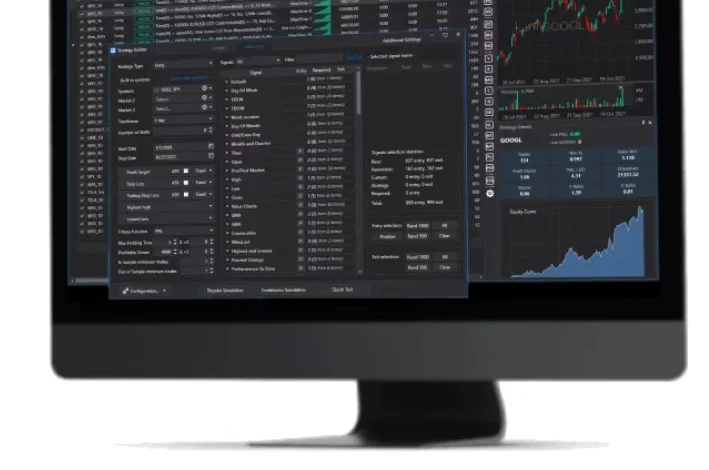
Build Alpha’s Custom Signal Editor is engineered for speed and simplicity, eliminating the need for coding or scripting. Creating a Signal Pool and integrating it into a trading strategy can be accomplished in just four intuitive steps:
- Open the Editor: Access the Custom Signal Editor via the "File" menu or by pressing the F4 shortcut. Select "Pool" as the signal type.
- Add Signals: Choose from an extensive library of over 7,000 built-in signals spanning numerous categories. Crucially, vary parameters and lookback periods to diversify the pool’s components.
- Set the Rule: Define the specific threshold for the percentage of active signals required to trigger the pool. This threshold transforms the aggregated percentage into a tradable signal.
- Generate Strategies: The newly created Signal Pool is now available as an entry or exit condition within the main Strategy Builder, treated just like any other signal.
The editor offers a visual representation of the pool’s performance, allowing users to plot its percentage output on any market. This plot enables quick inspection of the pool’s behavior across different assets without reconfiguring the setup. Furthermore, parameter variations within individual signals can exponentially increase the number of members in the pool. For instance, defining an RSI signal with a range of lookback periods and threshold values effectively creates dozens of individual signals that contribute to the pool.
Upon converting the pool into a tradable signal, the user simply defines the threshold. This could be "trade only when the pool is at or above 80%." Once saved, this custom Signal Pool becomes a first-class component within the Strategy Builder. Build Alpha automatically embeds the complete pool definition into any exported strategy code, ensuring that the logic is self-contained and functional across various trading platforms and programming languages.
Asset Class Agnosticism
The Signal Pool methodology is inherently asset-class agnostic. Its effectiveness is not confined to a particular market segment. Whether trading forex pairs, equities, exchange-traded funds (ETFs), futures, commodities, interest rates, or cryptocurrencies, the underlying principles and the mechanics of the Signal Pool remain consistent. The same engine, threshold logic, and export capabilities apply universally.
For traders who primarily operate within a single asset class, such as forex, the platform offers a pathway to break free from common pitfalls. The forex market, in particular, can be saturated with vendors selling thinly veiled lottery tickets or strategies that implicitly bet against short-term volatility. Developing and rigorously testing one’s own strategies, including those utilizing Signal Pools, provides a cleaner, more transparent, and ultimately more controlled approach. The robustness of a Signal Pool strategy is determined by its performance through validation tests, not by reliance on external subscriptions.
Automating Signal-Pool Strategies
Build Alpha facilitates the complete automation of strategies built with Signal Pools. The platform generates fully automatable code compatible with major retail and professional trading platforms, including TradeStation, NinjaTrader 8, MultiCharts, MetaTrader 4/5, TradingView Pine Script, ProRealTime, and Python. This ensures seamless integration into existing trading workflows.
Moreover, Build Alpha connects directly to live data brokers, enabling real-time monitoring of positions, profit and loss (P&L), and trade alerts for any strategy driven by a Signal Pool. As a standard practice, any newly developed strategy, particularly those employing complex signal aggregations like Signal Pools, should undergo a comprehensive robustness testing pipeline before deployment in live trading environments. This includes tests for noise, walk-forward optimization, Monte Carlo simulations, and comparisons against random trading strategies.
An Honest Caveat
It is crucial to acknowledge that pooling weak signals does not magically create predictive edge where none exists. If the underlying individual signals lack informational content for a specific market and timeframe, the aggregate Signal Pool will likely reflect this deficiency. The true benefit of Signal Pools lies in the statistical aggregation and breadth derived from combining multiple signals that each possess at least a small, consistent edge. The principle of "garbage in, garbage out" remains paramount. The robustness testing pipeline is the indispensable tool for discerning which signals contribute genuine value and which do not.
Key Takeaways from Signal Pooling
- One Number, Many Signals: A Signal Pool distills the collective sentiment of dozens of individual signals into a single, actionable percentage. This composite output provides a more comprehensive market view than any single indicator.
- Threshold as the Trading Rule: The percentage threshold applied to the Signal Pool is the primary determinant of the trading strategy. Whether it’s a high percentage for strong confluence (e.g., ≥ 80%), a moderate level for broader agreement (e.g., ≥ 67%), a specific value for AND logic (100%), or a low value for OR logic (> 0%), the threshold defines the trading rule.
- Breadth Over Depth: The most effective Signal Pools are built by aggregating signals from diverse categories—mean reversion, trend, volatility, market breadth, intermarket analysis, sentiment, and more—rather than simply pooling multiple variations of the same indicator.
- The Ensembling Imperative: Signal Pools leverage the statistical power of ensembling, transforming numerous weak predictors into a more robust and reliable composite signal. This is the same principle that drives success in advanced machine learning models.
- Statistics Trump Narrative: The necessity of explaining precisely why a Signal Pool works is often overstated. Rigorous statistical validation, including noise analysis, walk-forward testing, and Monte Carlo simulations, provides a more objective measure of a strategy’s efficacy than narrative explanations alone.
- Simplicity and Automation: Build Alpha enables the creation, validation, and export of Signal Pool-driven strategies in just four steps, without requiring any coding. The platform automatically embeds the pool logic into exported strategy code for seamless integration.
Summary: A Paradigm Shift in Signal Generation
In a market where most participants have access to the same data and employ similar analytical tools, the remaining edge in traditional technical analysis is often marginal and subject to decay. Trading Signal Pools offer a sophisticated method to counteract this trend by aggregating multiple "weak" predictors into a single, more informative composite signal. This approach provides a unique advantage without necessitating proprietary data or advanced machine learning expertise. It simplifies the implementation of complex logical conditions like "OR" and allows traders to extract enhanced signal from familiar indicators.
Build Alpha streamlines the entire process, from creation and validation to automated export, in a matter of clicks. The Signal Pool represents a valuable addition to any trader’s toolkit, offering a robust and adaptable framework for generating more resilient trading strategies across all asset classes. As the field of quantitative trading continues to evolve, methodologies like the Signal Pool are poised to become increasingly integral to achieving consistent performance in dynamic market environments.