Super Bowl of Wall Street: Big Tech Has to Deliver as Markets Scrutinize AI Spending and Cash Flow


The global financial markets are bracing for a transformative week as three of the world’s most influential technology giants—Alphabet, Microsoft, and Amazon—prepare to unveil their quarterly earnings. Representing approximately 11% of the S&P 500 index, these corporate behemoths serve as the primary bellwether for investor sentiment. As the current earnings season progresses, market participants are shifting their focus from top-line revenue growth toward the underlying sustainability of the massive capital expenditures currently fueling the artificial intelligence arms race. The central inquiry for shareholders is no longer just whether these companies can hit growth targets, but whether their aggressive investment in data centers and semiconductor infrastructure will translate into tangible, long-term free cash flow.
The Shift from Growth to Capital Efficiency
Historically, tech-sector rallies were predicated on aggressive expansion and revenue scaling. However, the current landscape has introduced a more discerning investor profile. The recent market reaction to Meta’s latest earnings report serves as a stark case study: despite delivering encouraging operational results, the company’s share price plummeted 6.1% following the announcement, largely driven by investor unease regarding the scale of its future spending commitments.

This sensitivity highlights a critical pivot in market psychology. Investors are increasingly prioritizing free cash flow—the capital remaining after operating expenses and heavy capital investment—over simple profit metrics. With Alphabet, Meta, Microsoft, Amazon, and Oracle collectively projected by some analysts to see their combined trailing annual free cash flow approach negative territory by December 2026, the cost of financing this expansion has become a primary risk factor. Furthermore, a data-center securitization spread index recently hit 2.34%, signaling that lenders are becoming increasingly wary of the debt-heavy capital structure required to maintain the current pace of AI development.
A Chronology of the AI Infrastructure Race
The path to this moment has been paved by a series of rapid, high-stakes investments. Throughout 2024 and 2025, the "Magnificent Seven" companies committed hundreds of billions of dollars to the construction of hyperscale data centers and the acquisition of high-end AI processing units.
- Early 2025: Tech firms accelerated their AI procurement cycles, leading to record-breaking capital expenditure (CapEx) reports.
- Mid-2025: Microsoft’s Azure growth became the industry’s North Star, with analysts tracking Copilot adoption rates as a key indicator of AI monetization.
- Late 2025: Market volatility spiked as the cost of capital began to weigh on tech valuations, leading to a broader correction in the Nasdaq.
- October 2026: The current "Super Bowl" earnings week marks the inflection point where investors demand to see the "return on investment" (ROI) phase of the AI rollout.
Technical Outlook for the Tech Giants
As these companies head into the week’s earnings calls, technical analysts are observing critical support and resistance levels that could dictate the short-term direction of the broader index.
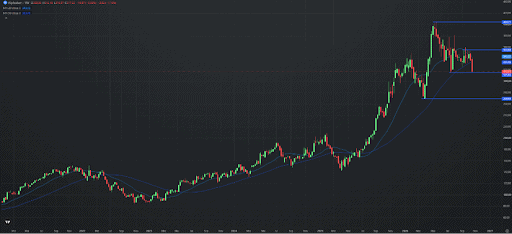
Alphabet, currently trading 21% below its all-time high, has entered a technical bear market. With a closing price of $317 last week, the stock is testing the structural support established in July at $315. Should this level fail to hold, market participants are bracing for a potential slide toward the March lows of $270. Stability, according to current market signals, would require a breakout above the $355 resistance level.
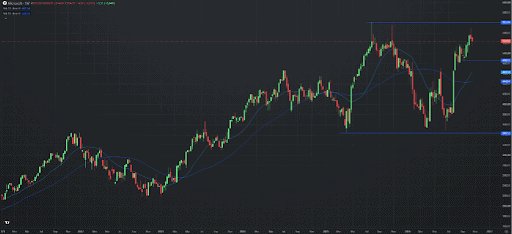
Microsoft presents a different narrative, characterized by a prolonged sideways trend. Having struggled to break decisively above its record high of $561, the stock is currently consolidating. Analysts note that as long as the support level at $486 remains intact, the company retains the potential for a renewed upward trajectory.
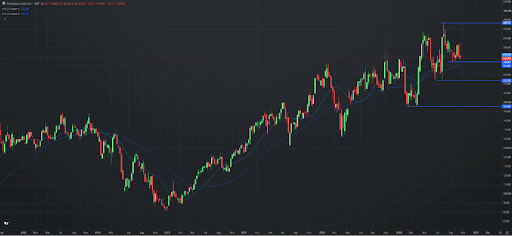
Amazon, meanwhile, remains under intense pressure. The $244 level—the low reached in September—has served as a vital floor. If the stock fails to reclaim its 20-week moving average of $252, the technical outlook suggests a possible test of the 50-week moving average at $241, heightening the risk of further downside for the retail and cloud giant.
Valuations and the Broadened Market
Despite the focus on big tech, the broader market is showing signs of decoupling from the "Magnificent Seven." These seven companies currently account for slightly less than 20% of total U.S. corporate profits, yet the remainder of the S&P 500 is displaying a resilient 15% growth rate.
Diversification is becoming a central strategy for institutional investors. Healthcare stocks, in particular, have demonstrated significant relative strength. Eli Lilly has recently touched fresh record highs, while Amgen has maintained stability during broader market turbulence. Pfizer is also showing signs of a breakout, moving out of a year-long consolidation base. In the consumer sector, firms such as Disney, Airbnb, Hilton, and Marriott are seeing renewed interest, signaling that discretionary spending remains robust despite the macroeconomic headwinds.
The Bond Market and Macroeconomic Variables
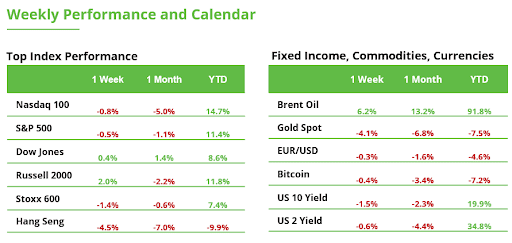
Beyond equity performance, the fixed-income market remains a critical component of the current investment calculus. With the ten-year Treasury yield projected to sit at 4.75% by the end of 2026 and potentially easing to 4.50% in early 2027, the bond market is expected to provide some relief to equity valuations. However, persistent concerns regarding inflation and federal deficits remain the primary risks to this forecast.
Rising financing costs continue to act as a drag on corporate valuation multiples. While the Magnificent Seven are currently trading at a multiple below 24x estimated earnings—well beneath the ten-year average of 29x—this discount may prove deceptive. Analysts have significantly hiked their 2027 earnings growth expectations to 27%, up from 19% just two months ago. This mismatch creates a fragile environment: if the underlying earnings growth fails to materialize, these "cheaper" multiples offer limited protection against a market correction.
Digital Assets: A Fragile Recovery
In the cryptocurrency space, Bitcoin remains caught between institutional adoption through ETFs and the reality of market leverage. After peaking near $85,000, Bitcoin has retreated to the $80,500 level. While weekly ETF inflows reached approximately $301 million, the late-week outflow of $774 million serves as a cautionary tale regarding investor conviction.
The current structure is delicate. A sustained break below the $79,200–$80,000 support zone would likely accelerate a downward move toward the $76,600 level, where the 50-week moving average currently resides. Ethereum remains in a weaker position, with ETF outflows totaling $221 million for the week. For both assets, a stable recovery requires more than just price movement; it requires a sustained shift in trading volumes and a reduction in the speculative leverage that has historically plagued the sector.
Strategic Implications for Portfolio Management
For investors and portfolio managers, the prevailing advice is to prioritize balance sheets with high liquidity and dependable cash generation. The era of "growth at any cost" has effectively concluded, replaced by a demand for fiscal discipline.
- Selective Exposure: Maintain equity exposure but focus on companies with lower debt-to-equity ratios and consistent dividend or buyback programs.
- Sector Rotation: Look beyond the tech giants toward healthcare and staples, which have demonstrated a capacity to perform during periods of high interest rates.
- Risk Mitigation: Staggered entries into volatile positions are recommended over lump-sum investments, as market support levels are currently being tested across all asset classes.
- Monitoring AI Monetization: For any technology-heavy portfolio, the primary metric for the coming months will be the realized ROI on AI infrastructure. If current data-center investments fail to generate meaningful margin expansion for companies like Alphabet or Microsoft, the case for "buying the dip" in tech will become increasingly difficult to justify.
As the markets await the results from the tech giants, the message is clear: the Super Bowl of Wall Street is no longer about the potential of AI, but about the cold, hard math of whether the current spending spree can produce a sustainable bottom line. The coming days will provide the data necessary to determine if the tech sector can justify its premium or if a more significant valuation adjustment is inevitable.
Related posts: