Brent Crude Surges to Five-Week High Amidst Escalating Middle East Tensions Before Diplomatic Overtures Trigger Profit-Taking


Brent crude oil prices experienced a significant surge on Monday, reaching a five-week peak after an opening that saw prices gap higher and decisively break through the psychologically important $90 per barrel barrier. This upward momentum extended last week’s impressive 13% advance. However, the rally proved to be short-lived, with a swift pullback of approximately $5 erasing all overnight gains as market sentiment shifted in response to diplomatic signals from Iran.
The primary driver behind this volatility was, once again, the increasingly precarious geopolitical landscape in the Middle East. Growing fears of a wider regional conflict, which could potentially engulf the entire region in hostilities, fueled demand for oil as a safe-haven asset. The specter of significant supply disruptions, particularly from the Strait of Hormuz, a critical chokepoint for global oil shipments, underpinned this bullish sentiment. However, subsequent pronouncements from Iran, emphasizing diplomacy rooted in national interests, were interpreted by the market as an opening for renewed negotiations. This diplomatic overture effectively deflated immediate bullish pressures, leading to the sharp reversal in oil prices.
Underlying Market Dynamics: A Tightrope Walk Between Geopolitics and Fundamentals
Despite the intraday price swings, the overall picture for Brent crude remains fundamentally bullishly aligned. The market is grappling with persistent uncertainty surrounding global oil supply. The latest escalation of conflict has led to the closure of the Strait of Hormuz, a waterway through which a significant portion of the world’s oil passes. This disruption comes after a period of fragile ceasefire, highlighting the inherent instability of the region and its impact on energy markets.
Technical indicators also contributed to the bullish leanings. Predominantly bullish daily studies underpinned the price action, suggesting that while geopolitical events can trigger sharp reactions, the underlying market sentiment remained supportive of higher prices. The break above the $90 mark, a significant psychological and technical level, was a key event, indicating a potential shift in market perception.
Key Technical Levels and Price Action Analysis
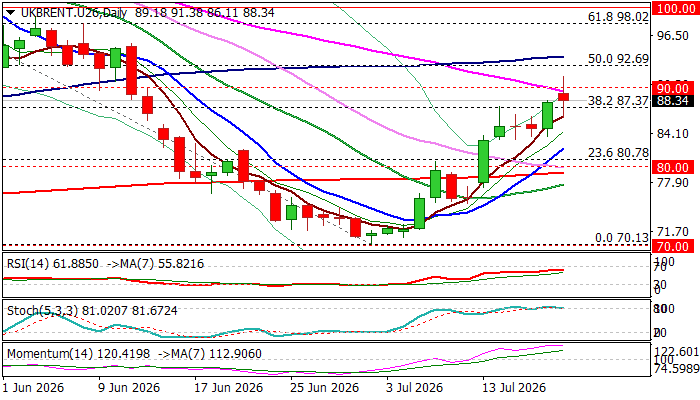
For immediate price direction, traders and analysts focused on several key technical levels. The price action on Monday was expected to ideally close above the broken Fibonacci barrier at $87.37, which represents the 38.2% retracement level of the move from $115.26 to $70.13. A close above this level would have been crucial for maintaining immediate bullish momentum. Failure to hold this level could have opened the door for a deeper pullback, with support anticipated in the higher base zone around $83.30.

Conversely, a firm break and sustained hold above the $90 level was seen as a catalyst for further upside, exposing potential targets at $92.69, corresponding to the 50% Fibonacci retracement, and $93.90, which aligns with the 100-day moving average (100DMA). These levels represent significant resistance points that, if breached, would signal a stronger continuation of the bullish trend.
Chronology of Events and Market Reactions
The events of Monday unfolded in a rapid sequence, demonstrating the market’s sensitivity to geopolitical developments and diplomatic pronouncements:
- Opening Bell: Brent crude futures gapped higher at the market open, reflecting overnight anxieties over the escalating Middle East tensions. Prices quickly surpassed the critical $90 per barrel mark, extending the rally from the previous week.
- Mid-Morning Surge: Initial trading saw prices climb further, buoyed by fears of a wider conflict and potential supply disruptions. The market was pricing in a heightened risk premium due to the volatile regional situation.
- Diplomatic Overtures: Reports emerged of comments from Iranian officials suggesting a willingness to engage in diplomacy based on national interests. This news was a significant turning point.
- Afternoon Reversal: The market interpreted Iran’s statements as a de-escalation signal, leading to a rapid unwinding of long positions. Prices reversed sharply, with Brent crude falling by approximately $5 from its intraday high.
- End of Day: By the close of trading, most of the overnight gains had been erased, with prices settling back below the $90 level, underscoring the market’s quick response to perceived shifts in geopolitical risk.
Supporting Data and Background Context
The surge in oil prices prior to Monday’s events was driven by a confluence of factors, including ongoing supply concerns from major oil-producing nations and persistent geopolitical instability. The Organization of the Petroleum Exporting Countries and its allies (OPEC+) has maintained production cuts to support market stability, contributing to a tighter supply-demand balance.
The specific escalation that triggered Monday’s market reaction involved heightened tensions in the Middle East, a region that accounts for a substantial portion of global oil production and transit. The Strait of Hormuz, a narrow waterway that separates the Persian Gulf from the Gulf of Oman, is particularly vulnerable. Its closure or significant disruption would have immediate and severe consequences for global oil supply chains, as an estimated 30% of the world’s seaborne oil trade passes through it. Past incidents involving the Strait have historically led to sharp increases in oil prices.
The "fragile ceasefire" mentioned in the original report likely refers to a period of reduced hostilities or diplomatic efforts that had been holding, but which recently broke down, reigniting fears of open conflict. The precise nature of this escalation would have been closely watched by market participants.
Statements and Reactions (Inferred)
While specific direct quotes from all parties may not be immediately available, the market’s reaction suggests the following inferred sentiment and responses:
- Market Participants: Traders and investors reacted with a dual approach. Initial fears of supply disruption drove a rush to buy, pushing prices up. However, the prospect of diplomatic solutions prompted a rapid sell-off as the perceived risk premium diminished. This highlights the market’s inherent desire for stability and its responsiveness to de-escalation signals.
- Iranian Officials: The comments from Iran, emphasizing diplomacy based on national interests, can be interpreted as a strategic move to avert a wider conflict while potentially seeking to improve their international standing and alleviate economic pressures. This could be an attempt to signal a willingness to engage without conceding key national interests.
- Other Middle Eastern Nations: Countries in the region, particularly those directly involved in or adjacent to the conflict, would likely have been observing the situation with extreme concern. Their statements, if any, would have been aimed at either de-escalating tensions, projecting strength, or seeking international support, depending on their specific strategic objectives.
- Major Oil Consumers: Nations heavily reliant on oil imports, such as those in Europe and Asia, would have been closely monitoring the price movements and geopolitical developments. They would likely have expressed concerns about price volatility and its impact on their economies, while potentially advocating for diplomatic solutions to ensure energy security.
Broader Impact and Implications
The volatility in Brent crude prices has significant implications beyond the financial markets:
- Global Economic Stability: Higher oil prices can fuel inflation, increase transportation costs for businesses and consumers, and potentially dampen global economic growth. Conversely, sudden price drops, while beneficial for consumers, can signal weakening demand or a resolution of supply fears, with their own set of economic interpretations.
- Energy Security: The ongoing geopolitical risks in the Middle East underscore the vulnerability of global energy supplies. This can incentivize a greater focus on diversifying energy sources, investing in renewable energy, and enhancing strategic petroleum reserves.
- Geopolitical Realignment: The interplay between oil prices and geopolitical events can influence international relations. Countries with significant oil reserves can wield considerable economic and political influence, while consuming nations are often compelled to engage in complex diplomatic maneuvers to secure their energy needs.
- Investment and Production Decisions: Sustained high oil prices can encourage investment in exploration and production, potentially leading to increased supply in the medium to long term. However, the uncertainty surrounding geopolitical stability can also deter long-term investment due to the perceived risk.
Future Outlook and Key Resistance/Support Levels
The immediate future for Brent crude will likely depend on the unfolding diplomatic landscape and any further developments in the Middle East. While the geopolitical backdrop remains inherently bullish, the market’s reaction to diplomatic overtures suggests that a sustained de-escalation could lead to a period of price consolidation or even a further correction.
Key Resistance Levels:
- $90.00: The psychological and immediate resistance level, which was tested and briefly breached.
- $91.38: A significant technical resistance point.
- $92.69: The 50% Fibonacci retracement level, a key target if bullish momentum resumes.
- $93.90: The 100-day moving average (100DMA), a crucial long-term technical indicator.
Key Support Levels:
- $87.37: The broken Fibonacci barrier, now acting as a potential support level.
- $86.27: A near-term support.
- $85.97: Another significant support level.
- $83.30: The higher base zone, identified as a potential area for a deeper pullback to find firm footing.
In conclusion, Monday’s trading session for Brent crude oil was a stark illustration of the market’s sensitivity to geopolitical events and diplomatic signals. While underlying fundamentals and persistent supply uncertainties continue to provide a bullish underpinning, the immediate price action demonstrated the power of de-escalation narratives to trigger rapid profit-taking and price reversals. The coming days and weeks will be crucial in determining whether the diplomatic overtures translate into a sustained period of calm or if the specter of wider conflict continues to cast a long shadow over global energy markets.