HaasOnline Launches Smart Trade on TradeServer Cloud to Revolutionize Manual Trading Discipline

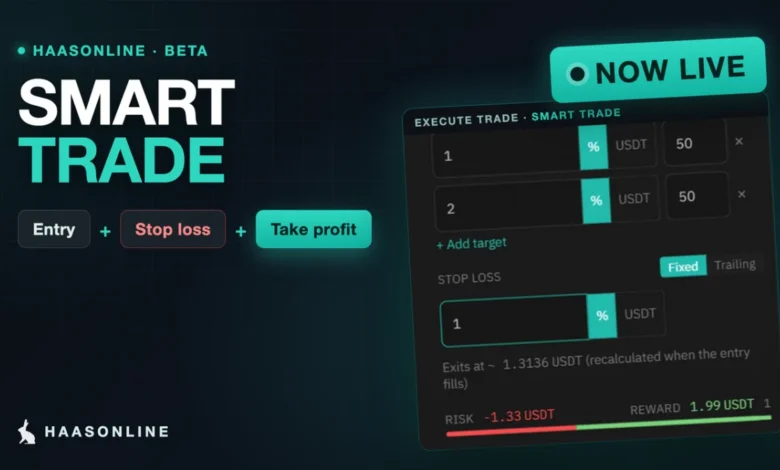
The introduction of Smart Trade on the HaasOnline TradeServer Cloud marks a significant shift in the platform’s historical focus, transitioning from purely automated algorithmic strategy deployment to supporting the granular needs of discretionary traders. While HaasOnline has long been synonymous with high-frequency trading bots and complex HaasScript-based automation, the release of Smart Trade acknowledges a persistent reality in the digital asset markets: a substantial volume of trading activity remains rooted in manual decision-making. By integrating automated exit management directly into the manual execution flow, HaasOnline is attempting to bridge the gap between impulsive human trading and the cold, calculated execution of algorithmic software.
The Evolution of HaasOnline’s Trading Ecosystem
For over a decade, HaasOnline has occupied a niche as a power-user platform for cryptocurrency enthusiasts. Historically, the software required users to possess varying degrees of programming knowledge, specifically through the implementation of HaasScript, to execute complex trading maneuvers. This high barrier to entry fostered a community of developers and data-driven analysts. However, the market landscape has shifted. With the rise of retail participation in decentralized finance (DeFi) and centralized exchange (CEX) spot markets, the demand for "middle-ground" tools—solutions that offer the protection of automation without the complexity of coding—has intensified.
The launch of Smart Trade is the culmination of a strategic roadmap aimed at democratizing professional-grade trading tools. By allowing users to pre-define take-profit and stop-loss parameters before an order is placed, the platform effectively mimics the functionality of institutional trading terminals, albeit within the context of the TradeServer Cloud environment.
Mechanics of the Smart Trade Interface
The operational architecture of Smart Trade is designed for immediate integration into a trader’s existing workflow. Accessible via the "Execute Trade" panel—designated by the dollar icon in the platform’s interface—the feature allows users to select their specific exchange account, trading pair, and position size. Upon toggling the "Smart Trade" switch, the user is prompted to define their exit strategy.
Unlike traditional limit orders that reside on the exchange’s order book, Smart Trade operates as an external management layer. Once the initial order is filled, the system initiates a monitoring process. The platform tracks real-time price action against the user’s predefined exit thresholds. When the market price hits a target, HaasOnline triggers a market order to close the position. This "client-side" monitoring is critical: it allows traders to apply sophisticated exit strategies to trades executed on exchanges that might lack advanced native conditional order types.
Managing Risk and Market Volatility
One of the primary objectives of the Smart Trade implementation is the mitigation of emotional trading, often referred to as "trader’s bias." Empirical data from the retail trading sector suggests that a significant percentage of losses are attributed to the failure to execute stop-loss orders in the heat of a market drawdown. By codifying the exit plan at the moment of entry, HaasOnline removes the necessity for manual intervention during periods of high volatility.
Furthermore, the "Lots" feature introduced with this update adds a layer of flexibility for spot market participants. Traders can now maintain multiple, distinct positions on the same asset—for example, a long-term "hold" position alongside a short-term "swing" position—each with its own independent stop-loss and take-profit parameters. By allowing up to 20 "lots" per spot market, the platform enables a modular approach to portfolio management that was previously difficult to track without external spreadsheets or secondary manual documentation.
The Technical Reality of Server-Side Monitoring
It is essential for users to understand the distinction between "exchange-held" orders and "platform-held" orders. In the context of Smart Trade, the take-profit and stop-loss logic is maintained by the HaasOnline TradeServer Cloud. This has specific implications for the user experience:
- Connectivity Requirements: Because the exit instructions reside on the HaasOnline cloud, the system must maintain an active connection to the target exchange. Should a user’s internet connection fail or the cloud instance experience a delay, the exit order may not trigger as expected.
- Execution Latency: As these are market orders triggered by price alerts, they are subject to the liquidity conditions of the exchange at the exact moment of execution. In "flash crash" scenarios, the final realized price may deviate from the user’s intended stop-loss level due to slippage.
- Privacy and Autonomy: The system allows for the management of trades initiated outside of the HaasOnline interface. Users can import existing positions from an exchange’s native web portal and "attach" a Smart Trade management layer, effectively retrofitting a professional risk-management strategy onto a previously unprotected trade.
Market Implications and Competitive Positioning
The move by HaasOnline to offer these tools in a "Beta" capacity reflects a broader industry trend toward "all-in-one" trading platforms. Competitors in the space, such as 3Commas or Cryptohopper, have long provided similar manual-management tools. By embedding these features into the TradeServer Cloud, HaasOnline is signaling a desire to retain users who might otherwise migrate to third-party terminal providers for their manual trading needs.
The professionalization of the retail trader has created a market where the standard "buy and hold" strategy is being replaced by active management. According to industry reports from 2023, platforms that offer integrated stop-loss and take-profit functionality see a 30% increase in user session duration, as traders feel more comfortable leaving larger positions open while they are away from their monitors.
Strategic Outlook and Future Iterations
While currently in its beta phase, the Smart Trade module is expected to serve as the foundation for more advanced features, such as trailing stops and "break-even" triggers, which are currently standard requirements for institutional desks. The inclusion of visual indicators on the Marketview chart—where users can drag and drop their entry, target, and stop levels—is a significant UX improvement, transforming raw data into a visual representation of risk-to-reward ratios.
As the cryptocurrency market matures, the infrastructure supporting it must become increasingly robust. HaasOnline’s strategy of leveraging its existing cloud infrastructure to manage these manual trades reduces the technical burden on the end-user while providing a high degree of precision. Whether this will draw a new demographic of traders to the platform—specifically those who prefer manual control over full automation—remains to be seen, but the intent to bridge that gap is clear.
Risk Disclosure and User Responsibility
Despite the technological advancements presented by Smart Trade, it is imperative to reiterate the inherent risks associated with digital asset trading. Automation software, regardless of its sophistication, cannot account for systemic exchange failures, API rate limiting, or extreme market volatility. The disclaimer provided by HaasOnline serves as a vital reminder: these tools are aids to decision-making, not guarantees of profit. A stop-loss order is a risk-mitigation tool, but in the event of an order book collapse or liquidity void, even the best-programmed stop-loss may fail to execute at the desired price.
As with all high-stakes financial tools, the responsibility for capital allocation remains with the trader. The ability to "set and forget" is an attractive proposition for the modern, busy trader, but it requires a disciplined approach to setting parameters that align with one’s personal risk tolerance and the liquidity characteristics of the specific asset being traded.
Getting Started with Smart Trade
For existing users of the TradeServer Cloud, the Smart Trade feature is available immediately without additional configuration. New users looking to explore the platform can utilize the 7-day trial period, which allows for experimentation within paper trading environments. By testing these parameters on simulated funds, traders can calibrate their strategies before exposing real capital to the market.
As HaasOnline continues to iterate on this feature, the feedback loop from the beta phase will be critical. Future updates will likely focus on improving the granularity of order execution and potentially integrating more complex order types, such as OCO (One-Cancels-the-Other) orders, which would further align the platform with the capabilities found in traditional equity and forex markets. In the current volatile climate of digital assets, tools that prioritize the systematic preservation of capital, like Smart Trade, represent a necessary evolution in the retail trading toolkit.
Related posts: