Overcoming the Valley of Death: How Enterprises Are Scaling Agentic AI in Customer Experience

As artificial intelligence matures from basic conversational scripts to autonomous decision-making agents, enterprise customer experience (CX) leaders face a formidable roadblock known as the scale-up phase. While early pilot programs consistently demonstrate efficiency gains, transitioning these isolated tests into enterprise-wide production systems frequently stalls. Organizations are continually held back by fragmented IT infrastructures, unprepared or unstructured internal knowledgebases, and inconsistent regulatory governance frameworks.
Recent empirical research underscores both the immense potential and the hidden pitfalls of deploying generative AI in customer support environments. A landmark study published by the National Bureau of Economic Research (NBER), examining 5,179 customer support agents, revealed that granting workers access to a generative AI assistant increased issue resolution rates by 14% on average. For novice and low-skilled workers, that productivity surge climbed to an impressive 34%.
Conversely, scaling AI without adequate safeguards invites severe operational and legal repercussions. A comprehensive 2023 report by the Consumer Financial Protection Bureau (CFPB) highlighted that while all of the ten largest U.S. commercial banks had deployed customer service chatbots, many consumers suffered substantial negative outcomes due to technological limitations. The CFPB formally warned that financial institutions utilizing poorly managed chatbots risk violating regulatory compliance obligations, systematically eroding hard-earned customer trust, and inflicting direct consumer harm.
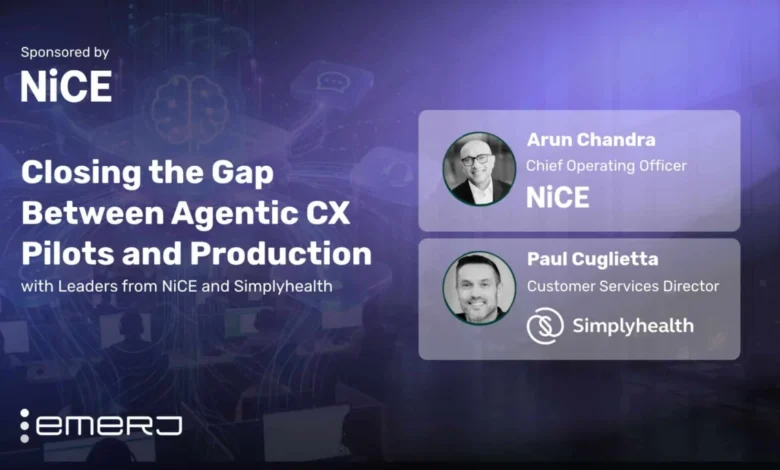
To unpack what it genuinely takes to transform enterprise knowledge into production-ready AI agents for large-scale CX transformation, Emerj recently hosted Arun Chandra, Chief Operating Officer at NiCE, and Paul Cuglietta, Customer Services Director at Simplyhealth, on the AI in Business podcast series. This analysis explores the strategic insights, operational frameworks, and governance models that CX leaders must implement to navigate the transition from experimental pilots to resilient, enterprise-wide deployments.
P&L-Anchored Use Case Selection to Secure CFO Investment
Over the past 12 to 18 months, many enterprise organizations rushed into artificial intelligence pilots primarily because external vendors aggressively marketed point solutions or because executive boards demanded immediate proof of AI adoption. Arun Chandra advocates for an alternative methodology: applying classic operations management principles directly to AI initiatives.
According to Chandra, corporate Chief Financial Officers (CFOs) are motivated strictly by two core financial metrics—tangible revenue generation and hard operational cost savings. A common strategic miscalculation occurs when leaders assume that automating customer interactions yields net financial savings without accounting for the underlying operational expenses of the AI models themselves.
"One thing we can maybe segue into is the cost of tokens," Chandra noted during the podcast. "AI is not free. We’re talking about, AI can automate something, and so we assume that we’ve reduced the cost of the humans, but wait a minute, the AI agents have their own operating cost, which is in token costs."
Similarly, improvements in Customer Satisfaction (CSAT) scores—such as an increase from 90% to 99%—must ultimately be tied back to the profit and loss (P&L) statement to justify capital allocation. Chandra draws a sharp distinction between isolated experimentation and true enterprise scale.
Drawing from his tenure as a senior executive at The Disney Company, where he modernized customer experience functions for streaming services supporting over 200 million subscribers, Chandra approached CX through the lens of a general manager. Rather than focusing narrowly on standard contact center metrics like average handle time, he positioned the CX organization as a value-creating enterprise hub. He established precise operational objectives designed to bend the cost curve, ensuring that as subscriber volumes scaled upward, the administrative cost structure flattened.
For organizations lacking immediate internal metrics, Paul Cuglietta suggests building a rigorous business case prior to deployment. By aligning the AI vision directly with corporate strategy and leveraging peer-reviewed, like-for-like industry case studies, leaders can secure necessary internal sponsorship and cross-departmental alignment.
Connected Knowledge and Systems for Autonomous Agent Workflows
Between initial AI testing and full enterprise deployment lies what Chandra describes as the operational "valley of death." Many technological initiatives falter in this intermediate phase because clean data alone is insufficient.
"More importantly, or as importantly, my knowledge has to be organized and available, because that knowledge and data is the lifeblood of what AI can produce for you in terms of outcomes," Chandra explained. "And then the third related thing is context also. So context has to be pretty well provided so that the AI can understand who reports to whom, what decision rights do I have versus what decision rights you have."
Beyond organized data and contextual frameworks, autonomous agents require deep API connectivity into back-end systems of record. This connectivity allows agents to execute multi-step workflows independently without continuously escalating tasks to human workers.
Paul Cuglietta encounters this exact architectural requirement from the consumer’s perspective at Simplyhealth. Modern customers frequently switch between voice calls, emails, and live chat channels. Maintaining a continuous thread across these touchpoints ensures consumers never have to repeat themselves, fundamentally elevating service delivery. Cuglietta advises against waiting for absolute architectural perfection before launching a new channel. Instead, organizations should leverage historical data to identify high-volume communication channels, coordinate priorities directly with the Chief Technology Officer (CTO), and iterate progressively.
Furthermore, architecture decisions dictate how far system connectivity can scale. Chandra strongly advocates for open systems and open protocols, such as the Model Context Protocol (MCP), noting that the industry is actively moving away from legacy Software-as-a-Service (SaaS) vendor lock-in toward open-source Large Language Models (LLMs) that reduce operational token costs.
Real-Conversation Testing Before Channel Launch
A disciplined rollout schedule is paramount, particularly because consumer patience for flawed digital interactions is remarkably low. Cuglietta emphasizes that organizations rarely get a second chance to launch a digital channel successfully.
"From my experience, you get one chance to get a new channel right," Cuglietta stated. "Otherwise customers may switch off to that channel and think, you know what, I think I’ll just stick to utilising the telephone or utilising another channel that I’m more familiar with. So what we don’t want to do is to get it wrong. And I think sometimes companies fall foul of wanting to evolve quicker than perhaps they’re ready."
A common pitfall in chatbot development is structuring agents solely around rigid Frequently Asked Questions (FAQs). Real-world consumers rarely frame inquiries precisely like a static FAQ document; they use varied colloquialisms, compound multiple requests into a single message, and communicate across voice channels with diverse emotional tones.
To mitigate these risks, Simplyhealth enforces rigorous user acceptance testing (UAT) utilizing both simulated sandbox environments and historical customer datasets. These iterative tests evaluate whether agents accurately interpret intent, maintain contextual awareness, and seamlessly escalate complex or sensitive scenarios to human representatives.
Risk appetite ultimately dictates implementation velocity. At Simplyhealth, every technological iteration passes through an internal AI governance framework requiring formal sign-off from all corporate stakeholders. These review sessions are meticulously documented for compliance and auditability. Moreover, human empathy remains the ultimate benchmark: while routine transactional inquiries are ideal for automation, emotionally vulnerable scenarios—such as a customer reporting the passing of a next of kin—trigger immediate routing to compassionate human professionals.
Hybrid Optimization Teams as an Adoption Accelerator
To execute complex AI integrations smoothly, Simplyhealth established a specialized internal optimization team comprising personnel drawn from both technical engineering backgrounds and frontline customer service operations.
"This team was made up of people who were, from a technical background in our organization, but also from my front line as well," Cuglietta explained. "So those on the front line that had the knowledge, they had the passion, they had the career ambitions to move into a slightly more technical role. Bringing those two together, technology and service, into an optimization team, they helped execute the AI deployments in our organization."
Effective change management is ultimately the determining factor in whether enterprise AI initiatives succeed or fail. Chandra emphasizes that organizations must proactively address human adoption across engineering, product management, and frontline service teams. Rather than replacing human agents entirely, successful agentic AI deployments streamline workflows, allowing customer service professionals to concentrate on high-touch capabilities like active listening, empathy, and complex problem-solving.
As enterprises continue to refine their automation strategies, selecting external technology partners who prioritize deep collaboration over rigid technical supremacy remains critical. By combining robust architectural foundations, disciplined financial metrics, and comprehensive human-in-the-loop governance, organizations can successfully scale agentic AI across the enterprise, unlocking sustainable, long-term customer experience transformation.