Building a Robust JSON Serialization Pipeline in Python for Modern Machine Learning Workflows

In the contemporary landscape of machine learning engineering, the primary hurdle for data scientists is often not the sophistication of their model architecture, but the reliability of the data plumbing that supports it. While industry discussions frequently center on hyperparameter tuning and neural network depth, senior engineers recognize that the movement of structured data between files, microservices, and APIs represents the most critical point of failure. Developing a robust JSON serialization pipeline—one capable of handling custom data types, graceful error recovery, and schema migrations—is a prerequisite for building production-grade machine learning systems that do not collapse under the weight of malformed or outdated data.
The Problem of Standard Serialization
The Python standard library’s json module is the industry default for data interchange. However, its simplicity is also its greatest limitation. The library is natively designed to handle basic Python primitives: integers, floats, strings, lists, and dictionaries. When a data scientist attempts to serialize complex objects—such as datetime objects, set collections, pathlib.Path instances, or Enum classes—the library invariably throws a TypeError.
This limitation is particularly problematic in machine learning experiments. Configuration files for experiments often include timestamps for versioning, file paths for training datasets, and categorical Enum flags for model architecture. When these objects encounter json.dumps(), the process halts entirely. In a distributed pipeline, such a failure can result in the loss of unsaved experiment logs, corrupted state information, and significant downtime for automated training clusters.
The Chronology of Data Plumbing Challenges
The evolution of data pipelines has shifted from simple monolithic scripts to complex, distributed microservices. A decade ago, serialized data was typically kept in memory or stored in simple flat files. Today, the lifecycle of a configuration object is significantly more perilous.
- The Encoding Phase: Data is extracted from a model training loop. It contains non-serializable objects.
- The Transmission Phase: Data is serialized into a JSON string and transmitted across a network to a storage service or a secondary model evaluation microservice.
- The Decoding Phase: The receiving service attempts to reconstruct the objects. If the schema has evolved—for instance, if a developer added a new
learning_rateparameter—the application may fail to parse the older JSON format. - The Validation Phase: The data is sanitized to ensure it conforms to the current version of the application logic.
Engineering a Custom Encoder
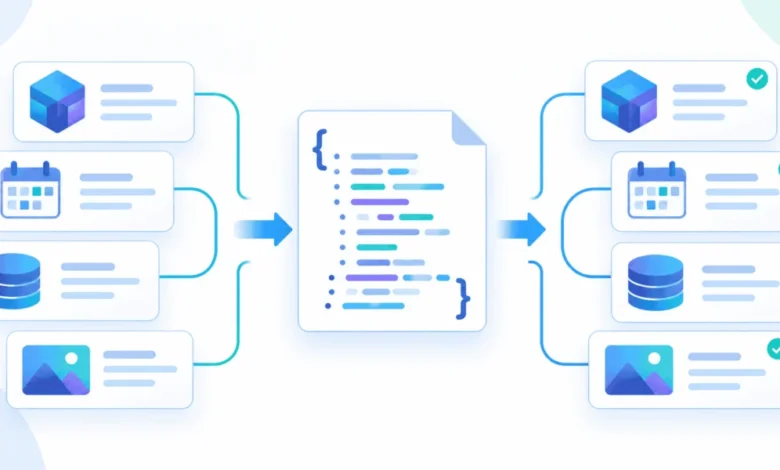
To overcome the inherent limitations of the json module, engineers must implement a custom encoder that inherits from json.JSONEncoder. This approach allows developers to intercept the serialization process at the point where the library encounters an unknown type.
By overriding the default() method, one can define specific logic for various data types. For instance, a datetime object can be transformed into an ISO-formatted string, while a set can be converted into a list. To ensure the integrity of the data during this transformation, it is standard practice to attach a metadata marker—often referred to as a "type tag"—such as "__type__": "set", "value": [...]. This tag serves as a fingerprint, allowing the decoding layer to identify exactly which constructor should be used to re-instantiate the original object.
The Role of the Object Hook in Decoding
The inverse process, deserialization, is arguably more complex. Standard json.loads() does not inherently know that a dictionary with an __type__ key should be converted back into a set or a Path object. To solve this, developers must employ an object_hook.
The object_hook is a function that json.loads() calls for every dictionary decoded from the JSON string. This allows the system to scan for the "type tags" injected during the encoding phase. If a tag is found, the system can trigger the corresponding constructor. Importantly, this layer should be wrapped in robust error handling. If a serialized file is corrupted or generated by a deprecated version of the system, the decoder should log a warning and return a fallback value rather than allowing the entire application to crash.
Addressing Schema Evolution and Migrations
One of the most persistent issues in machine learning is "configuration rot." As a project matures, the metadata schema inevitably changes. A configuration file saved six months ago might lack the learning_rate or dropout_rate parameters required by the current version of the code.
To maintain backward compatibility, engineers must implement a factory function that performs a "schema migration" during the loading process. This function acts as a validator, checking the keys in the deserialized dictionary and supplying sensible defaults for any missing parameters. For instance, if a dictionary is missing a learning_rate, the factory function can inject a default value (e.g., 0.001) before passing the configuration to the model trainer. This practice effectively decouples the stored data from the evolving application code, ensuring that older experiments can still be audited or resumed without manual intervention.
Practical Implications and Data Integrity
The implementation of a robust serialization pipeline has measurable impacts on the stability of machine learning operations (MLOps). By standardizing the way objects are moved across the system, teams reduce the likelihood of "silent" failures—errors where data is silently truncated or misinterpreted.
From a resource management perspective, these pipelines allow for better auditability. Because custom types are serialized with metadata, the provenance of training data is preserved. When researchers look back at a saved configuration, they can see exactly which Path was used and at what timestamp the experiment was initiated.
Furthermore, the transition from simple scripts to managed pipelines reflects a broader trend toward professionalizing data science codebases. As organizations move models from research environments to production, the rigor applied to serialization becomes a proxy for the maturity of the engineering team. Standardizing these processes reduces technical debt and allows for more seamless collaboration across data engineering and data science teams.
Conclusion
Building a reliable JSON serialization pipeline is not merely a task of fixing TypeError exceptions; it is a fundamental step in ensuring the reproducibility and scalability of machine learning models. By implementing a custom encoder for serialization, an object_hook for deserialization, and a robust factory function for schema migration, developers can create systems that are resilient to the inevitable changes in project requirements.
This multi-layered approach ensures that data integrity is maintained throughout the pipeline, from the initial model configuration to the eventual deployment in a production environment. As machine learning models continue to play a larger role in critical infrastructure, the adoption of these defensive programming practices will remain an essential component of the software development lifecycle, separating experimental scripts from production-ready systems. Through these structured techniques, the complexities of data plumbing are mitigated, allowing engineers to focus on the core objective: the effective and efficient deployment of intelligent models.
Related posts: