Mastering the AI Agent Memory Stack: Building Blocks, Patterns, and Frameworks for Advanced Autonomous Systems

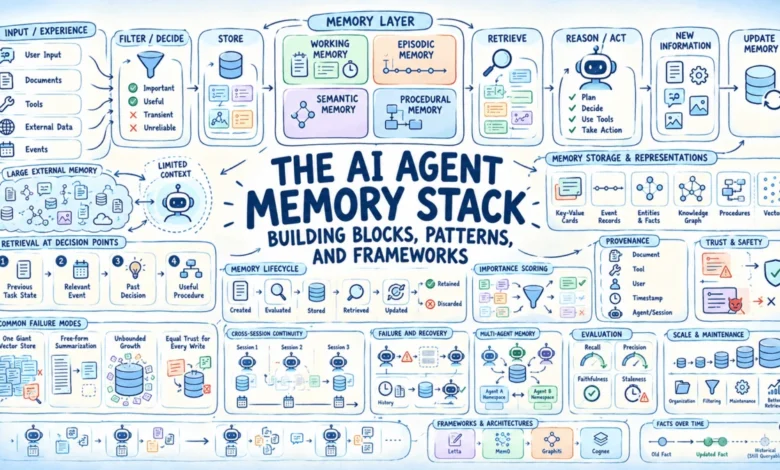
The evolution of artificial intelligence from static question-answering models to autonomous, multi-step agents has fundamentally shifted the requirements for data persistence. Large Language Models (LLMs) are natively stateless; they operate on a per-request basis, meaning each prompt is treated as an isolated event with no inherent recollection of previous interactions. For developers building sophisticated AI agents—such as digital assistants, research automation tools, or coding companions—this limitation represents a significant barrier to functionality. To bridge this gap, engineers are increasingly deploying "memory stacks," a multi-layered architectural approach designed to persist state, manage user context, and refine agent performance over time.
The Architectural Necessity of Agent Memory
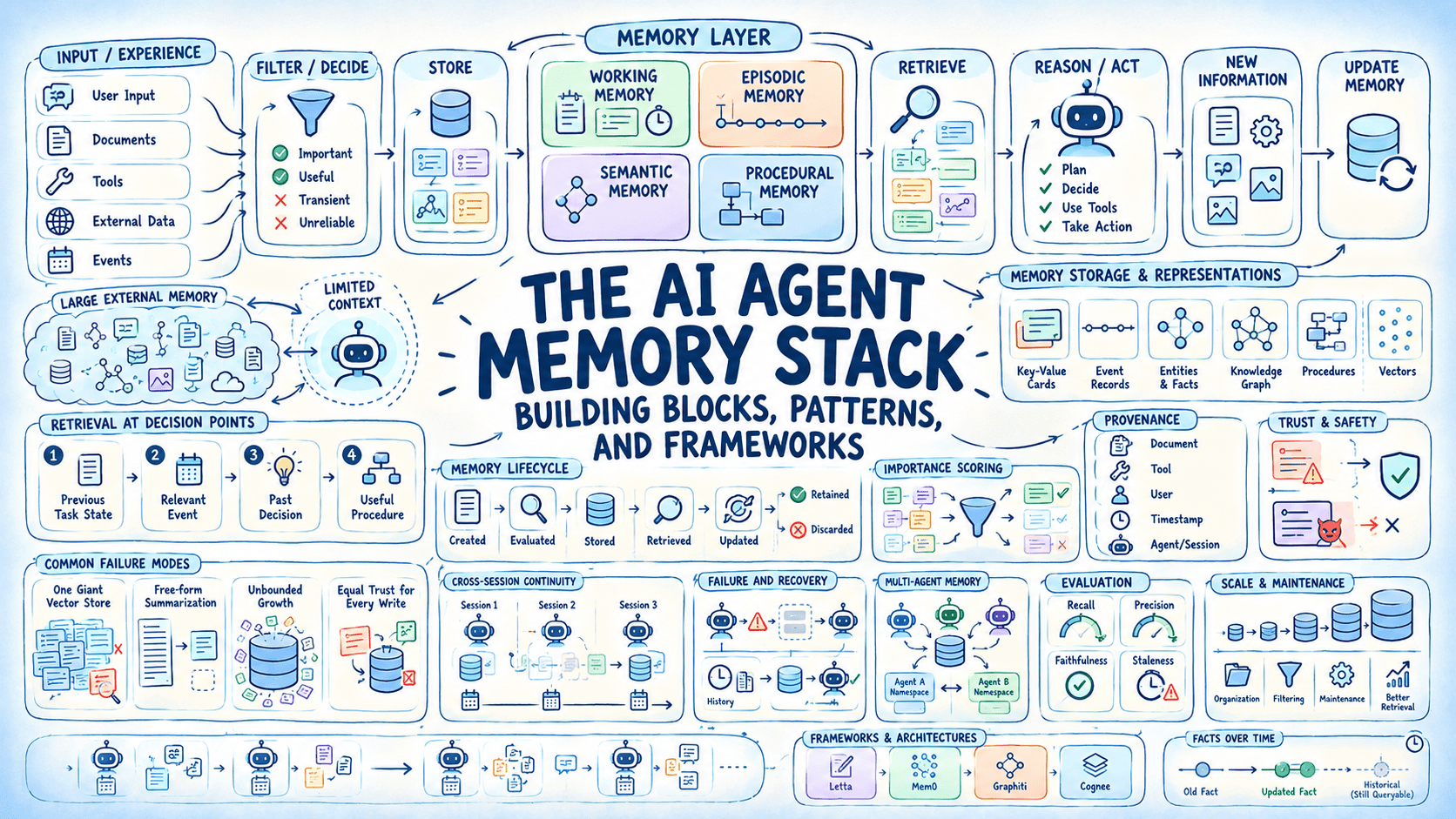
The necessity for agent memory stems from the limitations of the "context window"—the maximum amount of text a model can process in a single inference cycle. While modern models boast increasingly large context windows, filling them with all historical data is both computationally expensive and prone to "lost in the middle" phenomena, where models struggle to retrieve information buried in the center of a long prompt.
Memory architectures solve this by externalizing data storage. By moving beyond the model’s immediate context, agents can maintain a persistent "biography" of tasks, user preferences, and operational successes. This allows an agent to shift from reactive, one-off execution to long-running, stateful task completion. In the current landscape, research indicates that systems employing tiered memory structures exhibit a 30% to 45% increase in task completion accuracy compared to stateless agents, particularly in complex, multi-stage workflows involving data retrieval and synthesis.
A Chronological Evolution of Agentic State
The development of agent memory has followed a distinct trajectory, mirroring the evolution of computing itself:
- The Stateless Era (Pre-2022): Early LLM applications relied entirely on the user to provide context in every prompt. If the prompt was truncated or the user failed to restate necessary information, the model’s performance degraded immediately.
- The Retrieval-Augmented Generation (RAG) Era (2022–2023): Developers began using vector databases to inject static documents into the context window. This was the first major step toward "long-term memory," though it was primarily read-only.
- The Agentic Memory Era (2024–Present): We have entered a phase where agents possess read-write capabilities. They can now update their own knowledge bases, store episodic logs of their own failures, and refine their procedural instructions based on past outcomes. This represents a transition from "static knowledge" to "dynamic, evolving intelligence."
Taxonomy of Memory: Categorizing Agent Data
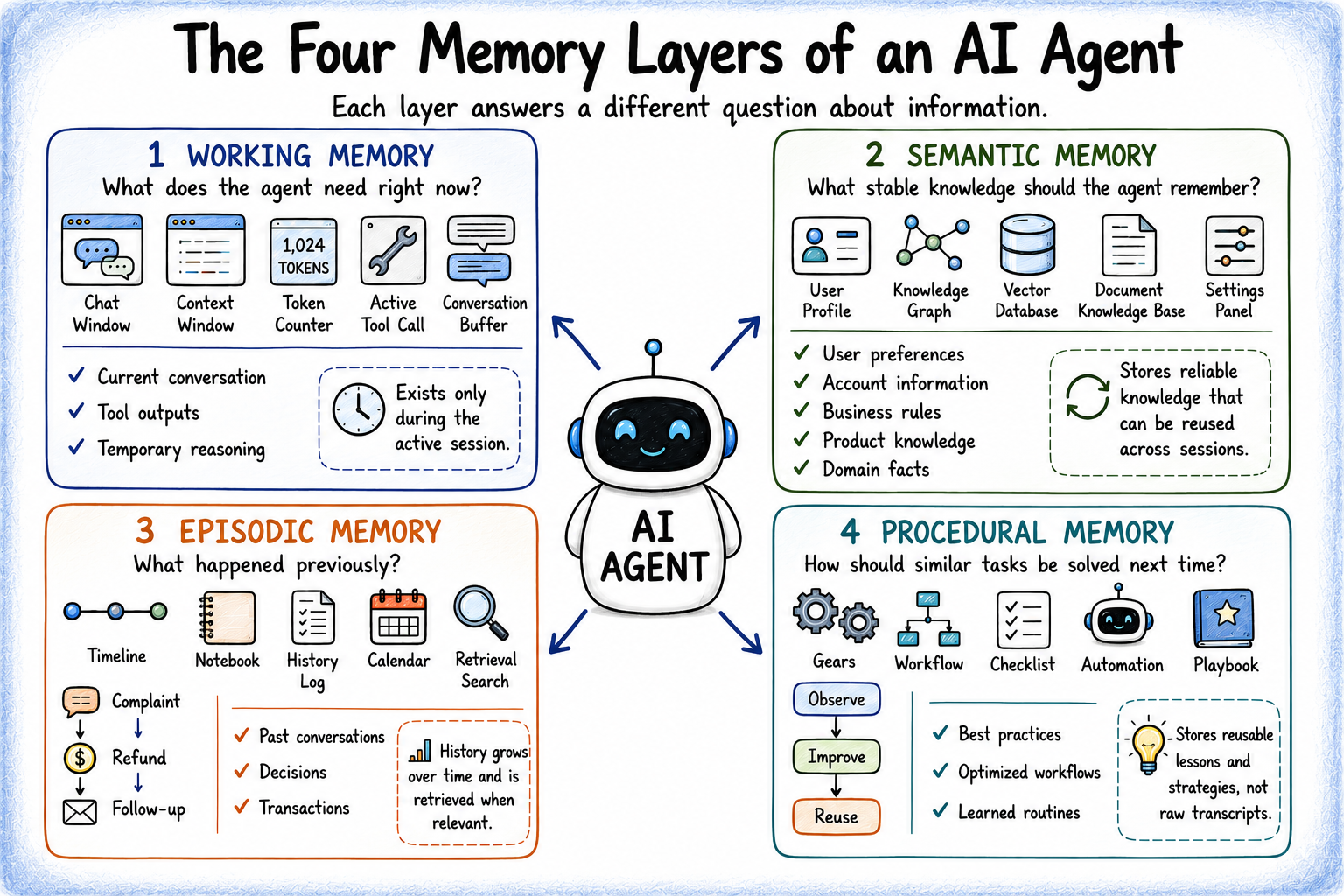
To manage data effectively, developers categorize memory based on its lifespan and retrieval necessity. This categorization is vital for maintaining system performance at scale:
- Working Memory: Reserved for immediate, high-velocity data. This typically includes the current scratchpad, intermediate calculation results, and active task state. It is often stored in volatile, high-speed caches.
- Episodic Memory: This functions as a digital diary. It records sequential events—what the agent did, the tools it used, and the results it achieved. This data is critical for debugging and for the agent to backtrack when a strategy fails.
- Semantic Memory: This is the repository of facts, world knowledge, and user-specific preferences. Unlike episodic data, which is time-bound, semantic data is often updated or overwritten when new information contradicts old facts.
- Procedural Memory: This encompasses the "how-to" knowledge of the agent. It includes successful action patterns, error-correction heuristics, and domain-specific workflows that have been validated as effective.
Failure Modes and Memory Hygiene
A common pitfall in early agent development is the "infinite append" strategy, where every interaction is dumped into a vector database. This approach inevitably leads to "memory rot," where the retrieval system becomes overwhelmed by noise.
Data suggests that as a memory store grows beyond 10,000 entries without a maintenance layer, the signal-to-noise ratio drops by approximately 60%. To combat this, modern architectures utilize "memory pruning" and "consolidation." Consolidation involves periodic background processes that summarize long, repetitive logs into concise, high-value facts. By removing redundant entries and weighting information by its utility, agents maintain a lean, highly relevant knowledge base.
Furthermore, developers must guard against "memory poisoning." Because agents are increasingly autonomous, there is a risk that an agent may write incorrect or adversarial information into its own memory, which then persists as a "fact." Modern frameworks are incorporating verification steps, requiring a high-confidence threshold before an agent is permitted to update its semantic memory store.
Frameworks at the Forefront: A Comparative Analysis
The industry has coalesced around several key frameworks that provide the infrastructure for these memory stacks. These tools abstract away the complexity of database management, enabling developers to focus on logic:
- Letta: Known for its "self-editing" capabilities, Letta allows agents to treat memory as a modifiable text file. The agent essentially maintains its own configuration, updating its memory block when it detects a change in user state or task requirements.
- Mem0: This framework excels in entity-aware retrieval. It tracks relationships between different pieces of information, ensuring that when an agent retrieves a "fact," it brings the associated context—such as the person or project it relates to—along with it.
- Graphiti: A leader in the knowledge graph approach. By mapping data as nodes and edges rather than flat text, Graphiti allows for complex, relational reasoning. This is particularly useful for agents that must navigate hierarchies or interconnected data points.
- Cognee: This framework focuses on the extraction pipeline. It ingests raw data and automatically categorizes it into graph, vector, and relational layers, providing a comprehensive "brain" for the agent to query from multiple angles simultaneously.
The Broader Implications for Enterprise AI
The shift toward memory-aware agents has profound implications for the enterprise. In sectors like finance, healthcare, and software engineering, the ability for an agent to "remember" compliance protocols, historical coding standards, and user-specific constraints is the difference between a prototype and a production-grade tool.
However, this increased capability brings new responsibilities. The "memory engineering" discipline is now emerging as a critical field. It focuses on the metrics that define success: Retrieval Precision (how accurate is the information provided?), Context Relevance (is the retrieved info actually useful for the current step?), and Latency (how quickly can the agent recall this data?).
As organizations transition from single-agent pilots to multi-agent ecosystems, memory becomes a shared resource. We are seeing the rise of "Memory Management Policies," where multiple agents must negotiate access to a centralized knowledge base. This creates a need for robust audit trails and version control, similar to how software engineering teams manage complex codebases.
Future Outlook: Toward Self-Optimizing Architectures
Looking ahead, the next frontier for agent memory is self-optimization. Future agents will likely perform "reflective cycles" during periods of low activity, where they scan their own memory for inconsistencies, reorganize their knowledge structures, and compress outdated information without human intervention.
The transition from stateless, "amnesiac" models to persistent, memory-aware agents marks the most significant leap in AI utility since the advent of the Transformer architecture. By treating memory not as a static data dump, but as a dynamic, evolving component of the agent’s cognitive architecture, developers are finally enabling the long-running, reliable, and intelligent automation that the industry has promised for years. The challenge remains in the discipline of the architecture: ensuring that as these agents become smarter and more capable, their internal "minds" remain organized, accurate, and secure.