Financial markets experienced a volatile roller coaster over a 12-hour period as early election returns pointed toward a shift in congressional control. Late Tuesday night, equities tumbled roughly 2%, with the technology-heavy Nasdaq taking the brunt of the selling pressure. Yet, by Wednesday morning, sentiment underwent a stark reversal, sending the S&P 500 up approximately 1% at the opening bell. This swift three-point round trip occurred despite zero fundamental changes in the underlying economic data, highlighting the knee-jerk emotional reactions that frequently characterize post-election trading environments.

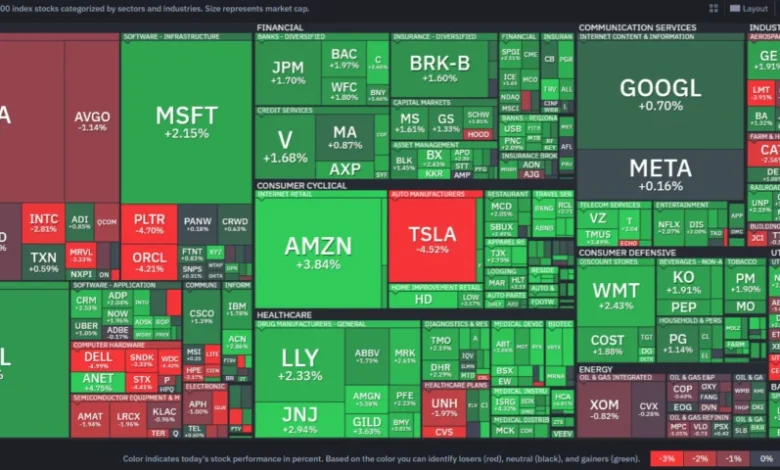
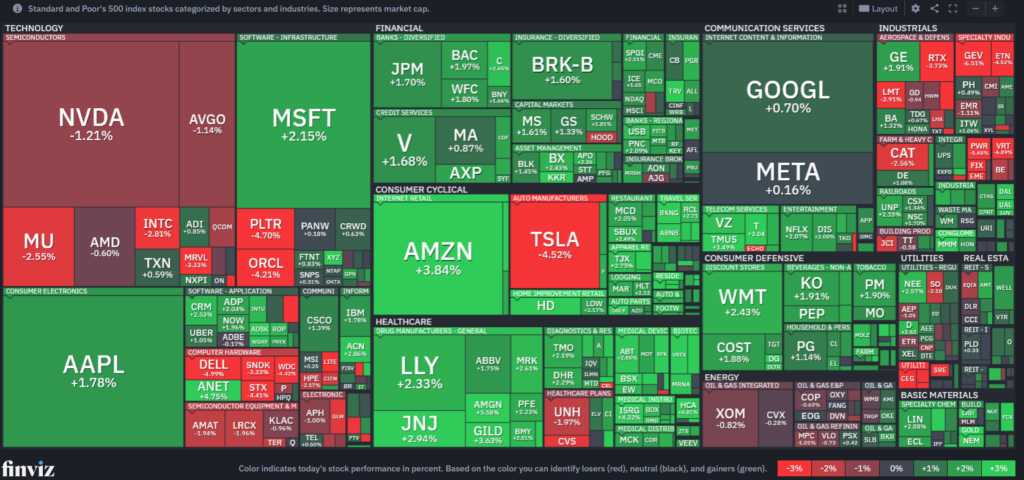
Initial sector movements reflected immediate speculation regarding which legislative agendas might emerge from a divided or newly aligned Washington. The broader value rotation reasserted itself, lifting traditional sectors such as banking, healthcare, and consumer staples. Within the "Magnificent Seven," most mega-cap tech stocks advanced, though notable exceptions included Nvidia and Tesla. More acutely, concentrated losses hit specific thematic trades. The data center power infrastructure complex suffered steep declines, with Vertiv dropping 6.8%, GE Vernova falling 6.3%, Quanta losing 5.5%, and Eaton sliding 4.7%. Enterprise software firms also retreated, as Oracle fell 4.3% and Palantir dropped 4.0%, alongside defense contractors like Lockheed Martin (off 4.1%) and RTX (down 3.2%), as well as broader semiconductor weakness across Broadcom, Intel, and Micron.
The Danger of Overinterpreting Overnight Reactions
Market historians immediately drew parallels to past elections, noting that initial overnight moves often represent positioning adjustments, forced short-covering, and algorithmic reflex rather than sober political or economic analysis. No institutional investor is genuinely pricing in utility regulatory shifts or healthcare legislative revisions at two in the morning. As market strategist Nick Colas aptly observed following the 2016 presidential election cycle, initial consensus reactions to major political shocks frequently prove entirely erroneous within a matter of hours.

Markets do not function on immediate headlines; they vote slowly through the grinding realities of legislative calendars, committee assignments, and the eventual gap between political rhetoric and statutory execution. This legislative filtering process takes weeks, if not months. Consequently, analytical focus should center not on overnight ticks, but on which asset price shifts maintain their momentum over a four-week horizon.
Portfolio Adjustments and the Flight to Safety
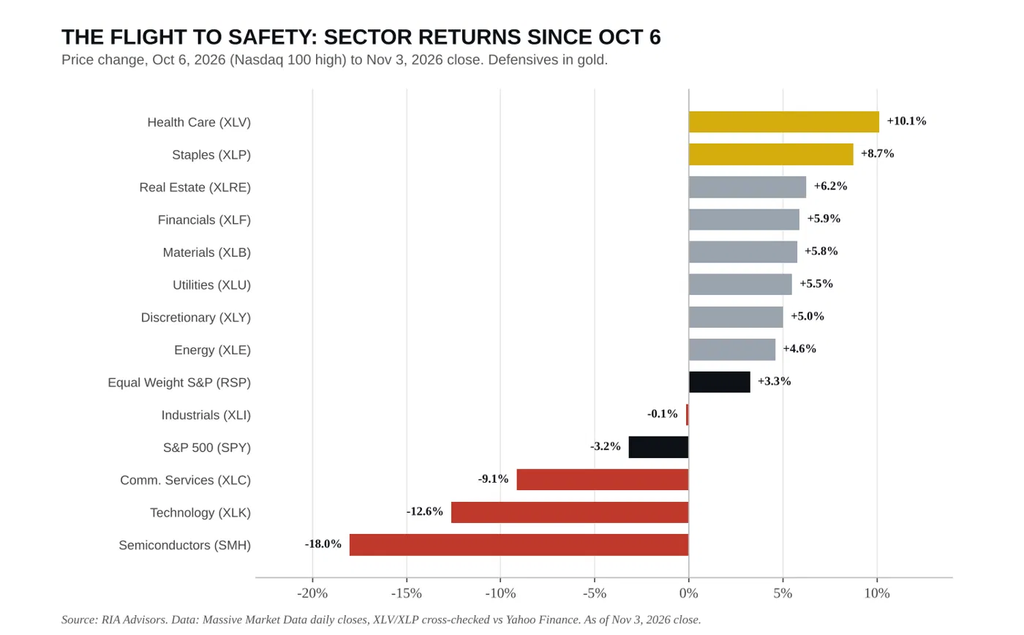
Beneath the headline indices, a quieter, more systemic transformation has been underway for weeks. Since the Nasdaq 100 peaked in early October, semiconductors fell roughly
18% and the broader technology sector pulled back by 12.6%. Simultaneously, investors rotated aggressively into safety, driving the Health Care Select Sector SPDR Fund (XLV) up 10.1% and the Consumer Staples Select Sector SPDR Fund (XLP) up 8.7%, while the S&P 500 slipped a modest 3.2%. This divergence underscores a deliberate portfolio reconfiguration rather than broad-based panic selling.
However, this defensive shelter has grown increasingly expensive. Health care equities reached valuations sitting roughly 15.8% above their 200-day moving average, accompanied by a 14-day Relative Strength Index (RSI) pushing near overbought thresholds of 70. Historical records indicate that instances of health care trading at such extended premiums above its long-term moving averages—such as in late 2009 and early 2013—frequently precede periods of consolidation or modest pullbacks over a six-month window. While defensive positioning remains fundamentally logical during economic uncertainty, crowded trades carry inherent risks, leaving sectors vulnerable to sharp corrections should upcoming corporate earnings miss lofty expectations.
Labor Market Dynamics: The JOLTS and Employment Reports
Macroeconomic data releases continue to provide mixed signals regarding the health of the broader economy. The Job Openings and Labor Turnover Survey (JOLTS) for September revealed a stronger-than-expected rise in job openings to 7.52 million, comfortably outstripping consensus forecasts of 7.10 million. Additionally, the quits rate ticked up to 2.1%, marking its highest level since mid-2025 and suggesting that workers retain confidence in alternative employment opportunities.
Despite the uptick in openings, actual hiring velocity remains subdued. The hiring rate hovered at 3.4% in September—matching its slowest pace since 2013—while total separations remained flat. This dynamic suggests that employers are actively advertising open positions without aggressively filling them, a trend heavily influenced by non-cyclical public sector hiring rather than robust private sector demand.
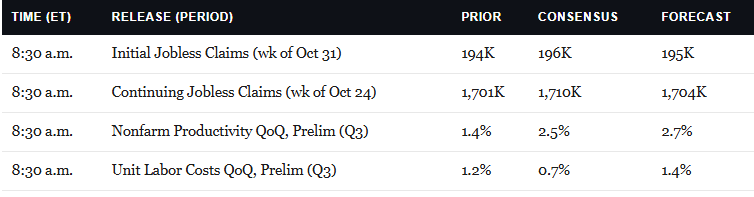
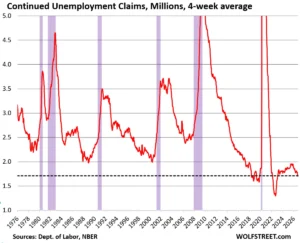
Looking ahead to the Bureau of Labor Statistics (BLS) employment report, analysts anticipate continued low hiring balanced against historically low layoff rates, with the layoff rate holding steady at 1.0%. This environment points to a "frozen" labor market characterized by modest, positive payroll prints rather than sudden contraction, reinforcing the narrative of a resilient but decelerating economy.
Credit Markets: Surface Stability Versus Subsurface Stress
Fixed-income markets reflect a similar duality, displaying immense surface-level calm alongside emerging pockets of underlying stress. Investment-grade corporate bond spreads continue to hover near the tightest ends of their 20-year ranges, and high-yield spreads remain anchored in the middle of their historical bands. These metrics suggest that the broader corporate sector harbors little immediate fear of a systemic credit crunch or an imminent, widespread recession.
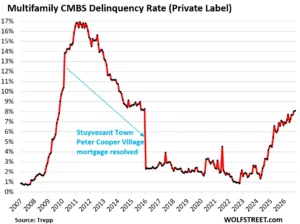
Nevertheless, a closer inspection of lower-tier credit reveals notable divergences. Spreads on CCC-rated debt have widened markedly, signaling that market participants are discriminating sharply between corporations capable of navigating elevated borrowing costs and those facing severe refinancing walls. While this distress has thus far remained isolated among the most vulnerable issuers without spilling over into B-rated or BB-rated categories, a contagion spreading upward into investment-grade credits would serve as an unambiguous warning sign for both equity markets and the broader macroeconomic outlook.
Implications for Investors
The intersection of political transitions, sector rotations, and bifurcated credit markets demands a disciplined, long-term approach to portfolio management. Initial market volatility driven by election outcomes tends to offer noise rather than actionable signal. By maintaining patience, monitoring underlying breadth indicators rather than headline indexes, and respecting the risks of overcrowded defensive trades, investors can better navigate the transition from political speculation to fundamental economic reality.
Related posts: