A Phenomenon: Initial Applications for Unemployment Benefits (4-Week Average) Drop to the Lowest since 1969

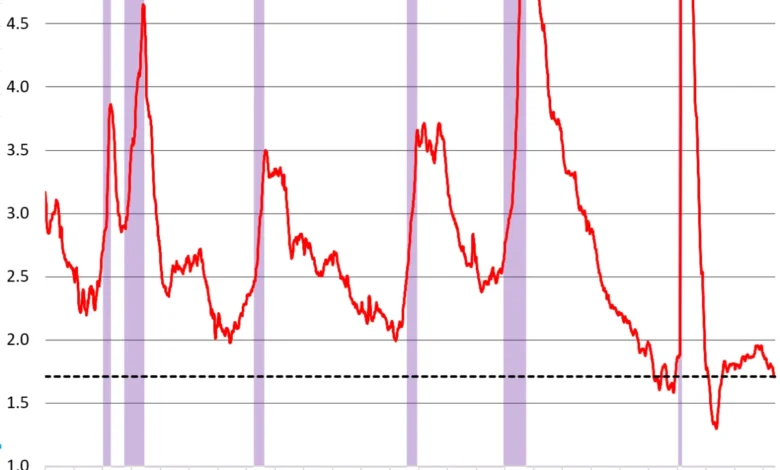
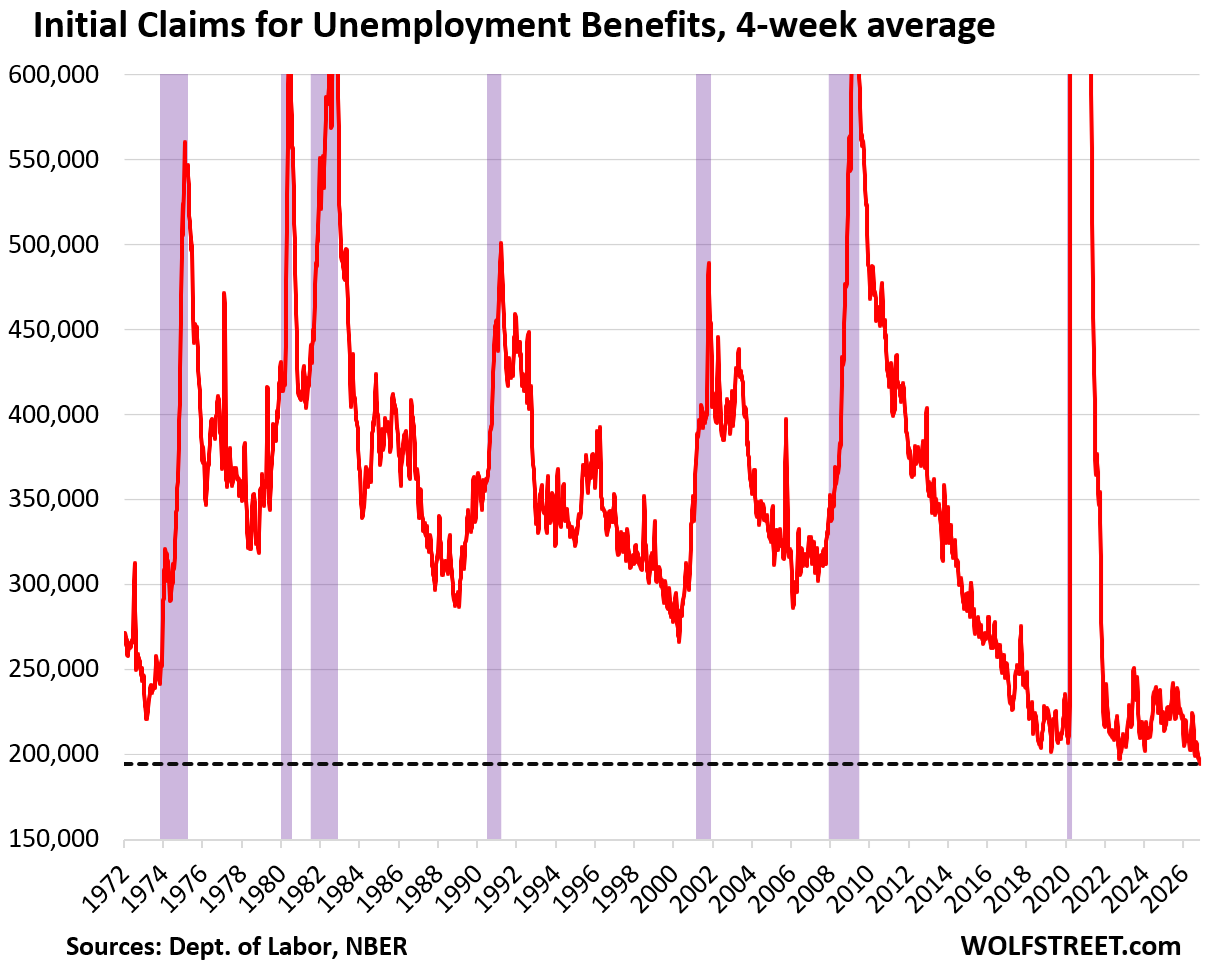
The United States labor market is currently defying traditional economic gravity, characterized by a paradoxical landscape where private-sector hiring remains sluggish and public-sector layoffs are mounting, yet initial unemployment claims have plummeted to levels unseen in nearly six decades. According to the latest data released by the Department of Labor, the four-week moving average of initial applications for unemployment insurance benefits has dropped to 194,700—the lowest reading since 1969. For the most recent week ending Saturday, initial claims hit 189,000, mirroring figures observed in mid-July and reinforcing a multi-generational low.
To understand the historical significance of these figures, one must account for the scale of the contemporary American economy. The U.S. population, the total labor force, and the sheer number of employed individuals are significantly larger today than they were during the late 1960s. Consequently, an absolute low in unemployment claims today represents a far more profound relative tightening of the labor market than the figures suggest on the surface.
A Shifting Employment Landscape
The current labor environment is defined by divergent trends across sectors. While some industries continue to navigate post-pandemic labor shortages, others are undergoing substantial restructuring. Since 2022, the technology sector has engaged in a unique "revolving door" strategy—simultaneously executing waves of layoffs while continuing to recruit for specialized roles. This trend is not limited to tech; sectors such as mortgage lending, which saw intense volatility throughout 2022 and 2023, have experienced significant contraction.
Compounding this, the public sector has become a primary driver of job losses. Since January 2025, federal government payrolls have shed approximately 328,000 positions. Similarly, state-level employment, particularly within higher education, has retracted by 53,000 roles over the same period. Under standard economic conditions, a combination of stagnant private-sector hiring and broad public-sector retrenchment would typically trigger a sharp spike in unemployment insurance claims and a subsequent rise in the national unemployment rate. The fact that this has not occurred highlights a fundamental change in the composition of the American workforce.
The Impact of Immigration Policy
A critical factor influencing these metrics is the recent, rigorous enforcement of immigration policies. The crackdown on illegal immigration and the stricter regulation of legal work visas have caused a measurable contraction in the available labor supply over the past 18 months. By reducing the number of low-wage and service-sector workers, the government has inadvertently kept the labor market tight despite cooling demand.
Furthermore, the structure of unemployment reporting obscures some of the labor market’s volatility. Many employees laid off during corporate restructuring receive extensive severance packages, which often include salary continuation for several months. These individuals are generally ineligible for state-funded unemployment benefits until their severance pay concludes. If these workers secure new employment during their severance period, they never enter the unemployment insurance data set. Additionally, H-1B visa holders and other non-citizen workers who are not eligible for state unemployment insurance are largely absent from these statistics, further masking the true scale of recent workforce displacement.
Chronology of Claims and Economic Indicators
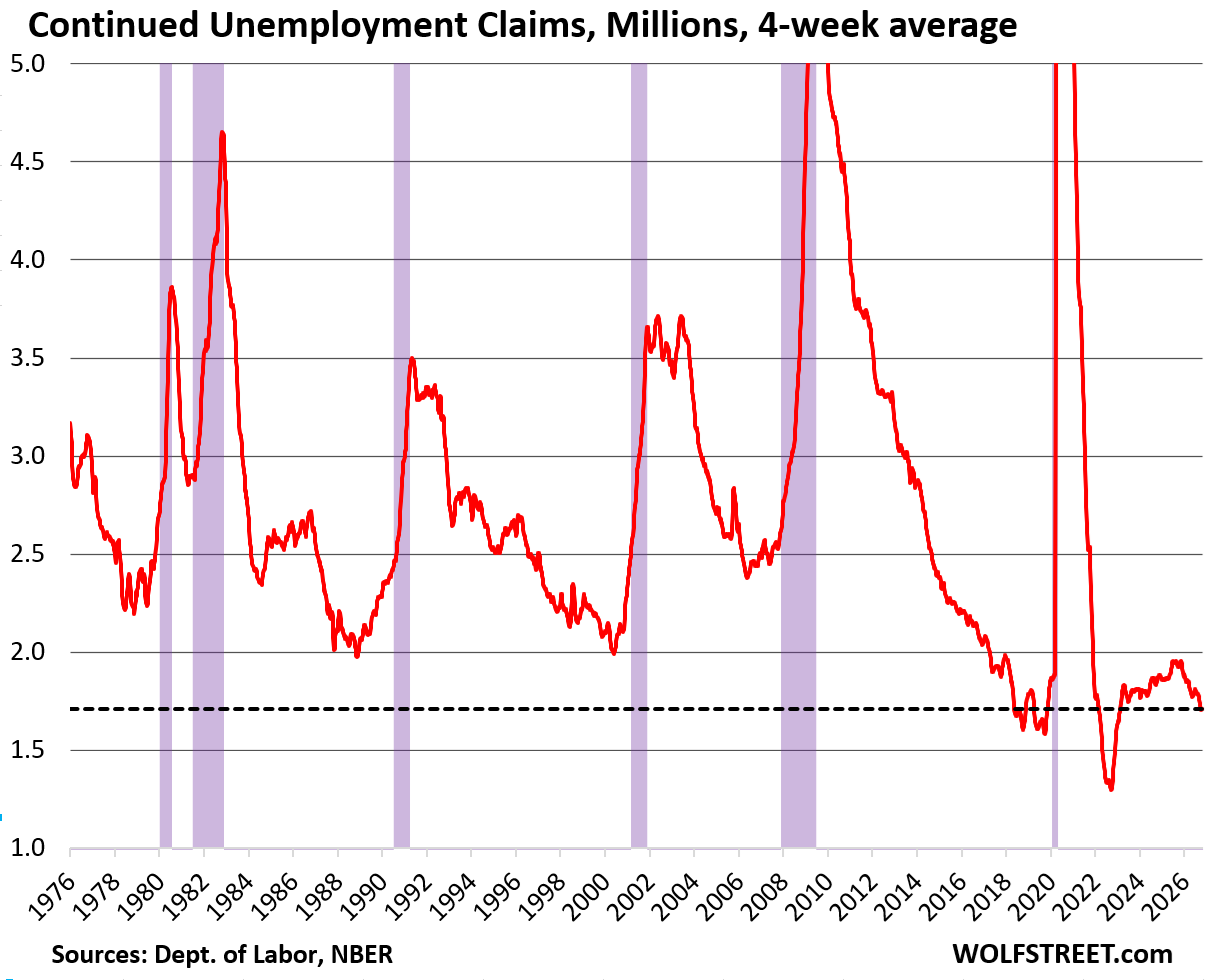
The trajectory of the labor market is best observed through the lens of "continued claims"—the number of individuals who have already filed for benefits and remain unemployed. Currently, continued claims hover around 1.72 million, with a four-week average of 1.71 million.

Historical analysis shows that during the post-COVID-19 labor shortage, continued claims remained suppressed. As the economy stabilized in late 2025, a downward trend emerged. Over the past 12 months, the duration of unemployment has effectively decreased, suggesting that while layoffs are occurring, displaced workers are finding new roles with greater efficiency than they did in the immediate aftermath of the pandemic.
The following timeline illustrates the recent divergence:
- Early 2025: Significant federal and state budget reallocations lead to the initial waves of public-sector workforce reduction.
- Mid-2025: Enforcement agencies intensify efforts regarding immigration compliance, leading to a visible decline in the total labor force participation rate.
- Late 2025: Initial claims begin to stabilize at record-low levels, while the private sector continues its "lethargic" but steady hiring pace.
- 2026: The divergence between high layoff activity and low unemployment claims becomes a primary feature of the macroeconomic landscape.
Broader Economic Implications
The current data set presents a challenge for policymakers at the Federal Reserve and the Treasury. A labor market that refuses to loosen despite government downsizing and private-sector caution suggests that the economy is supply-constrained rather than demand-driven.
Economists point to the fact that the decline in the labor force—driven by immigration policy—is the primary variable preventing the labor market from cooling. While low unemployment claims are typically viewed as a sign of economic health, in this context, they signify a labor market that is potentially unable to expand. Without an influx of new labor, businesses may find it increasingly difficult to fill roles, even if the economy slows down further.
Analytical Outlook
The resilience of the U.S. labor market in the face of these headwinds is unprecedented. Normally, the "purple zones"—representing recessionary periods in federal data—would show an immediate, vertical spike in initial claims as economic activity contracts. Currently, however, the data shows no such spike.
This suggests two potential outcomes. First, the labor market may be experiencing a "soft landing" where the supply-side contraction (via immigration changes) is perfectly offsetting the demand-side contraction (via high interest rates and fiscal tightening). Second, the current data may be creating a false sense of security; if the private sector continues its lethargic hiring pace and the public sector does not reverse its trend of shedding workers, the economy may eventually reach a breaking point where the current labor supply is insufficient to maintain current levels of GDP.
As investors and analysts look toward the next monthly employment report, the focus will remain on whether the downward trend in the labor force continues. If the labor supply continues to shrink, the "tightness" of the market will likely persist, keeping wage growth and inflation pressures in a state of flux. For now, the United States finds itself in a rare economic moment: one where the lowest unemployment claims in decades coexist with significant government-led job losses and a fundamentally reshaped immigration landscape. The sustainability of this equilibrium remains the primary concern for the remainder of the fiscal year.