A Critical NGINX Flaw, CVE-2026-42533, Exposes Servers to Remote Code Execution and Denial of Service

F5 has released critical patches for a significant security vulnerability within the NGINX web server, identified as CVE-2026-42533. This flaw, if exploited, allows a remote, unauthenticated attacker to trigger a heap buffer overflow in the worker process through specially crafted HTTP requests. While the immediate impact can lead to a denial-of-service (DoS) by crashing or restarting the worker process, the more severe implication, particularly in environments with Address Space Layout Randomization (ASLR) disabled or bypassed, is the potential for remote code execution (RCE). This vulnerability affects a wide range of NGINX versions, dating back to 2011, underscoring the urgency for administrators to apply the provided security updates.
Understanding the Vulnerability: A Deep Dive into the Script Engine Flaw
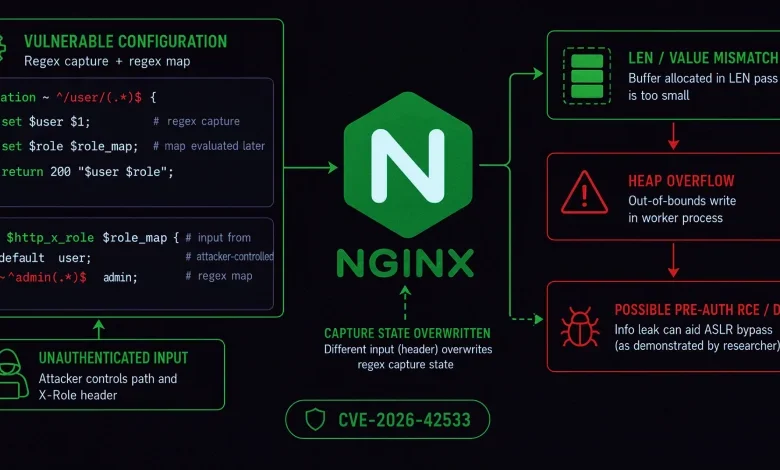
The vulnerability resides within NGINX’s script engine, a critical component responsible for assembling strings from various directives during the request processing phase. The exploit is contingent on a specific configuration involving a regex-based map directive whose output variable is subsequently referenced within a string expression. This reference must occur after a capture from an earlier regex match.
The root cause of the vulnerability lies in the two-pass evaluation mechanism employed by the NGINX script engine. In the first pass, the engine determines the required size for a buffer based on anticipated data. It then allocates memory accordingly. The second pass is responsible for writing the actual data into this allocated buffer. The critical issue arises because both passes read from the same shared capture state. However, if the map directive’s regex is evaluated between these two passes, it can overwrite this shared state.
This overwriting leads to a dangerous discrepancy. The initial measuring pass allocates a buffer sized for the original capture, such as a $1 reference derived from a location match. However, the subsequent writing pass, influenced by the attacker-controlled map evaluation, attempts to fill this buffer with data that can be significantly larger than anticipated. This mismatch results in a buffer overflow, where the excess data spills beyond the allocated memory. Crucially, both the size of the overflow and the content of the overflowing data are directly controlled by the attacker’s crafted HTTP request, making it a potent vector for malicious manipulation.
Timeline and Discovery: A Collaborative Effort to Secure NGINX
The discovery of CVE-2026-42533 is a testament to the diligence of the cybersecurity research community. F5, the vendor responsible for NGINX Plus and various related products, reported that the vulnerability was independently brought to their attention by over a dozen researchers. This broad reporting highlights the pervasive nature of the potential threat and the collaborative spirit in identifying and mitigating such risks.

F5 officially addressed the vulnerability on July 15th, releasing patches for the following versions:
- NGINX Stable Branch: Version 1.30.4
- NGINX Mainline Branch: Version 1.31.3
- NGINX Plus: Version 37.0.3.1
The timeline for vulnerability discovery and patching often involves a delicate balance between swift disclosure and ensuring robust fixes are in place. While the exact date of initial discovery is not publicly detailed, the July 15th release indicates a focused effort by F5 and the NGINX development team to address the issue promptly after its confirmation. The NGINX changelog specifically credits Mufeed VH of Winfunc Research and maintainer Maxim Dounin for their contributions to the fix.
Broader Impact and Affected Products
While the core NGINX server is directly impacted, F5’s advisory indicates that the vulnerability also affects several other products built upon or integrated with NGINX technology. These include:
- NGINX Ingress Controller
- NGINX Gateway Fabric
- NGINX App Protect WAF
- NGINX Instance Manager
At the time of initial reporting, F5 had not yet released specific fixed builds for these four downstream products, which could leave some users in a precarious position if they rely on these integrated solutions. This situation underscores the importance of closely monitoring vendor advisories for updates pertaining to all deployed NGINX-related components.
The vulnerability’s CVSS (Common Vulnerability Scoring System) scores reflect its severity. F5 rated it at 9.2 on the CVSS v4 scale and 8.1 on the older v3.1 scale. These scores indicate a critical level of risk. While the attack complexity is noted as "high," the potential for widespread impact and severe consequences justifies the high ratings. The broad range of affected NGINX versions, from 0.9.6 (released in 2011, when map gained regex support) up to 1.31.2, means that a significant number of web servers globally could be vulnerable if not updated.
Researcher Insights: Beyond Denial-of-Service
Stan Shaw, a cybersecurity researcher who publishes under the handle "cyberstan," provided a more in-depth analysis of CVE-2026-42533, extending beyond F5’s initial assessment. Shaw’s detailed write-up, available on his personal blog, argues that the vulnerability’s potential for exploitation is more profound than initially stated.

F5’s advisory suggested that remote code execution was only possible if ASLR was disabled or could be bypassed. However, Shaw contends that the very nature of the heap overflow flaw can provide the means to bypass ASLR. He elaborated in his communication with The Hacker News that the process of "capture clobbering" can also operate in reverse. When the overwritten capture is smaller than the original, the oversized buffer can inadvertently expose uninitialized heap data. Shaw demonstrated that on a default Ubuntu 24.04 build, a single unauthenticated GET request could recover memory addresses necessary for crafting a malicious payload, effectively circumventing ASLR protections.
"A reader of the F5 advisory could reasonably conclude this is DoS-only on default systems. It is not," Shaw stated, emphasizing the critical difference in his findings. His extensive testing reportedly showed a 100% success rate in exploiting the vulnerability on vulnerable configurations. Due to the sensitive nature of his findings and the potential for immediate misuse, Shaw is currently withholding the specific exploitation details and a proof-of-concept (PoC) to prevent widespread independent verification and potential malicious exploitation until more systems are patched.
Mitigation and Remediation: The Path to Security
The most effective and recommended solution for mitigating CVE-2026-42533 is to upgrade to the patched versions of NGINX or NGINX Plus. Specifically, users should ensure they are running:
- NGINX 1.30.4 (stable) or later
- NGINX 1.31.3 (mainline) or later
- NGINX Plus 37.0.3.1 or later
For organizations that cannot immediately apply these patches, F5 has proposed a temporary mitigation strategy: reconfiguring affected regex maps to use named captures instead of direct variable references. Shaw confirmed that this approach effectively closes the primary exploitation path and would cover most vulnerable configurations.
However, Shaw also identified a potential loophole in this mitigation. He discovered that if a map directive defines the same named group that is also referenced by the location regex, the vulnerability can still be triggered through a secondary code path. This subtle interaction, which he validated using AddressSanitizer, was not explicitly mentioned in F5’s advisory. Consequently, Shaw stressed that "Upgrading to 1.30.4 / 1.31.3 is the only complete fix," reinforcing the need for immediate patching.
Identifying Vulnerable Configurations
The specific conditions required to exploit CVE-2026-42533 are narrow but critical to understand for administrators seeking to identify their exposure. The vulnerability is triggered by a regex-based map directive whose output variable is referenced within a string expression. This reference must be paired with a numbered capture (e.g., $1, $2) from an earlier regex, with the capture being processed before the map variable.

To assist administrators in identifying these specific configurations within their NGINX setup, Stan Shaw has developed an automated scanner. This tool, available on GitHub, can analyze NGINX configuration files, including those included from other files, and flag only the precisely ordered directives that create the exploitable condition. It’s important to note that Shaw’s scanner is designed for detection and analysis, not for exploitation.
A Pattern of Vulnerabilities: The NGINX Script Engine Under Scrutiny
CVE-2026-42533 is not an isolated incident. It represents the third significant heap overflow vulnerability discovered in NGINX’s expression-evaluation code within approximately two months. This pattern suggests a deeper architectural vulnerability within the script engine’s two-pass processing logic.
Prior to CVE-2026-42533, two other critical flaws were disclosed:
- CVE-2026-42945 (Rift): Disclosed in May, this vulnerability was also a heap overflow related to the script engine and was reportedly already being exploited in the wild.
- CVE-2026-9256: Disclosed shortly after CVE-2026-42945, this flaw involved overlapping captures within the rewrite module, also leading to heap overflows.
All three vulnerabilities share a common root cause: the NGINX script engine’s two-pass design, where an initial measurement pass allocates a buffer, followed by a second pass that writes data into it. The fundamental weakness lies in the engine’s trust in its own measurements. Each vulnerability exploits this trust through different mechanisms: a stale flag in Rift, overlapping captures in the rewrite bug, and the clobbered capture state in CVE-2026-42533. This recurring pattern highlights a systemic issue that requires careful architectural review and robust testing from the NGINX development team.
The Urgency to Patch: Avoiding Exploitation
As of July 20th, CVE-2026-42533 had not yet been added to CISA’s Known Exploited Vulnerabilities (KEV) catalog, and no public exploit code had emerged. However, the history of similar vulnerabilities, particularly CVE-2026-42945 (Rift), serves as a stark warning. The Rift exploit went public within days of its disclosure and quickly saw active exploitation.
Stan Shaw plans to release his proof-of-concept exploit code 21 days after the patch’s release, a common practice to allow vendors and users time to secure their systems. The potential for this vulnerability to follow a similar trajectory to Rift underscores the critical need for immediate patching. Waiting for public exploit code or inclusion in KEV catalogs significantly increases the risk of compromise.

When The Hacker News inquired with F5 about the effectiveness of the named capture mitigation in light of Shaw’s findings and the timeline for fixes for downstream products, the vendor had not provided a response by the time of publication. This lack of immediate clarification further emphasizes the importance of proactive patching as the most reliable security measure.
The ongoing discovery of critical vulnerabilities in NGINX’s core functionality necessitates a vigilant approach from system administrators and security professionals. Regular updates, thorough configuration reviews, and a keen awareness of emerging threats are paramount to maintaining the security and integrity of web infrastructure.