AI Workflows vs. Agents: A Technical Framework for Architectural Decision Making

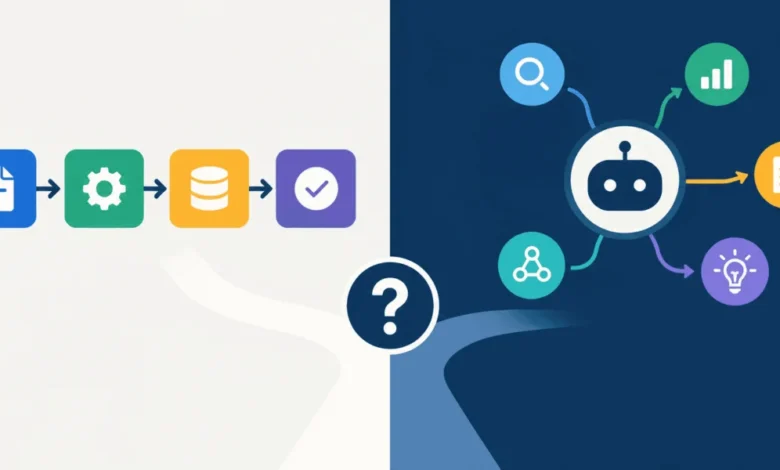
In the current landscape of enterprise software development, the term "AI Agent" has emerged as a pervasive buzzword, often misapplied to routine automation tasks. Distinguishing between structured AI workflows and autonomous AI agents is now a critical competency for engineers and CTOs alike. Failing to make this distinction often leads to brittle, expensive, and unpredictable systems. As businesses rush to integrate Large Language Models (LLMs) into their operational stacks, the fundamental architectural choice rests on whether the control flow is predefined or dynamically determined by the model itself.
The Evolution of Automation and the Agentic Paradigm
To understand the current confusion, one must examine the progression of AI application development. Historically, automation relied on rigid, rule-based systems—the traditional "workflow." These systems operated on deterministic logic: if condition A is met, execute function B. The advent of LLMs introduced a hybrid approach, where "judgment" could be inserted into these pipelines, allowing for semantic analysis of unstructured data.
An AI agent represents the next evolutionary step. Unlike a workflow, where the developer encodes the path, an agent is endowed with a set of tools and a high-level goal. It uses the model’s reasoning capabilities to evaluate the current state, determine which tool is most appropriate for the next step, observe the output, and refine its strategy iteratively. This "looping" behavior is the hallmark of agentic systems, yet it introduces significant non-determinism that can complicate enterprise integration.
Defining the Architectural Boundaries
A workflow is, by definition, a static execution graph. Even if the internal steps involve complex prompt chains or RAG (Retrieval-Augmented Generation) processes, the sequence of operations is locked at design time. For example, in a financial auditing tool, a developer might structure a pipeline to ingest a bank statement, parse specific line items, cross-reference them with a database of known vendors, and flag anomalies. Every step—from data ingestion to final report generation—is predictable, testable, and auditable.
In contrast, an agentic system is defined by dynamic pathfinding. If an agent is tasked with "Investigate the root cause of high latency in the payment gateway," it does not follow a pre-written script. It might first query error logs, observe that the error rate is concentrated in a specific region, decide to inspect CDN configurations, realize that the CDN is functioning normally, and then backtrack to investigate API authentication logs. Because the agent decides the "what" and the "when" of each step at runtime, the developer acts as a facilitator rather than a director.
Data-Driven Decision Making: The Cost of Autonomy
The shift toward agentic systems carries significant implications for operational overhead. Recent industry benchmarks suggest that agentic workflows often incur 3x to 10x the token usage of standard workflows due to the "thought-action-observation" cycles inherent in autonomous systems.
For high-volume, low-latency requirements, these costs can be prohibitive. A standard workflow might execute in milliseconds with predictable latency, whereas an agentic loop is subject to the model’s reasoning time, leading to unpredictable "jitter" in response times. Furthermore, the lack of a deterministic path makes debugging significantly more complex. When an agent fails, it is often difficult to reproduce the exact chain of thought that led to the error, creating a "black box" scenario that is unacceptable for many regulated industries.
The Practical Diagnostic: A Framework for Engineers
Before committing to an architecture, engineering teams should apply a rigorous diagnostic test: Can the entire process be mapped onto a static flowchart before the code is executed?
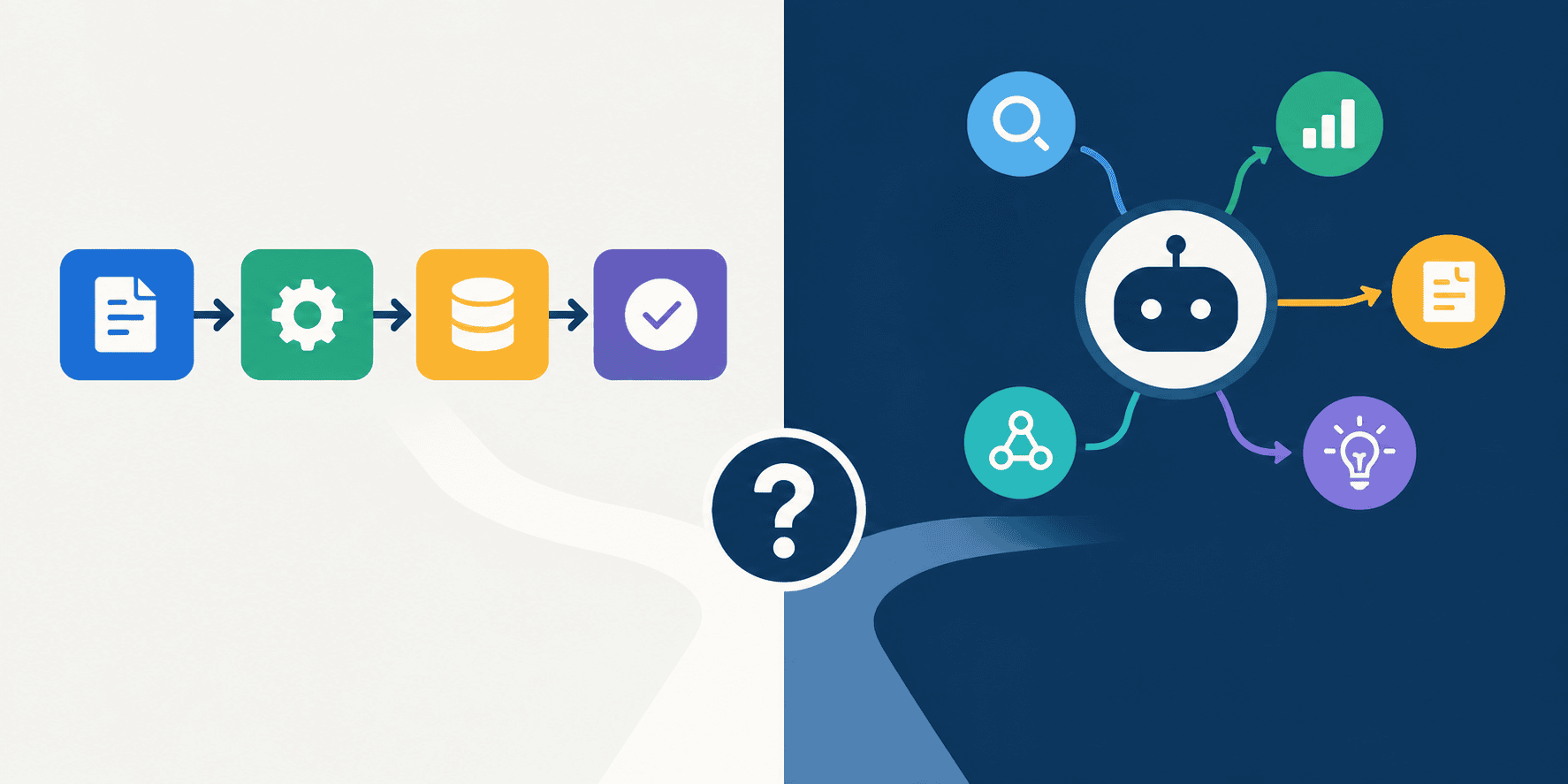
If the answer is yes, a workflow-based approach is almost universally superior. Workflows offer modularity, ease of testing, and compliance with audit requirements. They allow for the integration of "human-in-the-loop" checkpoints, where the AI provides a recommendation that is then validated by a human operator before proceeding.
However, if the task involves open-ended investigation, exploratory research, or handling highly variable, unforeseen scenarios, agentic architectures provide a distinct advantage. In these cases, the flexibility of the model to navigate through a vast, unstructured problem space outweighs the costs of increased token usage and decreased predictability.
Regulatory and Compliance Implications
From a compliance perspective, the predictability of a system is paramount. Financial, legal, and healthcare applications require strict adherence to standard operating procedures. A workflow ensures that every piece of data passes through a specific, authorized sequence of validations. By contrast, an agentic system, by virtue of its ability to "change its mind," creates a non-linear audit trail that is notoriously difficult to reconcile with traditional regulatory standards.
Industry experts suggest that organizations should adopt a "Workflow-First" policy. This means building the most complex, robust, and reliable workflow possible using LLM-enabled steps. Only when the limits of the static workflow are reached—and when the complexity of the task genuinely exceeds the developer’s ability to map it out—should the organization consider transitioning to an agentic architecture for specific, bounded sub-tasks.
Broader Market Trends and Future Outlook
The current "agent-hype" cycle is reminiscent of early enterprise adoption of cloud computing, where the benefits were often overstated and the implementation challenges underestimated. As tools for monitoring and observability of LLMs (often called "LLMOps") continue to mature, the distinction between agent and workflow may eventually blur. We are likely to see the rise of "Managed Agents," which combine the autonomous capabilities of an agent with the guardrails and structured control of a workflow.
Ultimately, the goal of any AI implementation is the delivery of reliable, value-added outcomes. For most business applications, the simplicity of a well-engineered workflow is not a limitation—it is a feature. By resisting the urge to build autonomous agents for tasks that can be effectively managed via directed logic, companies can reduce technical debt, lower costs, and improve the reliability of their AI deployments.
Conclusion: The Strategic Path Forward
The decision to utilize an agent is not a measure of the sophistication of the solution, but rather a reflection of the nature of the problem. A sophisticated, high-performance workflow can often solve more complex business problems than an unstable or unpredictable agent.
Engineers should prioritize the following sequence:
- Model the Task: Attempt to draft a comprehensive flow chart.
- Standardize the Logic: Build a pipeline using LLMs as specialized, stateless functions.
- Measure Performance: Assess latency, cost, and accuracy against the defined requirements.
- Evaluate Agentic Need: Only if the problem space is dynamic and requires real-time, context-dependent decision-making, explore agentic frameworks.
By maintaining this discipline, teams can ensure that they are using the right tool for the right job, rather than chasing the promise of autonomy at the expense of production stability. The maturity of an AI organization is often reflected not in how many agents they have deployed, but in how effectively they have mapped their business processes to the most efficient technical architecture.