Agent or Workflow? A Practical Test for Knowing When You Actually Need an AI Agent

Defining the Architectural Divide
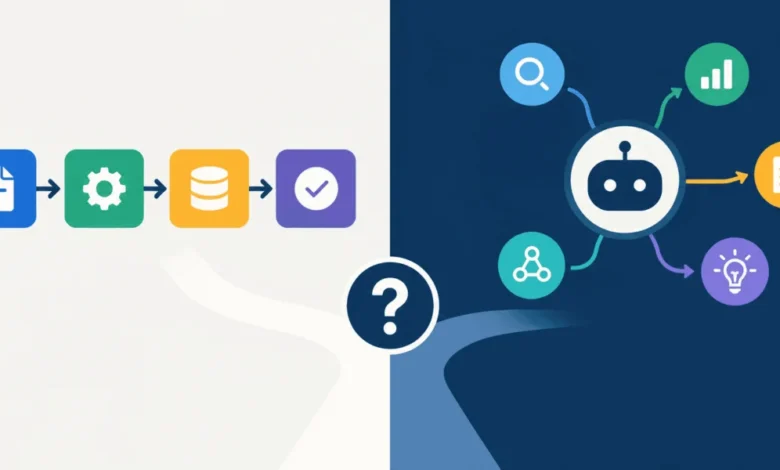
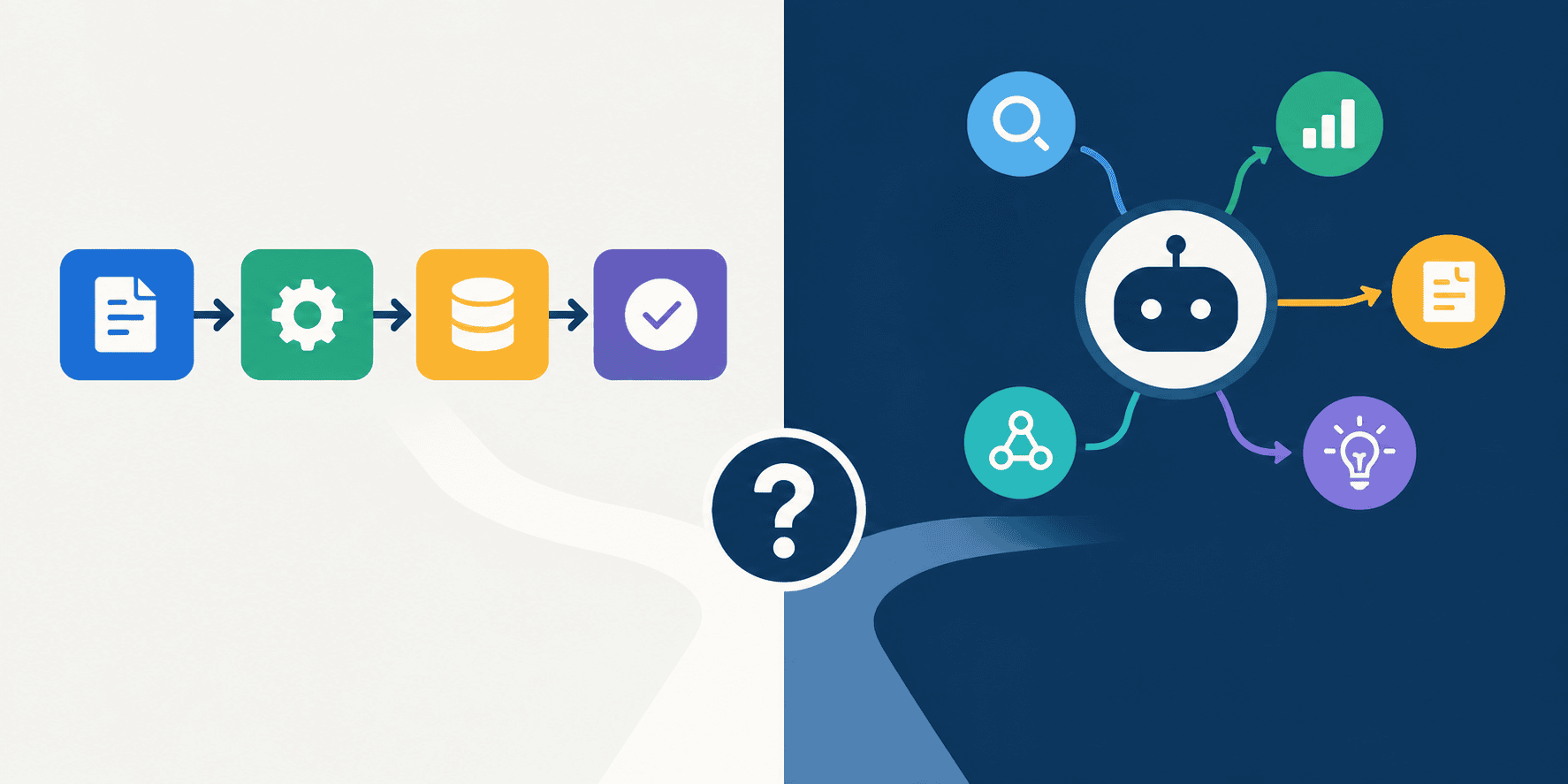
The distinction between an AI workflow and an AI agent lies primarily in the location of the "control flow." In a traditional AI workflow, the developer acts as the architect of logic. The system follows a predetermined sequence of operations, often referred to as a pipeline or a chain. Even if these systems integrate Large Language Models (LLMs) to perform specific tasks—such as summarizing text or classifying sentiment—the overall path remains static. The developer defines the triggers, the branching logic, and the stop conditions at design time.
Conversely, an AI agent operates under a model-centric control flow. The agent is provided with a high-level objective and a suite of tools, but the sequence of execution is determined at runtime by the model itself. The LLM evaluates its progress, observes the outcome of each action, and decides whether to proceed, backtrack, or invoke a different tool. This ability to engage in iterative planning and self-correction is the defining characteristic of agentic architecture.
Historical Context and the Rise of Agentic Hype
The current obsession with "agents" is a natural progression from the initial excitement surrounding generative AI. In 2022 and early 2023, the industry focused on the raw capabilities of foundation models. By late 2023 and throughout 2024, the focus shifted toward "agentic workflows," as enterprises realized that simply prompting a model was insufficient for complex, multi-step business processes.
Industry analysts at firms like Gartner and Forrester have noted that while the promise of autonomous agents is substantial, the deployment reality is often fraught with high latency and non-deterministic behavior. According to recent surveys of software engineering leads, nearly 60% of projects labeled as "AI agents" were actually sophisticated, multi-step orchestration workflows. This discrepancy suggests that while the "agent" label is highly effective for securing project funding, it often fails to describe the underlying technical reality, leading to project misalignment and increased technical debt.
The Single Practical Test for Architectural Selection
Before a single line of code is written, architects should apply the "Flowchart Test." The question is simple: Can a human engineer draw a complete, functional flowchart of the task before the LLM executes?
If the answer is yes, the task is inherently a workflow. A workflow is not necessarily "simple" or "primitive"; it can be highly complex, incorporating multiple LLM calls, retrieval-augmented generation (RAG) pipelines, human-in-the-loop validation, and intricate business logic. However, because the flow is fixed, it remains deterministic, auditable, and easier to debug. If the answer is no—if the sequence of actions is dependent on the intermediate findings of the model—then an agentic approach is warranted.
Empirical Data and Operational Implications
Data from recent pilot programs in the financial services and customer support sectors highlight the trade-offs between these two approaches.
- Latency and Cost: Agentic systems typically require significantly more compute resources. Because an agent must engage in "thought cycles"—looping through reasoning, tool selection, and validation—the token usage per request is often 3x to 5x higher than a structured workflow. For high-volume applications, this cost variance can be prohibitive.
- Predictability and Auditability: In regulated industries, such as healthcare or banking, the "black box" nature of autonomous agents poses a risk. Compliance departments require a clear, documented path for every decision. A static workflow allows for perfect audit logs, as every branch taken can be traced to a specific business rule.
- Failure Modes: Workflows fail predictably. When a step in a chain fails, the developer knows exactly where the error occurred. Agents, however, can enter "hallucination loops," where they repeatedly attempt the wrong tool or misinterpret a tool’s output, leading to expensive, runaway execution cycles.
Case Study: The Refund Processing Dilemma
Consider a customer support function responsible for processing refunds. In a workflow-based model, the system follows a rigid protocol: authenticate user, verify purchase history, check against current refund policies, and execute the transaction. Each step is a discrete call. If the system detects an edge case, it triggers a "human handoff" flag.
In an agentic model, the system might be given a broad goal: "Make the customer happy while minimizing financial loss." This allows the agent to negotiate, offer store credit, or escalate the issue based on its analysis of the customer’s sentiment. While this provides a more personalized experience, it introduces variability that may violate internal compliance standards or lead to inconsistent policy enforcement.
Strategic Recommendations for Enterprise Integration
For organizations looking to integrate AI, the consensus among systems architects is to start with the most constrained system possible. The "workflow-first" methodology offers several advantages:
- Baseline Performance: By building a workflow, you establish a baseline for quality and performance. If the workflow cannot solve a problem, you can then selectively introduce "agentic components" into specific, isolated nodes of the workflow.
- Component Testing: It is significantly easier to unit test a deterministic pipeline than it is to test an emergent, autonomous agent.
- Scalability: Workflows are inherently easier to monitor and scale across distributed systems.
Official guidance from leading AI research labs suggests that the most successful implementations are "hybrid systems." In these architectures, the main application logic remains a structured workflow, while small, bounded agentic loops are triggered to handle specific, non-deterministic sub-tasks.
Conclusion: Navigating the Hype Cycle
The utility of AI should be measured by its contribution to business outcomes, not its adherence to the latest industry trends. The push for autonomous agents is a natural evolution of the field, but it is not a universal solution. For many enterprise applications, the "agent" label is an unnecessary layer of complexity.
By prioritizing workflows when the problem space is understood, and reserving agentic architectures for genuinely exploratory or open-ended tasks, organizations can achieve a more stable, cost-effective, and transparent AI integration. Ultimately, the maturity of an engineering team is often defined not by how many agentic systems they deploy, but by how accurately they match the complexity of the solution to the requirements of the problem. As the technology matures, the industry will likely see a shift away from "agent" as a catch-all term toward more specific definitions of system behavior, resulting in more robust and maintainable software architectures.