Anthropic IPO Wealth Dilemma: $7.5M San Francisco Dream House Versus $8.5M in Pre-Tax Stock

The public debut of artificial intelligence pioneer Anthropic at a staggering $1.5 trillion valuation has created a profound financial juncture for thousands of tech employees, particularly in the San Francisco Bay Area. As these workers navigate the transition from startup equity to public market liquidity, they face complex decisions regarding taxation, real estate markets, and long-term asset allocation.
To understand the magnitude of this financial crossroad, financial analysts frequently utilize thought experiments to weigh the utility of immediate physical assets against high-growth pre-tax equities. The core dilemma centers on a stark choice for an affluent San Francisco resident: acquire a fully remodeled, 4,500-square-foot single-family home valued at $7.5 million free and clear, or accept $8.5 million in Anthropic stock subject to a mandatory six-month lockup period.
This scenario highlights the fundamental friction between paper wealth and tangible utility, forcing individuals to evaluate the true purpose of accumulated capital.

Background and Context of the Anthropic Public Offering
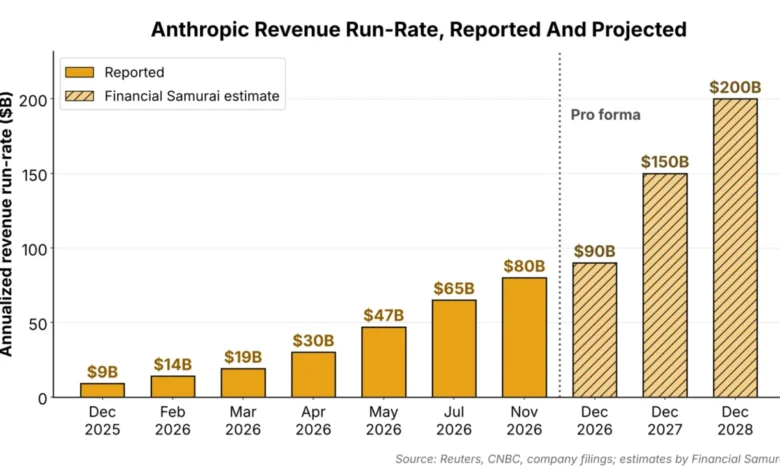
Anthropic’s ascent to a $1.5 trillion valuation reflects the broader generative AI boom that has dominated global markets over the past several years. Founded by former safety and research leaders from competing AI labs, the company experienced exponential growth, driven by enterprise adoption and surging demand for advanced large language models. By 2026, the company’s annualized revenue run rate reached approximately $80 billion, a dramatic increase from roughly $47 billion earlier in the year and under $10 billion at the close of 2025.
Furthermore, Anthropic reported its first positive adjusted operating income, marking a significant milestone for a sector historically characterized by heavy capital expenditures and substantial net losses. The IPO itself, underwritten by major Wall Street institutions, ranks among the largest technology debuts in history, placing Anthropic alongside contemporary giants and reshaping the net worth of its early employees and institutional backers.
The Tax Burden and Asset Conversion Mathematics

A primary driver behind the valuation gap between the two options in the thought experiment is the structure of the United States and California tax codes. Real estate acquired after-tax provides immediate utility in the form of housing, whereas equity compensation remains a pre-tax asset until liquidated.
Converting Anthropic stock into a $7.5 million residential property in California triggers significant tax liabilities. At standard long-term capital gains rates—comprising a 20% federal rate, the 3.8% net investment income tax, and California’s 13.3% state income tax—shareholders face a cumulative tax haircut of approximately 37.1%. Consequently, an investor liquidating stock to purchase the house outright would need to sell roughly $11.92 million worth of shares. If the holdings consist of Restricted Stock Units (RSUs) vesting at the IPO, the burden increases further as they are taxed at ordinary income rates, requiring nearly $15.84 million in stock to net the necessary cash.
While early employees holding Qualified Small Business Stock (QSBS) might qualify for federal exclusions, Anthropic surpassed the $50 million gross assets test years prior, restricting this relief to a narrow cohort of very early stakeholders. Therefore, the stock offer is set at a higher nominal value ($8.5 million) to account for the compulsory tax liabilities and the required waiting period.
Carrying Costs and Real Estate Advantages

Owning high-end real estate in San Francisco entails substantial ongoing expenses, yet it offers distinct financial and lifestyle advantages over renting while waiting out a stock lockup.
A free-and-clear $7.5 million home incurs significant annual carrying costs, primarily driven by property taxes. Based on local assessments, property taxes alone can account for nearly $87,750 annually, complemented by roughly $15,000 for utilities and maintenance, and $5,000 for insurance. This totals nearly $110,000 to $120,000 per year in maintenance expenses.
However, renting a comparable luxury property in San Francisco commands a monthly expenditure of approximately $25,000, translating to an annual gross yield of 4%. Ownership outperforms renting by over $180,000 annually when factoring in rental inflation. Over a standard six-month IPO lockup period, an employee waiting to sell stock would burn tens of thousands of dollars in rent.
Additionally, California real estate benefits from Proposition 13, which caps property tax assessment increases at a maximum of 2% annually, insulating owners from runaway property tax inflation. Primary residences also benefit from the federal capital gains tax exclusion of up to $500,000 for married couples upon sale—a tax shield unavailable to equity holders. Furthermore, homeowners can secure lines of credit against real estate equity without triggering immediate taxable events, a flexibility pre-IPO or locked-up shares cannot provide.

The Bull Case for Holding Equity
Despite the immediate utility of real estate, proponents of holding Anthropic stock argue that corporate growth trajectories can easily outpace traditional real estate appreciation.
Market projections indicate that Anthropic’s revenue could scale significantly over the next four years, driven by enterprise demand for artificial intelligence infrastructure. Assuming annualized revenue growth decelerates from historical highs to a steady progression reaching $200 billion to $300 billion by the end of the decade, the company’s valuation could normalize into standard software industry multiples.
Under bullish projections, holding the stock allows investors to capture compound annual returns that heavily eclipse the historical 4% to 5% appreciation rate of residential real estate. For an investor willing to absorb market volatility and the risks associated with sector-specific downturns—akin to historical pullbacks observed in major tech bellwethers like NVIDIA—retaining equity offers the potential for exponential wealth generation.
The Four-Year Breakeven Analysis
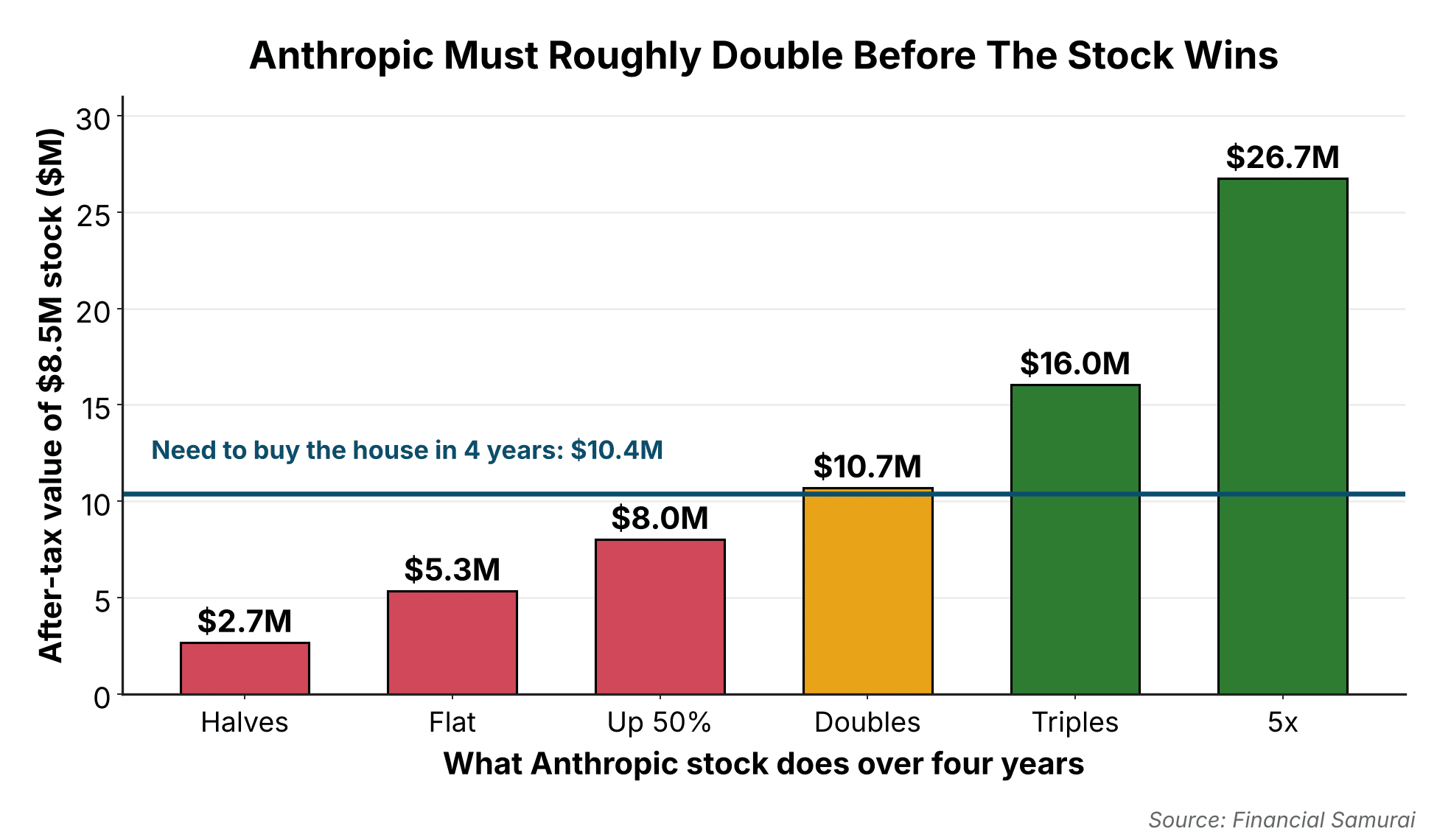
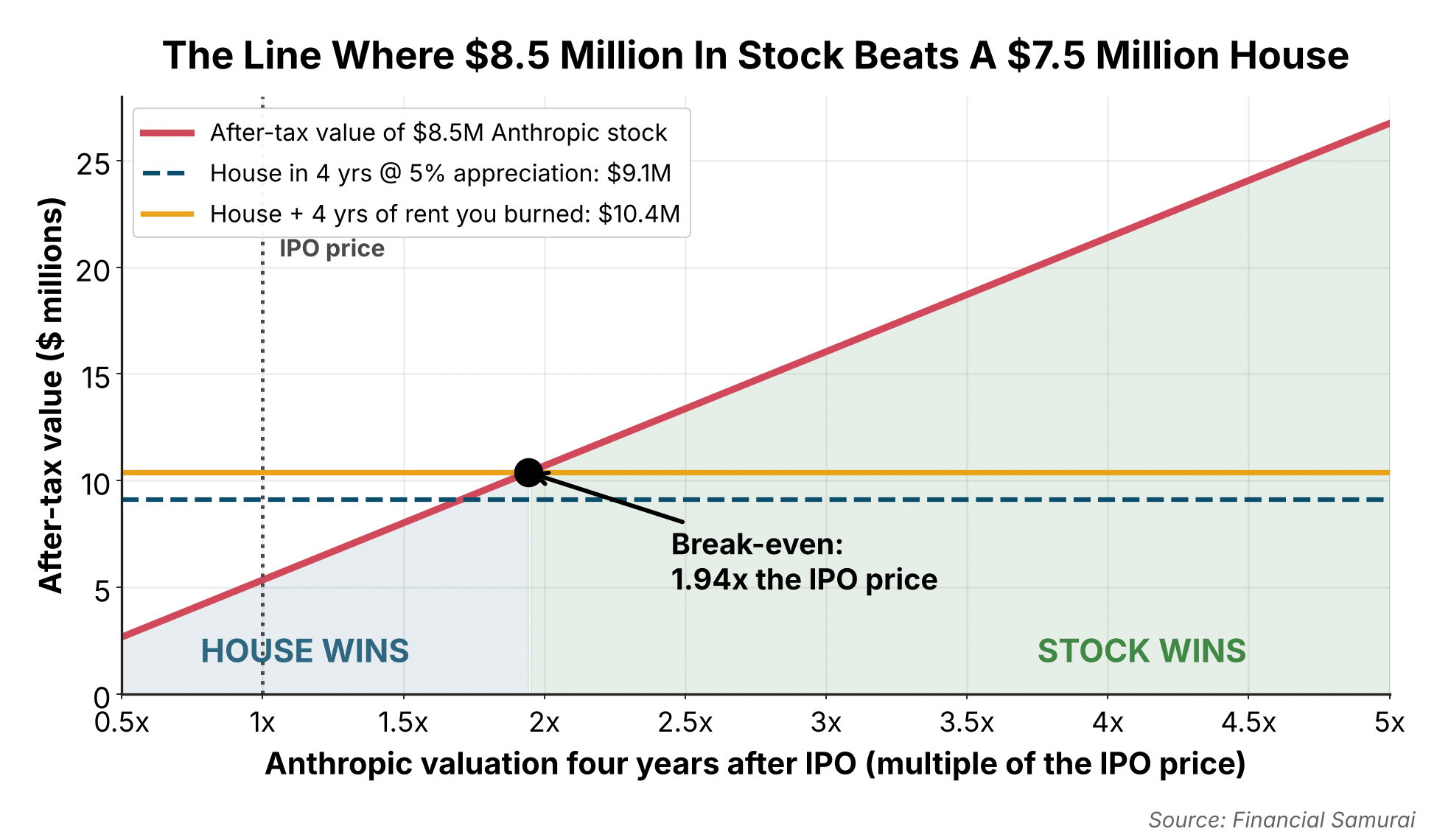
Financial planners analyzing post-IPO scenarios often project four-year holding periods to evaluate opportunity costs. If an employee chooses to hold $8.5 million in stock through a six-month lockup and rents a home while waiting to purchase a property later, the mathematics shift dynamically.
Assuming conservative real estate appreciation of 5% annually, a $7.5 million home appreciates to over $9 million within four years. Simultaneously, four years of cumulative rent at $25,000 monthly burns well over $1 million in non-recoverable capital. To break even on a future purchase, the original stock holding must generate substantial after-tax proceeds to cover both inflated housing prices and accumulated rental costs. This requires the pre-tax stock value to appreciate significantly, demanding robust double-digit compound annual returns from the issuing company.
Furthermore, supply constraints in the San Francisco housing market introduce competition risks. Real estate data from major metropolitan brokerages indicates a surge in luxury home sales, with multi-million dollar properties frequently receiving competitive all-cash bids well over asking price. An influx of newly liquid tech employees attempting to purchase the same limited supply of premier properties within a few years risks triggering localized bidding wars, driving housing prices higher than baseline appreciation models suggest.
Broader Implications of the Tech Wealth Wave
The intersection of artificial intelligence liquidity events and local real estate markets underscores a broader economic phenomenon: the physical constraints of technological expansion. While software and artificial intelligence models operate in digital realms, the human capital driving them requires physical infrastructure—from residential housing in metropolitan tech hubs to power grids and data centers.
Market analysts note that the influx of capital from major public offerings like Anthropic and SpaceX alters regional demographics, consumer price indices, and municipal tax bases. For the individual employee, however, the decision transcends spreadsheet optimization. It represents a fundamental choice between retaining high-risk, high-reward financial instruments or converting abstract digital wealth into tangible security, family stability, and lived experiences.
As market regulators and financial institutions process the historic volume of capital unleashed by the artificial intelligence boom, participants across the technology sector continue to weigh the elusive balance between maximizing net worth and realizing the practical utility of wealth.