The Realities of Venture Capital Paper Wealth: Inside the Meteoric Rise of AI Startup Instinct

The debate over the tangible value of financial assets has taken a sharp turn as private equity and venture capital valuations outpace historical benchmarks, particularly within the artificial intelligence sector. While traditional investors have long favored physical assets like real estate for their tangible utility and psychological comfort, the staggering velocity of private company funding rounds is forcing a reevaluation of paper wealth. This dynamic is best exemplified by the unprecedented funding trajectory of Instinct, a text-based artificial intelligence assistant that has captured the attention of Silicon Valley and global venture capitalists alike.
Main Facts and Company Background
Founded in April 2026 by 23-year-old former Sierra research scientist Noah Shinn, Instinct operates as an AI assistant accessible directly via text message, bypassing the need for dedicated mobile applications. Despite being free and operating on an invite-only basis, the company has encountered significant compute constraints, necessitating aggressive capital-raising efforts to scale its infrastructure.
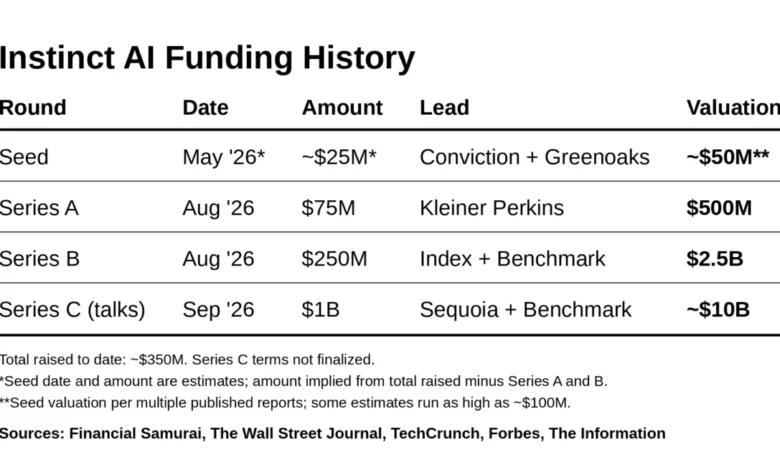
The scale of Instinct’s financial backing has broken conventional venture capital timelines. Seeded at a $50 million valuation, the startup has rapidly progressed through subsequent financing tiers, culminating in talks to raise $1 billion at a $10 billion valuation. If finalized, this trajectory would represent an estimated 200-fold gross return for early seed investors in roughly five months—a pace virtually unprecedented in the history of institutional venture capital.
Chronology of Funding Rounds

The speed at which Instinct secured institutional validation highlights the intense competition within the artificial intelligence market:
- April 2026: Noah Shinn registers Instinct. The seed round is backed by Conviction and Greenoaks at a reported $50 million valuation.
- Early August 2026: Kleiner Perkins leads a $75 million Series A funding round, pushing the company’s valuation to $500 million.
- Late August 2026: Index Ventures and Benchmark co-lead a $250 million Series B round, elevating the valuation to $2.5 billion.
- September 2026: Reports emerge that Instinct is in advanced talks to secure a $1 billion investment at a $10 billion valuation, with Sequoia Capital and Benchmark reportedly in discussions to lead the round.
Supporting Data and Venture Capital Metrics
For limited partners (LPs) and capital allocators exposed to these private funds, tracking portfolio performance relies on specialized financial metrics that distinguish between unrealized appreciation and actual liquidity. Understanding these terms is critical for evaluating the true health of a venture portfolio:
- Multiple on Invested Capital (MOIC): Measures the total value of an investment relative to its initial cost, calculated before fees and carried interest. For early backers, accounting for dilution from subsequent financing rounds still yields substantial gross MOIC figures, though net returns are adjusted downward based on fund management fees and carried interest (typically ranging from 20% to 35%).
- Total Value to Paid-In Capital (TVPI): Represents the fund-level ratio of distributions plus remaining net asset value (NAV) relative to the capital actually drawn down by the fund. Because venture funds call capital incrementally over several years, early TVPI marks can appear exceptionally high following a valuation spike, though these valuations frequently lag until official quarterly financial statements are released.
- Distributions to Paid-In Capital (DPI): Tracks the actual cash returned to investors divided by the capital paid in. In the context of hyper-growth startups that remain private, DPI often remains at zero, underscoring the distinction between paper wealth and liquid cash.
Broader Impact and Economic Implications
The meteoric rise of startups like Instinct carries significant psychological and economic implications for investors and regional economies, particularly in technology hubs like San Francisco. While paper gains from venture capital cannot immediately be utilized for consumer purchases or debt reduction, they exert a powerful influence on investor sentiment, risk tolerance, and regional wealth effects.
Furthermore, the concentration of capital within the artificial intelligence sector highlights a broader structural challenge: the friction between software innovation and physical infrastructure. As AI applications scale, their reliance on high-performance compute infrastructure places unprecedented demands on physical data centers, power grids, and municipal permitting processes. This bottleneck has prompted institutional investors to increasingly hedge their high-beta software exposure with investments in real assets, such as physical data center real estate and energy infrastructure, to capture the downstream economic value of the artificial intelligence boom.