The True Cost of Playing Fair: IPO Allocations and the Unwritten Rules of Modern Finance

The recent public debut of artificial intelligence pioneer Anthropic on the Nasdaq exchange under the ticker symbol ANT has sparked a broader debate surrounding market transparency, capital allocation, and the practical limitations of ethical adherence in modern finance. While the initial public offering (IPO) marked a significant milestone for the tech sector, it simultaneously highlighted a systemic divergence between the nominal rules of equity distribution and the actual mechanics utilized by sophisticated institutional and retail investors.
The Mechanics of Oversubscription and Retail Allotments
The core controversy centers on the allocation process during the IPO book-building phase. According to market participants familiar with the syndicate desk operations, investors frequently submit inflated indications of interest to secure a desired volume of shares in anticipation of heavy oversubscription. This practice, deeply embedded in institutional trading culture, historically stems from the expectation that underwriters will systematically scale back orders.
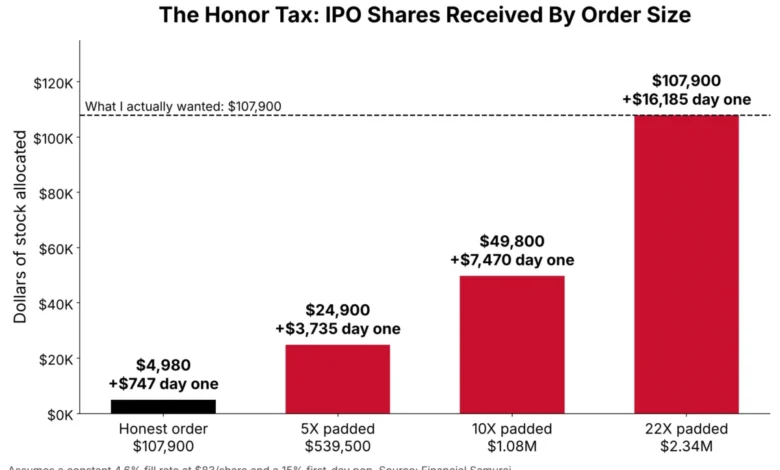
In the case of Anthropic’s market debut, discrepancies between requested shares and actual allocations proved stark. A veteran finance professional who submitted an honest indication of interest for 1,300 shares—representing approximately $107,900—ultimately received a fill of only 60 shares, amounting to a 4.6% allocation rate. Analysts note that such fractional distributions are standard procedure when demand vastly outstrips supply, particularly for high-profile technology listings expected to experience significant first-day trading volume.
Market historians point out that this practice is not isolated to recent market entries. During historical tech booms, syndicate desks routinely managed order books where institutional demand exceeded available shares by factors of five to ten. Consequently, investors who adhere strictly to their literal capital requirements frequently find their positions reduced to negligible fractions, while those who strategically pad their initial orders capture closer to their target exposure.
Chronology of Modern IPO Book-Building
To understand how retail and institutional investors navigate public listings, analysts examine the multi-stage timeline of an initial public offering:

- S-1 Filing and SEC Review: The issuing company files its registration statement with the Securities and Exchange Commission, disclosing financial health, business model, and risk factors.
- Roadshow Execution: Company executives and underwriting investment banks present the investment thesis to institutional investors to gauge baseline interest and price sensitivity.
- Book-Building and Indications of Interest: Syndicate desks open the order books, collecting non-binding purchase commitments from institutional and eligible retail accounts over a period of several days.
- Pricing and Allocation: Underwriters determine the final IPO price based on aggregate book demand and allocate shares to participating accounts, frequently scaling down large orders to manage scarcity.
- Secondary Market Trading: The stock lists on an exchange, where initial public pricing often encounters immediate volatility and price discovery driven by broader market sentiment.
Institutional Perspectives and Market Realities
Representatives from major brokerage platforms and underwriting syndicates maintain that allocation decisions are governed by fiduciary standards, historical account value, relationship longevity, and regulatory compliance. Underwriters argue that scaling back orders is a necessary mathematical adjustment to ensure fair distribution across a broad base of participating clients rather than a punitive measure against individual investors.
However, independent financial analysts and seasoned market veterans contend that the reliance on unwritten allocation rules creates an asymmetric disadvantage for market participants who follow the explicit guidelines of the prospectus without inflating their demand metrics. This dynamic forces a strategic choice among experienced investors: either accept fractional liquidity as the price of adherence, or participate in the broader systemic inflation of order books.
Broader Implications for Wealth Accumulation and Strategy
Beyond the immediate mechanics of equity markets, financial strategists observe that the tension between formal rules and informal execution extends into various professional and personal domains, including educational admissions, career transitions, and compensation negotiations.
In competitive environments characterized by scarce resources—such as elite preschool placements, corporate severance negotiations, and venture-backed allocations—adherence to strict ethical norms without strategic positioning frequently results in suboptimal outcomes. Observers categorize this phenomenon as an "honor tax," wherein individuals absorb tangible opportunity costs, financial losses, or administrative friction as a byproduct of playing strictly by the literal rules while competitors leverage unwritten efficiencies.
Conversely, behavioral economists suggest that the willingness to absorb such costs often correlates with accumulated capital and financial security. Wealthier or more established participants may experience diminishing marginal utility from incremental gains, reducing their incentive to engage in competitive hyper-optimization. This behavioral divide explains why certain investors prioritize procedural compliance or simplicity over aggressive resource acquisition once a baseline level of financial independence has been achieved.
As public markets continue to evolve alongside technological disruption, regulatory bodies and exchange operators regularly review the transparency of the allocation process. Nevertheless, market experts advise that until structural reforms alter how syndicate books are managed, participants must carefully weigh the practical implications of their strategic approach against the realities of competitive modern finance.